Mikhail Kutuzov
War and PeaceMikhail Kutuzov is the Russian commander in chief whose decisive strength lies in understanding what an individual commander cannot control. He appears amid inspections, retreats, councils, battles, occupations, and withdrawals, but his leadership is repeatedly measured against the material condition and morale of the army rather than against the theatrical brilliance of a plan. In contrast with Napoleon Bonaparte’s image as a directing genius, Kutuzov learns to wait, preserve his forces, and allow the enemy’s own movement, exhaustion, and isolation to bring about its defeat.
Identity and Introduction
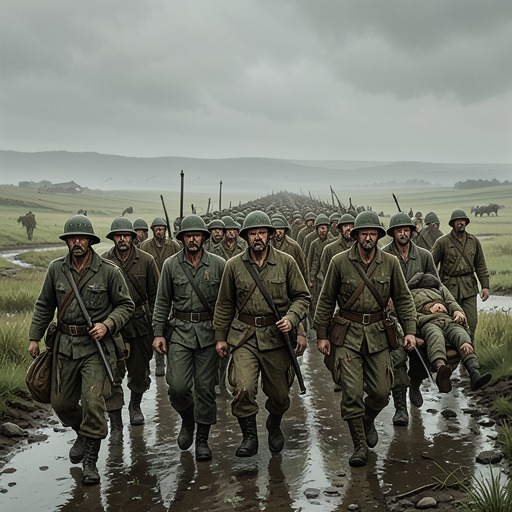
Mikhail Kutuzov first appears as commander in chief of the Russian army at Braunau in October 1805, while Russian forces occupy Austrian villages and towns and newly arriving regiments burden the inhabitants quartering them. The army has marched hundreds of miles toward a war whose strategic purposes are expressed in official language, but whose actual conditions are defined by distance, fatigue, supplies, roads, and the vulnerability of men and horses. The regiment awaiting inspection has marched twenty miles before being kept awake all night to clean and mend itself; two thousand soldiers stand in exact parade order, with every button and strap in place, even though more than half their boots are in holes after a march of about seven hundred miles.
Kutuzov’s arrival exposes the difference between formal appearance and military reality. He comes in a light blue Viennese carriage beside an Austrian general, steps down heavily, and initially seems not to notice the regiment gazing at him. Yet his inspection is attentive to the men rather than merely to ceremonial display. The regiment is in splendid condition compared with others and has only 217 sick and stragglers, but its defective boots remain a visible reminder that discipline cannot repair failed supply. When the soldiers later sing and march at ease, Kutuzov allows them to continue, and he and his suite show pleasure at the music, the dancing soldier, and the company’s cheerful movement. Among them, Mikhail Kutuzov notices the bold marching of Fyodor Dolokhov, whose grace and confidence contrast with the formal hierarchy surrounding the commander.
His public manner combines rank with physical frailty and emotional reserve. At a crisis near the commander’s headquarters, the exhausted staff work on the floor beside an improvised writing table while orders are prepared for Prince Pyotr Bagration. The atmosphere tells Prince Andrei Bolkonsky that something important and disastrous is approaching. Kutuzov emerges preoccupied, with a swollen face and one sound eye, apparently unaware of the adjutant standing before him. Yet when he sends Bagration toward danger, his face softens, tears come to his eyes, and he gives him his blessing. The scene establishes a commander whose authority is not detached from human attachment: military necessity and personal grief coexist in his gestures.
The 1805 Campaign and the Limits of Command
During the retreat along the Danube, Kutuzov commands only about 35,000 Russian soldiers while a French army of 100,000 under Napoleon pursues them. The Russians encounter an unfriendly population, lose confidence in their allies, suffer shortages, and fight rearguard actions only when necessary to escape without losing their heavy equipment. The actions at Lambach, Amstetten, and Melk display courage and endurance, but their immediate result is a still more rapid retreat. After the Austrian forces that escaped capture at Ulm separate from him, Kutuzov is left with weak and exhausted forces, and the defense of Vienna becomes impossible.
The practical aim that remains is not the offensive previously designed by the Austrian Hofkriegsrat but a junction with advancing Russian forces without allowing the army to be destroyed as Mack’s force was at Ulm. Kutuzov crosses to the left bank of the Danube and places the river between his army and the main French force. On October 30 he attacks Mortier’s division at Krems, breaks it up, and captures banners, cannon, and two enemy generals. This is the first time in a fortnight of retreat that the Russian troops halt, hold the field after a fight, and repulse the French. The victory does not erase the army’s condition: the troops are ill-clad and exhausted, a third of their number has been lost through death, wounds, sickness, and straggling, and hospitals at Krems and in converted houses cannot contain all the casualties. Kutuzov’s success is therefore preservation under pressure rather than a triumph of effortless strategy.
His realism is clearest when he speaks privately about the coming battle. Prince Andrei hears him say that he thinks the battle will be lost and that he has already told Count Tolstoy to inform the Emperor. The statement cuts through the confidence of officers who discuss maps and flanking movements as though approved plans could guarantee results. Kutuzov’s judgment is not presented as omniscience; it is an acknowledgement that plans meet forces, fatigue, confusion, and circumstances beyond any one person’s command. His knowledge of danger makes his later restraint intelligible: he does not confuse a carefully drawn disposition with control over the battle itself.
Leadership in 1812
When Kutuzov receives command of the armies in 1812, he recalls Prince Andrei and orders him to report to headquarters. He arrives at Tsarevo-Zaymishche while Kutuzov reviews the troops for the first time, and the new commander in chief is greeted by regimental music and cries of approval. Kutuzov’s popularity is not merely ceremonial. After the failures and strain of the campaign, the troops recognize in him an authority associated with Russian experience, endurance, and the refusal to sacrifice the army for abstract glory.
At Borodino, Kutuzov’s command is defined by attention to the army’s spiritual condition. Sitting on the rug-covered bench, with his gray head hanging and his heavy body relaxed, he gives few direct orders and often merely assents to or rejects proposals. He listens less to the literal content of reports than to the reporters’ expressions and tones. Years of military experience have taught him that hundreds of thousands of people struggling with death cannot be directed like pieces on a board by a single will. The result of battle, in his understanding, depends not simply on orders, positions, cannon, or the number of slaughtered men, but on the intangible force called the spirit of the army.
That spirit is bound to concrete losses. When he hears that the French have captured the fleches and that Prince Pyotr Bagration is wounded, Kutuzov groans, orders an exact report, and immediately turns to the next command problem. His emotional response does not weaken his practical attention; it reveals the human cost that abstract military language conceals. The novel accordingly places his leadership beside the logistical experience of ordinary troops. In the Pavlograd Hussar Regiment, men go without provisions and fodder near a ruined German village, scatter in search of potatoes, and often give starving inhabitants the last of their own rations. Although only two men are wounded in action, nearly half the regiment is lost to hunger and sickness. Such facts explain why Kutuzov measures success by preserving the living force of the army rather than by pursuing spectacular engagements.
Patience, Retreat, and Historical Necessity
Kutuzov’s governing principle after Borodino is patience. At night he reflects that offensive action can only lead to loss and thinks of patience and time as his warriors. He compares the French army to a wounded animal and an unripe apple: the wound must be allowed to ripen, and an apple plucked too soon is spoiled. The image expresses a military doctrine grounded in timing rather than passivity. Kutuzov does not deny action; he distinguishes useful action from movements undertaken merely so commanders can demonstrate their cleverness.
This restraint becomes especially important after the French occupation and evacuation of Moscow. The narrative presents the abandonment and burning of Moscow as an outcome produced by the whole situation, not by the isolated will of Count Fyodor Rostopchin. Wealthy residents leave with what they can carry, poorer people remain and destroy what is left, and the city’s fate emerges from a broad social response to invasion. When the French enter the deserted wooden city, soldiers disperse in search of quarters and valuables, officers are drawn into the same disorder, and the army is engulfed by Moscow’s abundance. Fires and looting arise from the collision between a famished occupying army and a city abandoned to it; the Fire of Moscow cannot adequately be assigned to one person or group.
Kutuzov’s patience therefore belongs to a larger theory of history. The French invasion begins when millions cross the Russian frontier on June 12, 1812, but the novel rejects explanations that reduce the war to one ruler’s ambition, one diplomatic note, the Continental System, or a single political grievance. It likewise rejects the assumption that victory is the transparent product of a great man’s intention. Russian resistance includes soldiers, civilians, abandoned towns, destroyed supplies, and dispersed guerrillas. Guerrilla warfare breaks the accepted tactical rule that an attacker should concentrate forces, yet scattered groups repeatedly attack when opportunity appears and withdraw before stronger forces. Kutuzov’s command fits this national movement because he does not try to substitute his private design for the accumulated action of the people and the army.
Reputation and Ending
Kutuzov’s methods are widely misunderstood. In 1812 and 1813 he is openly accused of blundering, and the Emperor is dissatisfied with him. A history written by official order calls him a cunning court liar, frightened by Napoleon’s name, and responsible through mistakes at Krasnoe and the Berezina for depriving the Russian army of a complete victory over the French. Such judgments measure him by the conventional standard of aggressive command: advance, destroy, and claim visible glory. They cannot recognize a commander whose principal achievement is knowing what must not be attempted.
The French retreat makes the consequences of his approach visible. After the frosts begin on October 28, the French army’s flight becomes catastrophic. From Moscow to Vyazma, its force falls from 73,000 men, excluding the Guards, to 36,000, although no more than 5,000 have fallen in battle. The army continues to melt away from Vyazma to Smolensk, from Smolensk to the Berezina, and from the Berezina to Vilna. Beyond Vyazma, the French abandon their three-column movement and huddle into one mass, while Berthier reports that scarcely a quarter of the soldiers remain with their standards. The deterioration confirms Kutuzov’s belief that time, distance, cold, hunger, pursuit, and the army’s wounded condition can accomplish what an impatient offensive might only disrupt.
When Emperor Alexander I arrives at Vilna, Kutuzov is physically weakened and is criticized for the slowness of the pursuit and for errors at Krasnoe and the Berezina. He answers neither the dissatisfaction nor the Emperor’s plans for a new campaign abroad. His submissive silence recalls his earlier obedience at Austerlitz, but it now carries a different historical weight: his task in 1812 has already been fulfilled. As he leaves the imperial study, Count Tolstoy presents him with the Order of St. George of the First Class. Kutuzov seems not to understand at first, then remembers, smiles almost imperceptibly, bows, and accepts it.
The narrative finally reverses the verdict of contemporaries and official historians. Napoleon is celebrated as grand even though he is described as an insignificant tool of history, while Kutuzov is dismissed as weak or indefinite. Yet Kutuzov remains unwavering from Borodino to Vilna, directing himself toward one aim: the preservation and victory of Russia’s army. His significance lies in the union of personal humility and historical effectiveness. He succeeds not by imposing a private plan on events, but by recognizing the larger forces already moving through soldiers, civilians, supplies, weather, fear, endurance, and the army’s spirit.