Military occupation
War and PeaceMilitary occupation in War and Peace is presented as a volatile social and political condition rather than a stable military achievement. When the French enter Moscow, they possess the city but rapidly lose the army that entered it: soldiers disperse into deserted houses, become marauders, and help produce the fires and disorder that destroy both the occupiers and the occupied city. Occupation also exposes the limits of administrative commands, legal procedures, and individual responsibility, while the Russian response depends on evacuation, destruction, mobilization, and scattered popular resistance rather than on official direction alone.
Definition and Historical Setting
Military occupation emerges within the French invasion of Russia, which begins on June 12, 1812, when the forces of Western Europe cross the Russian frontier. The narrative treats the war as an immense collective catastrophe involving crimes, thefts, arson, murder, fraud, and treachery on a scale that cannot be adequately explained by assigning responsibility to a single diplomatic quarrel or ruler. Occupation is therefore part of a wider movement in which millions of people, armies, civilians, governments, and private interests are drawn into an event whose consequences exceed the intentions of its supposed leaders.
The Russian response demonstrates that occupation begins before an enemy formally settles into a city. After the Battle of Borodino, the abandonment and burning of Moscow are described as inevitable consequences of the position in which the Russian army and population find themselves. Wealthier inhabitants leave, taking what they can and abandoning houses and possessions, while poorer residents remain and destroy what is left. This departure is not represented as the simple result of Count Fyodor Rostopchin's proclamations or fear of French atrocities. It is a broad, largely unspoken form of patriotism: people act through private decisions that collectively deny the invader the intact city needed for a secure occupation.
The French Entry into Moscow
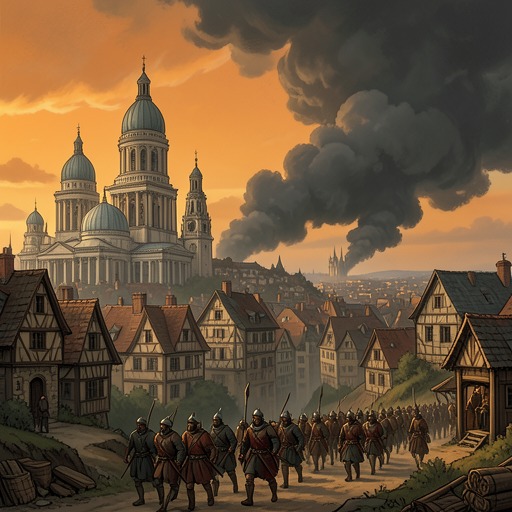
The French enter Moscow in apparently good marching order, although the army is tattered, hungry, worn out, and reduced to a third of its original number. The city contains no normal population to receive or contain them. Instead of being billeted among residents according to ordinary urban practice, the soldiers occupy Moscow as though it were an open camp, spreading through streets and abandoned houses.
That dispersion immediately changes the nature of the occupying force. While the troops remain concentrated, they are still an army; once they separate into lodgings among wealthy, deserted homes, they become something neither citizens nor soldiers but marauders. The transformation is material as well as moral. Soldiers search cellars and storerooms, unlock or break open coach houses and stables, gather provisions, choose houses, cook, bake bread, and seize objects that appear valuable or useful. Some appropriate several houses, mark them with their names, and quarrel or fight with other units over them. Officers who follow in order to restrain the men are drawn into the same process, selecting carriages and participating in the appropriation of the city's wealth.
The French commanders issue orders forbidding dispersion, violence, and looting, and announce a roll call for the evening. These commands fail because the city's abundance overwhelms military cohesion. The narrative compares the army to cattle that remain together while crossing barren ground but scatter uncontrollably when they reach rich pasture. Moscow absorbs the troops like water entering dry sand: the soldiers spread outward from the Kremlin, and the institutional army dissolves into innumerable individual pursuits.
Occupation, Fire, and the Failure of Control
The occupation creates the conditions for the Fire of Moscow without making any one person its sufficient cause. The French attribute the disaster to the fierce patriotism of Count Fyodor Rostopchin; the Russians attribute it to French barbarity. The narrative rejects both explanations as too narrow. A largely wooden city, emptied of its inhabitants and filled with soldiers who smoke, light campfires, and cook twice a day, is structurally bound to burn. The fires arise from the convergence of abandonment, military presence, combustible buildings, and the absence of the ordinary institutions that might have contained accidental flames.
The occupiers' attempts to impose order therefore operate like detached clock hands: visible, active, and disconnected from the mechanism governing events. Napoleon's campaign plan cannot be carried out because it is out of touch with reality; the fortification and mining of the Kremlin prove useless; diplomatic messages fail to reach Emperor Alexander I; the creation of a municipality does not halt robbery and instead allows some officials to loot or protect their own property. Even the execution of supposed incendiaries does not prevent Moscow from burning. Occupation reveals an administrative system issuing commands after the circumstances that would have made those commands effective have already disappeared.
This failure extends to the occupying army's future. Five weeks later, when the French leave Moscow, they no longer form an army but a mob of marauders carrying whatever they have acquired. Their objective has changed from conquest to preserving their loot. The wealth of the city becomes a burden that they cannot abandon, and possession turns into a trap. The occupation thus reverses the apparent logic of victory: entering Moscow looks like triumph, but the city's abundance dissolves discipline, encourages plunder, and contributes to the destruction of the force that captured it.
Occupied Bodies and the Suspension of Law
Military occupation also transforms people into administrative categories. When Pierre Bezukhov is arrested, the first guards treat him with hostility mixed with respect because they are uncertain whether he may be an important person. The next guard sees only a large, stout man in a peasant coat and identifies him as No. 17 among captured Russians. His previous actions, social identity, and personal intentions are displaced by the bureaucratic label assigned to a prisoner.
The legal process continues this reduction. Pierre and the other suspects are questioned by a French general, colonels, and officers about who they are, where they have been, and what they intended. The questions are designed not to discover the essence of the matter but to channel answers toward a predetermined conviction, particularly for incendiarism. Occupation therefore produces an exceptional legal space in which formal procedure exists while genuine inquiry is excluded. Pierre experiences the system as a force that deprives him of life without requiring any single individual to intend his death: a concurrence of circumstances becomes the agent of annihilation.
At the execution site near a kitchen garden by the Virgin's Field, the prisoners are arranged according to a list, with Pierre sixth, while French troops and soldiers of German, Italian, and French backgrounds form rows around them. The drums strip Pierre of the ability to think and understand. Later, when a corporal shuts a shed door despite Pierre's appeal for a sick prisoner, the changed face of the familiar man, the marching equipment, and the rattling drums reveal the same impersonal force that governed the executions. Personal sympathy cannot overcome the machinery of occupation once individuals become instruments of orders.
Russian Society and Resistance
The Russian response to occupation cannot be reduced to official heroism. In the account of 1812, most people are guided by private interests rather than by a conscious attempt to shape history. Yet those apparently limited actions—leaving Moscow, abandoning property, refusing to provide the invader with a functioning city, or acting according to immediate practical needs—can become more effective than deliberate patriotic schemes. Efforts to understand and direct the general course of events often prove useless or harmful, while unconscious action produces historical consequences.
The same principle appears in the Russian partisan war of 1812. Scattered groups attack men concentrated in masses, withdraw before stronger forces, and strike again when opportunities arise. This form of warfare contradicts the conventional tactical rule that an attacker should concentrate forces to gain superiority at the decisive point. Its effectiveness lies precisely in refusing the organized form that occupation expects to confront. Resistance is dispersed, opportunistic, and difficult to govern from above, making it a social response as much as a military tactic.
The state nevertheless seeks to convert society into military power. At the Sloboda Palace, nobles and merchants gather in response to the danger threatening the empire. The Moscow nobility resolves to furnish ten fully equipped men out of every thousand serfs, matching the contribution of the Smolensk gentry. Emperor Alexander I thanks the nobles for their devotion and urges them to act because time is precious. The scene joins aristocratic property, serf population, public ceremony, and military supply: occupation and invasion force the state to draw private resources into national defense.
A different attempt at social reform appears in Pierre's administration of his Kiev estates after his admission to the Masonic Brotherhood. He instructs his stewards that his serfs are to be freed, that labor is not to be excessive, that nursing women are not to be sent to work, that assistance should be provided, corporal punishment replaced by admonition, and hospitals, asylums, and schools established. The stewards respond according to their own interests: some fear exposure for embezzlement, some mock Pierre's speech, and the cleverest learn how to manipulate him. The episode shows the administrative limits of benevolent intentions even outside direct military occupation, while also clarifying how power over land, labor, and bodies forms part of the same social order that war later militarizes.
Narrative Significance
Military occupation is significant because it dismantles the belief that conquest is achieved when an army enters a capital. The French capture Moscow but cannot govern its wealth, streets, fires, inhabitants, or even their own soldiers. Commands, plans, legal judgments, and municipal institutions continue to appear, yet they fail to control the material conditions created by hunger, abandonment, plunder, fear, and exhaustion.
The occupation also shifts attention from rulers to systems and populations. Napoleon Bonaparte's intentions, Rostopchin's broadsheets, the emperor's appeals, and the orders of French commanders matter, but none alone explains what happens. The decisive forces arise from the interaction of armies with deserted houses, civilians with property, serfs with mobilization, prisoners with legal machinery, and soldiers with the abundance of a city. In this sense, occupation is both a military condition and a test of historical causation: the most consequential results emerge from countless actions that no participant fully understands.
Finally, the occupied city becomes an image of power consuming itself. Moscow's houses shelter the soldiers who destroy military discipline; its supplies encourage the looting that turns an army into a mob; its fires erase the material prize that conquest was supposed to secure. The French presence is therefore strongest at the instant it becomes least governable. Occupation ends not in settled possession but in disintegration, as the force that entered the city is transformed by the city into one of the instruments of its own defeat.