Moscow
War and PeaceMoscow is presented as more than a capital or military objective: it is a living historical organism whose withdrawal, occupation, and destruction overturn the logic of conquest. In 1812, Napoleon Bonaparte reaches the city expecting possession to signify victory, but Moscow’s inhabitants have abandoned it, and the city’s apparent surrender becomes the condition of the French army’s disintegration. Through Moscow, the narrative contrasts official explanations and heroic intentions with the cumulative force of ordinary movements, material conditions, and collective action.
Definition and Early Social Setting
Moscow first appears as part of the social and political world of the Russian elite. In 1805, Anna Pavlovna Scherer’s reception in Saint Petersburg is organized through French-language invitations and courtly ceremony, while discussion of war and Napoleon Bonaparte treats European politics as both moral crisis and salon subject. Moscow belongs to the same imperial world, but it carries a different imaginative weight: it is the old Russian city whose life cannot be reduced to the calculations of courts, diplomats, or commanders.
The novel repeatedly places Moscow’s fate beside the institutions that claim to explain history. Official reports describe defeat and retreat in carefully controlled language; military declarations present war as the execution of imperial purpose; and court society turns international conflict into a matter of reputation and access. Yet the city’s later history exposes the limits of such explanations. Moscow is shaped not by a single decision alone, but by the converging actions of armies, residents, officials, soldiers, and accidental material circumstances.
The City as a Historical Objective
The French invasion of Russia begins on 12 June 1812, when immense forces cross the Russian frontier. The narrative challenges explanations that assign the war to one diplomatic insult, one ruler’s ambition, or one policy such as the Continental System. Moscow becomes the clearest test of this argument. It is treated by Napoleon Bonaparte and his army as the decisive prize, but the city’s significance cannot be secured merely by occupying its streets.
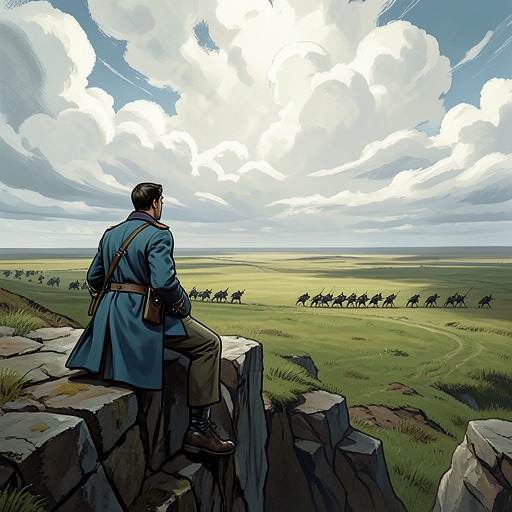
After the Battle of Borodino, the Russian army withdraws through Moscow toward the Ryazan road. On the morning of 2 September, Napoleon stands on Poklonny Hill and looks across the city. Moscow appears spacious and alive, with its river, gardens, churches, and glittering cupolas. Its unfamiliar architecture awakens in him an uneasy curiosity: the city seems to possess a life of its own, independent of his recognition and indifferent to his authority. The visual scene therefore reverses the expected relation between conqueror and conquered. Napoleon can see Moscow, but seeing it does not mean that he possesses its inner life.
The timing intensifies the contrast. From Borodino to the French entry, unusually warm autumn weather makes the city shine with almost magical clarity. Moscow seems to continue its ordinary existence even as the Russian army has departed. The brightness of the city and the absence of its inhabitants create a deceptive image of intactness: the physical capital remains visible, but the social body that made it a city has withdrawn.
Evacuation and French Entry
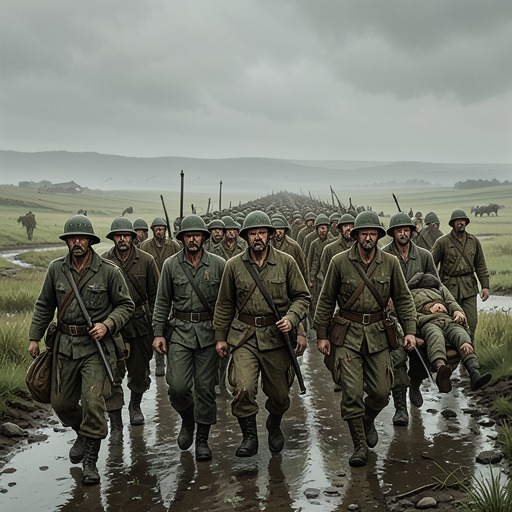
The French enter a Moscow emptied of its normal civic order. The occupying troops are not billeted among residents, because there are no masters of the houses to receive them. Instead, they live in the city as in a camp, quartering themselves in streets including Vozdvizhenka, Nikolski, and Tverskoy. Though tattered, hungry, exhausted, and reduced to roughly a third of their original number, they initially enter in good marching order, still appearing to be an army.
That appearance collapses almost immediately. Once the regiments disperse into wealthy, deserted houses, the army becomes something neither civic population nor disciplined military force: a mass of marauders. Soldiers search cellars and storerooms, break open coach houses and stables, seize valuables, and claim several houses for themselves. Cavalrymen move from one adequate stable to another because a better house may lie nearby; companies chalk their names on buildings and quarrel over possession. Generals select carriages in Carriage Row, while officers who should restrain the soldiers are drawn into the same process of appropriation.
The city’s abundance accelerates the collapse. The French discover not a defeated population to govern but a vast field of unguarded wealth, with further unexplored districts apparently promising still greater riches. Moscow therefore defeats the army through the very success that seems to reward it. The invaders cease to act toward a common military aim and begin to act as separate individuals defending what each has taken. Their objective changes from conquest to retention, and that change makes the army’s eventual ruin inevitable.
Occupation, Language, and Violence
The occupation also appears in intimate encounters inside abandoned homes. A French officer enters with cheerful confidence, asks whether Gerasim is the bourgeois, and demands quarters and lodging while assuring him that the French are good-natured. The exchange is marked by linguistic asymmetry: the officer speaks French and broken phrases of accommodation, while Gerasim responds with alarm and incomprehension. Pierre Bezukhov, present in the house, becomes a silent witness to the new power relation created by occupation.
Moscow’s occupied spaces soon become sites of arbitrary detention and judgment. Pierre Bezukhov is arrested by French soldiers and treated with a mixture of hostility and respect because they do not know who he is. The following guard reduces him to No. 17 among captured Russians, stripping away the individuality that had made him interesting to his captors. He is questioned by a French general and colonels in a procedure whose formal precision conceals a predetermined purpose: the questions are shaped to produce conviction, not to discover the truth.
The city also witnesses the execution of Russian prisoners. From Prince Shcherbatov’s house, the captives are marched across the Virgin’s Field to a kitchen garden where a post and a freshly dug pit await them. French troops in blue uniforms form rows on both sides, and the prisoners are arranged according to a list, with Pierre sixth. The execution of the factory worker makes violence physically and morally undeniable. The man adjusts the blindfold that hurts him, settles his feet against the post, and is shot; his body is thrown into the pit while the soldiers hurry to conceal the evidence of what they have done. Moscow is thus not merely a backdrop to military occupation. Its gardens, houses, streets, and fields become the spaces in which the occupation turns human beings into prisoners, numbers, bodies, and hidden remains.
The later treatment of a sick prisoner reveals the same force in another form. When Pierre asks what will happen to the sick man, the corporal’s familiar face has changed under marching orders, and drums drown the man’s groans. Pierre recognizes in the altered voice, uniform, and noise a system that compels people to kill against their own personal impulses. Within Moscow, military power is shown as an impersonal mechanism that survives changes of individual intention.
The Fire and the City’s Destruction
The Fire of Moscow is attributed differently by the opposing sides. The French blame the fierce patriotism of Count Fyodor Rostopchin; the Russians blame French barbarity. The narrative rejects both explanations as sufficient. Moscow burns because a deserted wooden city occupied by soldiers, without its residents or functioning civic precautions, has been placed in conditions where fire is bound to spread.
The material causes are concrete. French soldiers smoke pipes, build campfires from chairs taken from the Senate House in Senate Square, and cook meals twice a day. A wooden city already vulnerable to frequent peacetime conflagrations becomes vastly more exposed when its inhabitants and police force have gone. The image is not of one will setting the whole city alight, but of sparks repeatedly falling onto a heap of shavings. Responsibility is dispersed across the circumstances that make destruction unavoidable.
The fire emerges from the same process as the looting. The famished army pours into the rich and deserted city like water into dry ground; both city and army disappear into the resulting mud. Wealth draws soldiers farther into Moscow, dispersing them from their regiments, while fires and theft destroy the environment that sustains them. The city consumes the occupying force even as the occupying force consumes the city.
Historical and Narrative Significance
Moscow’s decisive significance lies in the reversal of military victory. The French may enter the city, but occupation does not produce political control, food, order, or a functioning army. Five weeks later, the troops leave carrying objects they consider valuable or useful. Their purpose is no longer to conquer but to keep their loot, and the burden of possession helps turn retreat into ruin. Moscow becomes the point at which the French army’s identity changes permanently: it enters as an army and departs as a mob of marauders.
The city also completes the moral consequence of Borodino. The Russian victory there is described not simply as the capture of ground or standards but as a moral victory that convinces the French of their own impotence. The French can still roll forward to Moscow by accumulated momentum, yet the city reveals that this movement is already mortally wounded. Its occupation is therefore not the culmination of the invasion but the visible beginning of its collapse.
Moscow’s narrative method repeatedly makes familiar things strange. A capital is viewed from a hill as if it were an unfamiliar living body; an army becomes a crowd of house-claiming looters; a formal trial becomes a channel designed to produce conviction; and drums transform a personal appeal into the sound of an impersonal killing system. Through this defamiliarization, Moscow ceases to be an automatic symbol of national possession. It becomes a material, inhabited, abandoned, burning, and remembering space in which the limits of individual explanations and grand historical claims are exposed.