Napoleon Bonaparte
War and PeaceNapoleon Bonaparte stands at the center of the novel’s historical argument: he appears to direct Europe by force of will, yet the narrative steadily exposes the limits of that appearance. He is a dazzling ruler, commander, and public symbol whose decisions give history a recognizable face, but whose victories, invasions, retreats, and humiliations are governed by the collective movement of peoples and armies more than by personal genius.
Identity and Rise
Napoleon Bonaparte first appears through the political language of the Saint Petersburg elite, where Anna Pavlovna Scherer calls him an Antichrist, murderer, and villain and treats the struggle against him as Russia’s sacred duty. At the same time, the novel refuses to leave him within that simple demonology. Prince Andrei Bolkonsky can suddenly exclaim that he is an extraordinary genius and a fortunate man, revealing the fascination Napoleon exerts even upon those who oppose him. The contrast establishes Napoleon’s double identity: to some he is the embodiment of revolutionary evil, while to others he is the most astonishingly successful political and military figure of the age.
The historical account of his rise strips away the legend of effortless greatness. After the French Revolution destroyed an older political group and its established customs, a new military mass formed, requiring a leader capable of accepting responsibility for the deceptions, robberies, and murders committed in its movement. Napoleon emerges from this turbulent field as a man without convictions, habits, traditions, or an inherited name, and not even a Frenchman by birth. His advancement depends on the ignorance of colleagues, the weakness of opponents, the frankness of his falsehoods, and his dazzling self-confidence, while the soldiers’ qualities, enemy hesitation, and his own childish audacity secure his military fame. What later appears as destiny is therefore assembled from innumerable contingencies.
Court, Authority, and Political Theater
Napoleon’s public power is inseparable from spectacle. Before departing Dresden, where he had spent three weeks surrounded by princes, dukes, kings, and an emperor, he displayed favor toward some rulers, reprimanded others, and presented the Empress of Austria with pearls and diamonds taken from other kings. He tenderly embraced Empress Marie Louise, who regarded him as her husband even though he had left another wife in Paris, and then departed for the army while diplomats still hoped for peace. His letter to Emperor Alexander I addressed him as a brother and professed a desire for peace, but his practical orders accelerated the eastward movement of the French troops. The gap between diplomatic language and military action defines his political method.
That theatrical authority is rendered with particular precision when Napoleon receives the Russian envoy Balashev in Vilna. Balashev enters the very house from which Emperor Alexander I had dispatched him, but the setting has changed hands: French grenadiers, hussars, Uhlans, aides-de-camp, pages, generals, and Napoleon’s Mameluke Rustan now occupy the scene. Balashev is amazed by the luxury and magnificence of the French court. Napoleon enters in a blue uniform, white waistcoat, tight white leather breeches, and Hessian boots, with one lock of hair falling over his broad forehead and the smell of Eau de Cologne surrounding him. His short, corpulent body carries the stately appearance of imperial power, and his brisk movements suggest a man convinced that every moment belongs to him and that he will always say the right thing. Yet the same encounter indicates his self-absorption: Balashev’s individuality scarcely interests him; what matters is the process unfolding within Napoleon’s own mind.
War and the Limits of Command
The novel’s most searching treatment of Napoleon comes through the Battle of Borodino. On August 24, the Battle of the Shevardino Redoubt was fought; August 25 passed without a shot; and on August 26 the Battle of Borodino took place. Its immediate consequences were disastrous for both sides. The Russians were brought nearer to the destruction of Moscow, while the French were brought nearer to the destruction of their entire army. Before the battle, the forces stood at roughly one hundred thousand Russians against one hundred and twenty thousand French; afterward, the balance was little more than fifty thousand against one hundred thousand. The battle therefore appears irrational when judged as the deliberate choice of commanders.
Napoleon’s supposed genius cannot explain what happens within the battle itself. The narrative emphasizes that he was so far away that he could not know the course of the fighting, and none of his orders during the battle could be executed. The later claim that the French failed because Napoleon had a cold is treated as a revealing absurdity. If Russia’s survival depended on the precise manifestation of one man’s will, then even a valet who failed to bring Napoleon his waterproof boots could be called the savior of Russia. Such reasoning mistakes a visible personal detail for the cause of an event whose conditions were collective, accumulated, and historical.
A related contrast appears in the scene after the Battle of Austerlitz. Napoleon encounters Prince Andrei Bolkonsky, who lies wounded beside a fallen flagstaff. Napoleon calls it a fine death, and Bolkonsky recognizes that the speaker is his former hero. Yet Napoleon’s words become no more meaningful to him than the buzzing of a fly. Above the wounded man stands the remote, lofty, everlasting sky, and beside that infinite reality Napoleon suddenly seems small and insignificant. The conqueror can order that the living man be carried to a dressing station, but he cannot command the transformation taking place in Bolkonsky’s consciousness. The scene deflates imperial appraisal at the very moment when Napoleon appears most powerful.
Moscow and the Retreat
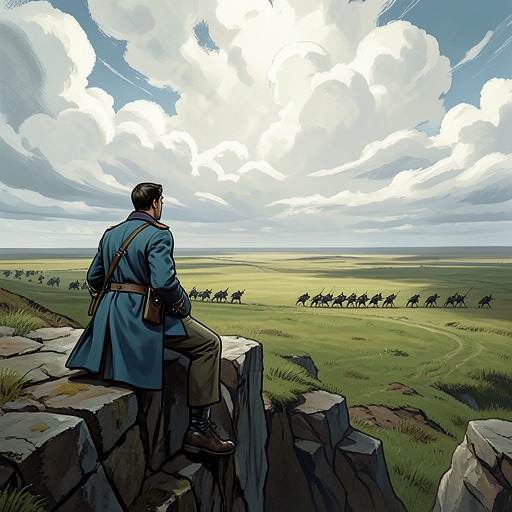
On September 2, Napoleon stands among his troops on Poklonny Hill, looking toward Moscow. The city shines beneath an extraordinary autumn sky, with its river, gardens, churches, and glittering cupolas appearing to live according to its own full force. Napoleon’s curiosity is mixed with uneasiness because Moscow seems like an alien form of life that has no knowledge of him. He has reached the symbolic object of the invasion, but the city does not confirm his mastery; it remains self-contained and resistant to the meaning he wishes to impose upon it.
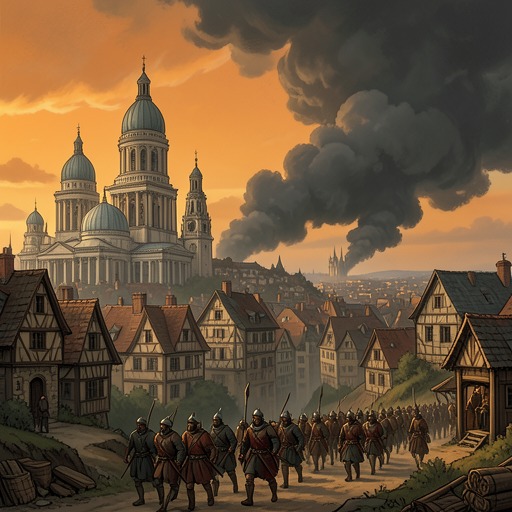
The retreat exposes the failure of the image more starkly. After the French turn onto the Kaluga road, the army’s movements increasingly resemble a flight in which it destroys itself. Historians nevertheless continue to describe Napoleon’s arrangements, maneuvers, profound plans, and military genius. The unnecessary retreat from Malo-Yaroslavets along a devastated road, despite an open route into a well-supplied district, is explained as a profound calculation; the withdrawal from Smolensk to Orsha receives the same treatment. At Krasnoe, Napoleon is said to have prepared to take personal command and to have declared that he had acted as Emperor long enough and should now act as general, yet he soon runs away again, abandoning the scattered remnants of the army. Even his final departure from the army is transformed by historians into an act of greatness, although ordinary moral language would call it baseness.
Historical Significance
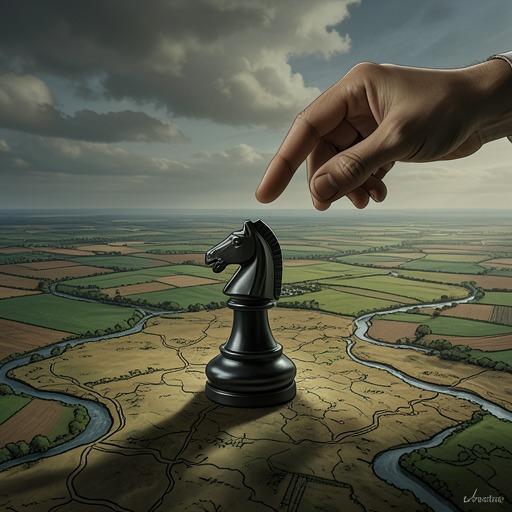
Napoleon Bonaparte therefore functions less as a conventional protagonist than as the most visible test case for the novel’s theory of historical causation. Modern history, the narrative argues, habitually explains enormous movements through the personalities of rulers: Napoleon supposedly begins the war because he wills it, captures Moscow because he commands it, and loses Russia because illness or a particular decision interrupts his genius. Against this habit, the novel insists that the activity of the general mass controls the historic hero as much as the hero appears to control the mass.
The ship-and-wave analogy clarifies the point. When a ship moves, waves foam before it; from a distance, those waves seem to direct the vessel, though they are produced by its movement. Historical figures and their commands likewise appear to anticipate and govern events because they are the most visible features of an already advancing collective process. Napoleon’s orders matter only within conditions that make action possible, and however many commands are issued, an event does not occur unless other causes are present. His authority is real as a social force and false as an explanation of total historical movement.
In this sense, Napoleon embodies the tension between historical appearance and historical reality. His uniforms, courts, proclamations, audiences, victories, and titles make him seem like the author of an age. The narrative repeatedly restores the neglected scale: six hundred thousand men enter Russia, armies move west and east, peoples abandon old traditions, and the supposed master of events finally abandons his army. Napoleon’s significance lies precisely in this contradiction. He is powerful enough to become history’s most convenient name for the period, yet insufficiently powerful to be its true cause.