Nikolai Rostov
War and PeaceNikolai Rostov is defined by a directness that makes military life feel less like a career than a calling. He is impulsive, sociable, proud, and readily moved by loyalty, but the same emotional openness that makes him a natural soldier also exposes him to vanity, gambling, financial irresponsibility, and the powerful claims of family obligation. His trajectory therefore joins a youthful romance with the army to a later education in debt, inheritance, marriage, and stewardship.
Identity and Introduction
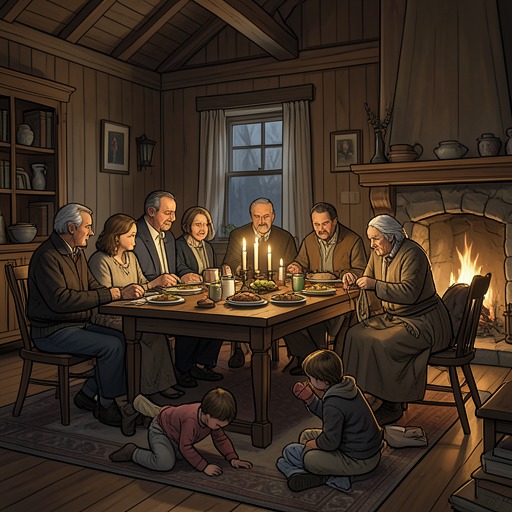
Nikolai first appears as the Rostov family's eldest son, a handsome undergraduate whose curly hair, open expression, flushed face, and impetuous enthusiasm distinguish him from the taller, calmer Boris Drubetskoy. At a family gathering, he struggles to find something to say when he enters the drawing room, while Boris immediately turns the absurd story of the doll Mimi into a composed joke. Nikolai's embarrassment belongs to the same emotional world as his later courage: he feels everything openly and has difficulty concealing what he feels.
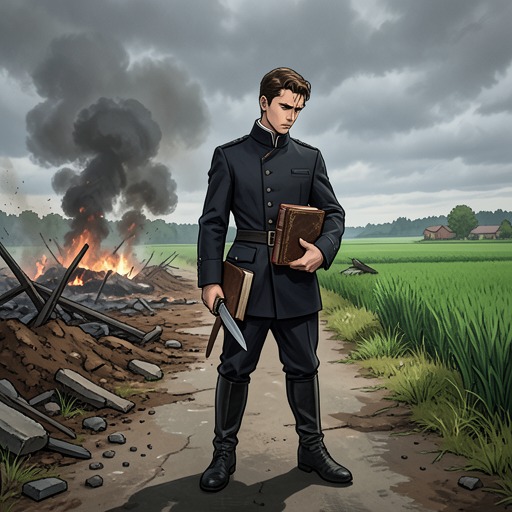
His family recognizes that he is about to cross from domestic youth into military life. Count Ilya Rostov explains that Boris has become an officer and that Nikolai is leaving the university to enter the service, with a place available in the Archives Department if he wished to remain a civilian. Nikolai rejects the suggestion that friendship has determined his choice. He insists that the army is his vocation and says that he is useful nowhere else, since he is neither a diplomat nor a government clerk. His declaration is less a calculated plan than an act of self-recognition: the army offers him a world in which energy, courage, comradeship, and visible action have an immediate value.
Military Life and the Formation of a Soldier
Nikolai joins the Pavlograd Hussars, and his early military identity is shaped by ceremony, comradeship, and the intoxicating presence of authority. At the imperial review, he is swept into the officers' collective rapture over Emperor Alexander I. When he rides past the Emperor on Bedouin, a horse recently purchased from Denisov, he controls the animal's excited, showy trot and feels himself perfectly united with it. The Emperor praises the Pavlograds, and Nikolai experiences such devotion that he imagines he would be happy to leap into a fire at the Emperor's command. The scene reveals both his bravery and his susceptibility to heroic illusion: after the review, he and many officers believe that victory must follow simply because the Emperor personally commands them.
Under fire, however, military feeling becomes more complex. In the hussar squadron, cannonballs pass over the men's heads, and every face shows conflict, irritation, and excitement. Nikolai, mounted on Rook despite the horse's game leg, presents the pleased appearance of a schoolboy certain that he will distinguish himself before an audience. He wants others to notice how calmly he sits under fire, yet the sternness around his mouth betrays the new reality pressing through his performance. His courage is genuine, but it is not effortless or abstract; it is courage experienced through fear, self-consciousness, discipline, and the watchful presence of comrades such as Denisov.
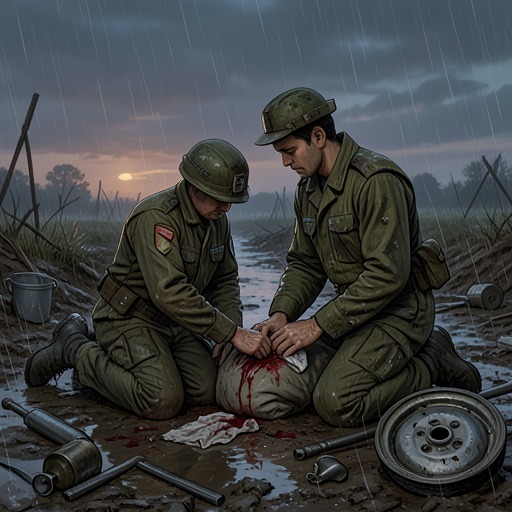
The wider campaigns expose him to the material conditions that romantic military language cannot master. In 1805, the Russian army under Kutuzov retreats along the Danube while fighting rearguard actions at Lambach, Amstetten, and Melk. The force is weakened by exhaustion, losses, poor clothing, and inadequate supplies. The Pavlograd Hussars later suffer even more starkly from logistical failure: near a ruined German village, the thaw makes roads impassable, provisions and fodder cease to arrive, and soldiers search abandoned villages for potatoes. Although the regiment has suffered only two men wounded in action, nearly half its men are lost through hunger and sickness. Nikolai's military world is thus not sustained by individual glory alone; it depends on boots, food, transport, horses, roads, and the endurance of ordinary soldiers.
Temptation, Debt, and Family Obligation
Nikolai's impulsiveness becomes dangerous when it leaves the battlefield and enters the card room. Playing against Fyodor Dolokhov, he marks a seven of hearts with an eight-hundred-ruble stake even though his father has given him only two thousand rubles to last until May, of which twelve hundred remain. The wager threatens not merely money but his word of honor and his parents' security. As the game escalates, the comforts of home return to him with painful vividness: jokes with Petya, conversations with Sonya, duets with Natasha, piquet with his father, and his bed at the Povarskaya house. The recollection does not immediately free him; instead, it sharpens the sense of what his recklessness may destroy.
Dolokhov finally tells him that he owes forty-three thousand rubles. Nikolai asks whether an I.O.U. will be accepted and promises payment the next day. Dolokhov's taunt about being lucky in love and unlucky at cards, together with his allusion to Nikolai's cousin Sonya, makes the debt feel deliberately humiliating. Nikolai's fierce refusal to let Sonya be mentioned shows that the loss has become a moral and emotional crisis, not a private sporting mishap. His military pride cannot protect him from the consequences of financial irresponsibility, and the family whose warmth he idealizes becomes the very family he fears he has betrayed.
The same conflict returns after years of service. By 1809 Nikolai commands the squadron he inherited from Denisov and enjoys the sheltered, orderly existence of military life, where compulsory idleness can feel like duty fulfilled. Letters from his mother report that the family's affairs are worsening and urge him to return to comfort his parents. Nikolai dreads leaving the regiment for the tangled world of stewards, accounts, quarrels, social obligations, and his promise to Sonya. He answers in cold, formal letters that avoid saying when he will come. His reluctance reveals how deeply he has come to rely on the army as protection from civilian responsibility.
War, Family Crisis, and the Return Home
Nikolai's military career unfolds against campaigns in which individual intent is repeatedly subordinated to larger movements of retreat, supply, and exhaustion. The Pavlograd regiment reaches the later campaign too late for the first actions, serves with Platov's independent division, exchanges fire with the enemy, takes prisoners, and captures Marshal Oudinot's carriages. Yet the regiment's losses from hunger and sickness exceed its combat casualties. This contrast helps define Nikolai's experience: service gives him a language of honor and belonging, but war continually reveals how fragile that language is when material conditions fail.
His relationship to the national crisis also appears through his encounters with others. When he rides toward Bogucharovo with Ilyin and Lavrushka, he is in a cheerful military mood, racing horses and looking for hay and provisions before the French arrive. He does not know that the estate belongs to the Bolkonsky family, whose history is connected with his own through his sister's former engagement. The scene places Nikolai's practical duties as a squadron commander beside the intimate and political networks disrupted by war: the search for fodder is at once a military necessity and an intrusion into a threatened household.
After Count Ilya Rostov dies, Nikolai receives the news while serving with the Russian army in Paris. He immediately resigns his commission and travels to Moscow, refusing to regard the inheritance as separable from his father's memory. The debts prove to be double the value of the property. Friends advise him to decline the inheritance, but Nikolai accepts both the estate and the obligation to pay what is owed. Creditors move quickly, the estate is sold at auction for half its value, and half the debts remain unpaid. To pay debts he considers genuinely due, Nikolai accepts thirty thousand rubles from his brother-in-law Pierre Bezukhov; to avoid imprisonment for the remainder, he returns to government service, although he dislikes civil employment and cannot rejoin the army because his mother now depends on him.
Marriage, Stewardship, and Change
Nikolai's later life marks a decisive change in the meaning of duty. In the winter of 1813 he marries Princess Mary and moves to Bald Hills with his wife, his mother, and Sonya. Within four years he pays all remaining debts without selling his wife's property, and after receiving a small inheritance from a cousin he repays his debt to Pierre. By 1820 he has purchased a small estate adjoining Bald Hills and is negotiating to buy back Otradnoe, the recovery of his family's home having become a personal dream rather than a vague sentimental wish.
Farming begins as necessity but becomes his favorite and almost sole occupation. Nikolai dislikes innovations, especially fashionable English methods; he laughs at theoretical treatises, distrusts factories and expensive specialized production, and refuses to turn any single technique into a hobby. His attention remains fixed on the estate as a whole. The practical intelligence that once expressed itself through horses, regimental order, and battlefield readiness is redirected toward the interdependence of soil, tools, manure, crops, and labor.
Most important, Nikolai's understanding of the peasant changes the character of his authority. He no longer regards the serf merely as an instrument of production. He watches the peasants to learn what they consider good or bad, pretends to give orders while actually studying their methods, speech, and judgment, and recognizes the peasant laborer as both a judge of farming and an end in himself. This does not erase the social hierarchy of his world, but it gives his stewardship a more reciprocal and attentive basis. The impetuous young man who once claimed that the army was his only vocation becomes a man capable of assuming responsibility for an entire household, estate, and network of dependents.
Narrative Role and Significance
Nikolai is a rounded character because his core qualities remain recognizable while their consequences change. His openness, loyalty, pride, and appetite for action appear first as youthful virtues and liabilities: they draw him toward the army, make him glow under the Emperor's gaze, and help him endure danger, but they also leave him vulnerable to gambling and evasive responses to family crisis. Later, those same qualities are tested by debts that cannot be escaped through courage or charm. His acceptance of the inheritance, return to civil service, repayment of obligations, marriage to Princess Mary, and patient reconstruction of the estate transform temperament into responsibility.
His story also gives the novel a social and material counterpoint to purely heroic accounts of history. Military life offers exhilaration, comradeship, and identity, yet the campaigns are governed by inadequate boots, hunger, sickness, impassable roads, and broken supply lines. Family life is sustained not by sentiment alone but by money, inheritance, labor, and care across generations. Nikolai's final vocation therefore carries the memory of the soldier without reproducing the soldier's escape from ordinary obligations. His achievement is not to become a different kind of person, but to make his instinctive loyalty durable: first to comrades, then to parents and creditors, and finally to a household and working community whose survival depends on his sustained attention.