People's war principle
War and PeaceThe People's war principle is the novel's central explanation for why the French invasion of Russia collapsed despite the French army's apparent military superiority. Its decisive claim is that the fate of the campaign was determined not by the formal victory of one army over another, but by the Russian people's refusal to fight according to the conventions that made Napoleon's invasion intelligible. The principle appears through the image of a cudgel: when the polished rules of warfare cease to describe the struggle, the Russian people take up the simplest available weapon and strike until the invasion is destroyed.
Definition and Historical Setting
The principle emerges in the account of the war that began when Western European forces crossed the Russian frontier on June 12, 1812. The scale of the conflict exposes the inadequacy of explanations that assign responsibility to a single ruler, diplomatic mistake, or written agreement. The war produced crimes on a vast scale, yet those who committed them did not regard their actions as crimes at the time. Against historical accounts that reduce the invasion to Napoleon's ambition, Alexander's firmness, the Continental System, or the wording of diplomatic memoranda, the narrative presents the campaign as the result of innumerable intersecting actions rather than one decisive intention.
The Russian response becomes visible in the sequence of events from the burning of Smolensk through the retreat after Borodino, the Fire of Moscow, the seizure of transports, the capture of marauders, and the guerrilla war. These developments departed from the inherited rules of war. A conventional military history might treat the burning of towns, the abandonment of territory, or attacks by scattered groups as failures to conduct a proper campaign. The People's war principle instead treats those departures as the very means by which Russia made conquest impossible.
The Cudgel Against Conventional War
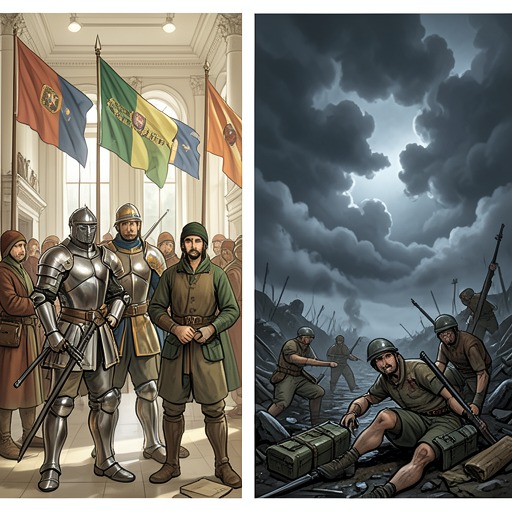
The governing metaphor contrasts a formal fencing match with an uncontrolled struggle for survival. The French army is imagined as a fencer who insists on using a rapier according to the rules of the art. The Russian people, recognizing that the contest concerns life itself, throw away the rapier and seize the first cudgel at hand. The contrast is not between refinement and barbarism in a moral sense; it is between a system that mistakes its own conventions for reality and a population that responds directly to danger.
Napoleon experiences this reversal when, in Moscow, he expects the orderly continuation of military conquest but encounters resistance that cannot be assimilated to his assumptions about war. He complains to Kutuzov and to Emperor Alexander that the conflict is being conducted contrary to the rules, even though the narrative insists that there can be no fixed rules governing the killing of people. Some highly placed Russians also feel embarrassed by the cudgel-like character of popular resistance and wish to restore the graceful poses and calculated thrusts of conventional military science. Yet the people's weapon does not wait for official approval. It rises and falls with what the narrative calls stupid simplicity and consistency until the French invasion perishes.
Collective Action Beyond the Army
A national war does not require all resistance to pass through a single army. The principle identifies scattered groups attacking men concentrated in a mass as one of the most effective departures from conventional military law. Such groups disperse, strike individual targets, retreat before stronger forces, and attack again when circumstances permit. The same pattern is associated with guerrillas in Spain, mountain tribes in the Caucasus, and the Russians in 1812.
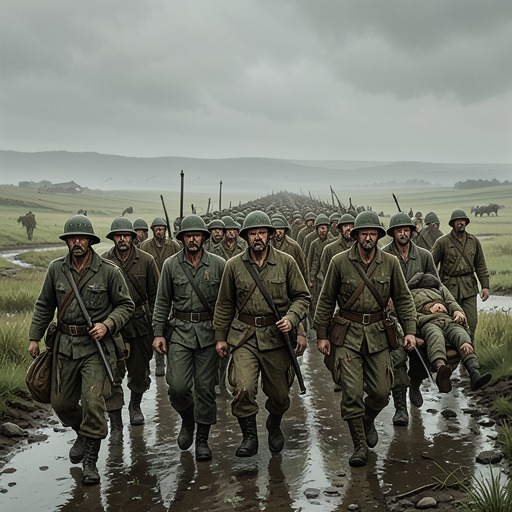
This method directly violates the tactical maxim that an attacker should concentrate forces in order to achieve superiority at the moment of conflict. Military science treats numerical strength as the principal measure of an army's power, but the narrative argues that numbers alone cannot explain why smaller detachments sometimes defeat larger ones. The French entered Moscow in good marching order even though they were hungry, worn out, and reduced to a third of their original number. Their apparent strength, however, could not survive the conditions created by the Russian response.
The same principle operated through the refusal of the countryside to sustain the invader. Peasants such as Karp and Vlas did not display heroic emotions in every personal action, and after the French evacuation they even drove carts to Moscow to pillage it. Nevertheless, they and countless others refused to bring hay to Moscow for the high prices offered by the French and burned it instead. This destruction of forage deprived the French army of the ordinary material conditions on which military victory depended. Popular resistance therefore did not need to resemble patriotic rhetoric or a unified national plan; ordinary acts, including the withholding or destruction of supplies, accumulated into a force that regular strategy could not overcome.
The Spirit of the Army
The principle's most exact formulation appears in the discussion of the army's spirit. Military science searches for the unknown factor that explains why a smaller force defeats a larger one, attributing it in turn to formations, equipment, or the genius of commanders. The narrative rejects these explanations as attempts to preserve the comforting idea that wartime orders and celebrated leaders determine history. The unknown factor is the greater or lesser readiness of the men composing an army to fight and face danger.
Army strength is therefore presented as the product of mass and spirit. A large force with a collapsed will may be weaker than a smaller force whose members are prepared to endure hardship without compulsion. The narrative even proposes comparing historical engagements through ratios: if ten units defeat fifteen while losing four, the relation between the unknown factors can be expressed as 4x = 15y, yielding x/y = 15/4. The equation does not discover the absolute value of either spirit, but it shows how historical events might reveal the relation between them.
The contrasting movements of the French and Russian armies in 1812 confirm the argument. According to conventional tactics, a retreating army should divide into smaller detachments, while an attacking army should concentrate its forces. The French did the opposite: their spirit had fallen so far that only mass could hold them together. The Russians, whose spirit had risen, divided into small units, allowing individuals to strike the French without orders or external compulsion. Their military effectiveness thus came not from perfect obedience to tactical doctrine but from an inner readiness to expose themselves to danger.
Consequences and Significance
The People's war principle changes the meaning of victory. The French victory in a particular battle did not produce conquest, and the winning of a battle was not even an invariable sign of eventual success. The fate of peoples lay elsewhere, in the interaction of armies with populations, landscapes, supplies, retreats, fires, and the willingness of ordinary people to deny the invader a stable world in which victory could be consolidated.
The French occupation of Moscow illustrates the process. The army entered a deserted city in orderly military form, but once its regiments dispersed among wealthy abandoned houses, it ceased to be an army and became a collection of marauders. Soldiers and officers competed for houses, carriages, provisions, and valuables. The city absorbed and scattered the force that had entered it. The French attributed the Fire of Moscow to Rostopchin's patriotism, while the Russians attributed it to French barbarity; the narrative rejects both explanations as the assignment of a collective process to a single culprit. A wooden city, abandoned by its inhabitants and occupied by soldiers who smoked, made campfires, and cooked meals, was placed in conditions under which burning became inevitable.
The principle also clarifies why the language of rules repeatedly fails. The French army is not defeated simply because a Russian commander discovers a superior maneuver. It is worn down by a social environment that refuses to provide forage, shelter, security, or a clear object of conquest. The occupation of Moscow gives way to looting; looting turns the army into a mob; retreat becomes an attempt to preserve stolen goods rather than to pursue military objectives. The invaders carry away what they have seized and cannot abandon it, so the material gains of occupation become an additional burden in the retreat.
In this sense, the People's war principle is both a military rule and a critique of heroic history. It shifts attention from Napoleon and other commanders to the collective spirit that makes commands effective or useless. It also explains why resistance can remain powerful without a single headquarters, a complete plan, or a uniform moral performance. The Russian people do not win by displaying a more elegant version of conventional warfare. They win by refusing to let conventional warfare define the struggle, taking up the cudgel of popular resistance and continuing until the French invasion has lost not merely a battle, but its army, its purpose, and its capacity to continue.