Pierre Bezukhov
War and PeacePierre Bezukhov is one of the novel’s principal figures, a large, inexperienced, and intellectually restless young man whose life repeatedly places abstract conviction against painful experience. Introduced as the illegitimate son of the dying Count Bezukhov, he enters society as an outsider, inherits an immense fortune, makes a disastrous marriage, seeks moral renewal in Freemasonry, witnesses the violence of war and execution, endures captivity and illness, and finally acknowledges his lifelong love for Natasha Rostova. His importance lies not in mastery or social authority but in the long, difficult movement by which confusion is converted into a more humane understanding of life.
Identity and Introduction
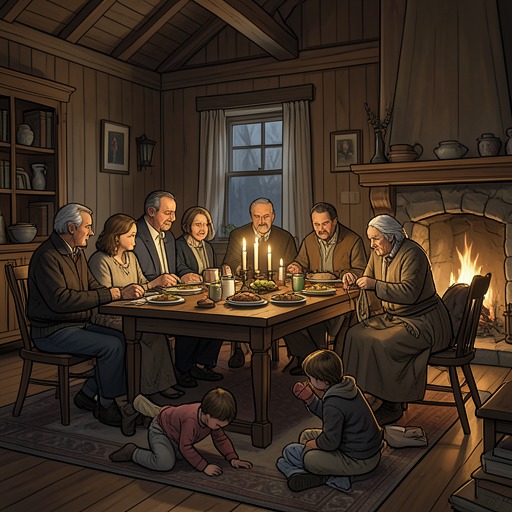
Pierre first appears at Anna Pavlovna Scherer’s reception as a stout young man with close-cropped hair, spectacles, fashionable light-colored breeches, a high ruffle, and a brown dress coat. He is the illegitimate son of Count Peter Kirilovich Bezukhov, a well-known grandee of Catherine’s time who is lying gravely ill in Moscow. Having been educated abroad and not yet entered into either military or civil service, Pierre is making his first appearance in society. His physical size already seems excessive for the drawing room, but the deeper reason for Anna Pavlovna’s alarm is his clever, shy, observant, and natural expression, which does not fit the polished conventions of her salon.
Pierre’s social awkwardness is active rather than passive. He leaves a lady before she has finished speaking, refuses to be smoothly redirected toward another guest, and begins arguing that the Abbé Morio’s scheme for perpetual peace is interesting but hardly feasible. At Prince Andrei Bolkonsky’s study, he behaves as though completely at home: he lies on the sofa, takes Caesar’s Commentaries from the shelf, and reads in the middle of the book. His conversation turns to perpetual peace and the possibility of brotherhood, while Prince Andrei is more concerned with the practical question of whether Pierre will become a guardsman or a diplomatist. Pierre has ideals but no settled vocation, and this mismatch between expansive thought and uncertain action defines his earliest identity.
Fortune, Marriage, and Moral Crisis
The death of Count Peter Kirilovich Bezukhov abruptly changes Pierre’s position. After the announcement that the count is no more, Pierre is comforted by Anna Mikhaylovna Drubetskaya, who tells him that he is now, or is expected to be, in command of an immense fortune and that such wealth imposes duties. Pierre therefore passes almost at once from an inexperienced outsider to a fabulously wealthy heir. The inheritance gives him social power without giving him the judgment or emotional independence needed to use it well.
Six weeks later Pierre is married and settled in Count Bezukhov’s large, newly furnished Petersburg house. Society regards him as the happy possessor of a celebrated beauty for a wife and of millions of money. The speed and public nature of this transformation expose the difference between appearance and inward reality: Pierre has acquired rank, property, and marriage, but not certainty. The marriage brings him into destructive proximity with Fyodor Dolokhov. At a dinner where Pierre eats and drinks as usual, those who know him notice that he has become silent, gloomy, and absorbed in an unsolved problem. Hints from his cousin and an anonymous letter suggest that Dolokhov has an intimate connection with Pierre’s wife, Helene Kuragina.
Pierre does not simply accept the accusation. He disbelieves the hints and the letter, yet Dolokhov’s handsome, insolent eyes awaken something terrible in him. He remembers that, after recovering his position following the campaign, Dolokhov had come directly to his house; Pierre had lodged him and lent him money, while Helene had expressed disapproval of his presence. Dolokhov then cynically praised Helene’s beauty and remained constantly with the couple. Pierre’s jealousy is intensified by his knowledge of Dolokhov’s character and by the humiliating possibility that his own generosity has supplied the means of his dishonor. The conflict culminates not in confident action but in a value reversal: hospitality, friendship, and self-possession give way to suspicion, rage, and the threat of violence.
Search for a Moral Life
Pierre’s moral restlessness leads him toward Freemasonry. In a roadside encounter with Joseph Alexeevich Bazdeev, a famous Mason and Martinist, Pierre admits that he wants to become better but has received no help, while also acknowledging that he is chiefly to blame for his failures. Bazdeev answers that help comes from God, though the Order can offer what assistance it possesses, and advises Pierre to spend time in solitude and self-examination rather than resume his former way of life.
The encounter gives Pierre the sensation of beginning again. After Bazdeev leaves, Pierre paces through the room, reconsiders his vicious past, and imagines a virtuous future that seems immediately attainable. He comes to believe that he has been vicious because he had somehow forgotten the goodness of virtue, and Freemasonry presents to him the possibility of a brotherhood united in mutual support. In Petersburg he withdraws from society, reads Thomas a Kempis, and experiences an unfamiliar joy in believing both that perfection is possible and that active brotherly love can be practiced. Yet the movement is not a simple solution. Pierre’s recurring weakness is his tendency to receive an external system as the answer to an inward problem; his ideals are sincere, but his life must still test whether they can survive experience.
That test begins when Natasha Rostova’s attempted elopement with Anatole Kuragin is revealed. Marya Dmitrievna Akhrosimova tells Pierre that Natasha has rejected Prince Andrei Bolkonsky without her parents’ knowledge because of Anatole and has tried to elope during her father’s absence in order to marry secretly. Pierre is scarcely able to believe what he hears, because the woman involved is the Natasha who had once seemed so charming and because Anatole’s conduct is connected with the social world of Pierre’s own marriage. The disclosure turns Pierre from a distant observer of scandal into a reluctant intermediary who must confront the damage caused by the values and relationships surrounding him.
War, Violence, and Captivity
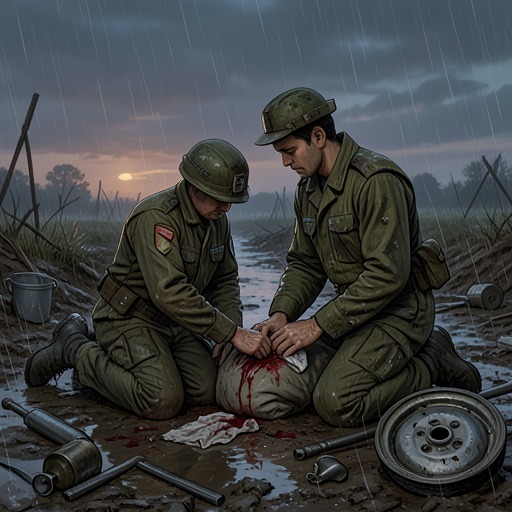
At the Battle of Borodino, Pierre enters the physical center of history without understanding its military importance. He is taken to the famous Knoll Battery, or Raevsky’s Redoubt, a position regarded by the French as the key to the whole battlefield. Ten guns fire through openings in its earthwork, with additional guns on either side and infantry behind them. Pierre does not recognize the redoubt as the decisive point; because he happens to be there, he assumes it is among the least significant parts of the field. He sits in a trench and watches with an unconsciously happy smile, moving about under fire while trying not to obstruct the soldiers.
His white hat and nonmilitary figure initially disturb the artillerymen. A young officer sternly orders him to stand aside, and the soldiers look at him with distrust. Their attitude changes when they see that he does no harm: he sits quietly, makes way for the men, and walks about as calmly as though on a boulevard. The soldiers begin to treat him with kindly, bantering sympathy, like the animals that live with a regiment. Pierre’s presence thus creates an unusual human perspective on battle. He is neither a commander nor a conventional hero; his innocence allows him to perceive the battery’s shared, almost familial animation, while his lack of military understanding prevents him from reducing the scene to strategy.
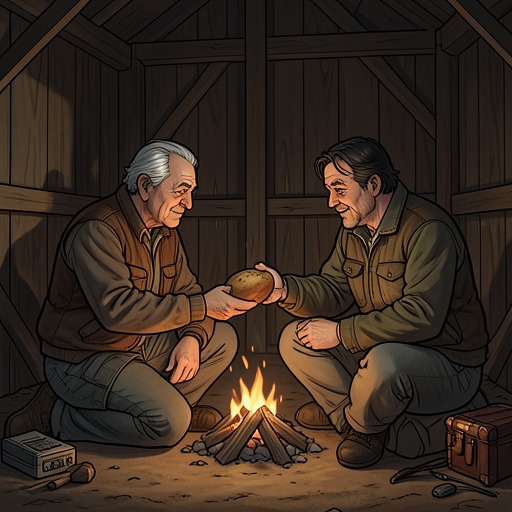
Pierre’s moral crisis deepens after the French occupation of Moscow. Following an execution, he is separated from the other prisoners and placed alone in a small, ruined, befouled church. A noncommissioned officer later tells him that he has been pardoned and takes him to the prisoners’ barracks, where some twenty men surround him. Pierre hears their questions but cannot understand their meaning. The murders he has witnessed were committed by men who did not wish to commit them, and the experience seems to wrench out the mainspring that had made the world appear alive. His faith in the right ordering of the universe, in humanity, and in his own soul collapses into a heap of meaningless fragments. This is not merely physical danger; it is the destruction of the explanatory system on which his previous moral life depended.
Liberation, Recovery, and Love
After his liberation, Pierre reaches Orel but does not immediately recover from captivity. On the third day, while preparing to travel to Kiev, he falls ill with what doctors call bilious fever and remains laid up for three months. The effects of deprivation and strain emerge only after the immediate ordeal has ended. During this period his memories are fragmentary: gray rainy and snowy weather, bodily distress, pain in his feet and side, the sufferings of other people, questioning by officers and generals, and the difficulty of obtaining conveyance and horses. He also learns of several deaths, including Petya Rostov, Prince Andrei, and Helene.
The post-captivity Pierre is marked less by a triumphant explanation than by a changed relation to experience. Earlier he sought perfection through systems, declarations, and institutions; after war, execution, captivity, and illness, the grand abstractions that once promised order have been stripped of their authority. What remains is a capacity for compassion and a more chastened awareness of human vulnerability. His transformation is therefore earned through collapse rather than conquest: he becomes more capable of life not because suffering has supplied an easy doctrine, but because suffering has made false certainties impossible.
That altered Pierre finally speaks openly about Natasha Rostova. When Natasha leaves the room, his confusion and awkwardness disappear, replaced by eager excitement. He asks Princess Marya Bolkonskaya for help, admitting that he knows he is not worthy of Natasha and that it is impossible to speak of love immediately, yet also confessing that he has loved her and her alone all his life and cannot imagine life without her. He cannot propose at present, but the possibility that she might someday become his wife—and that he might lose that possibility—terrifies him. Princess Marya advises him not to speak to Natasha at once, then tells him that she believes Natasha loves, or will love, him. Pierre responds with frightened hope, seizing her hand and asking whether he may believe in that future.
Narrative Role and Significance
Pierre’s trajectory combines social ascent with inward disorientation. Inherited wealth makes him powerful but not wise; marriage exposes his susceptibility to humiliation; Freemasonry gives language to his desire for virtue but cannot spare him from contradiction; war and captivity destroy his faith in abstract order; illness and bereavement leave him ready to value human attachment more directly. Each stage overturns the identity he had provisionally adopted, so that his development is best understood as a repeated revision of the self rather than a straight ascent.
His outsider’s perspective also gives the novel a way to examine institutions from within and without. In the drawing room he reveals the artificiality of polite society by failing to observe its rules. At the battery he exposes the gap between military significance and lived perception: the most important position on the field appears to him merely accidental. In captivity he confronts the terrifying machinery by which ordinary men perform violence they do not wish to perform. Pierre’s apparent ineptitude therefore becomes a form of moral perception. He is often unable to act efficiently, but his failures keep the novel’s social, military, and philosophical worlds from appearing self-justifying.
Pierre’s decisive movement is from borrowed answers toward lived responsibility. His confession to Princess Marya does not erase his awkwardness or declare that love has solved every problem; it shows him speaking with unusual clarity after a lifetime of hesitation. The possibility of a future with Natasha Rostova emerges alongside grief, death, and uncertainty, not outside them. Pierre’s significance lies in that combination of vulnerability and persistence: he remains recognizably himself while learning, through loss and fellowship, what it means to live for something more substantial than appearance, wealth, doctrine, or momentary impulse.