Platon Karataev
War and PeacePlaton Karataev is a peasant soldier of the Apsheron regiment whom Pierre Bezukhov meets in a French prison shed in Moscow. He is not a conventional hero, strategist, or political thinker. His importance lies in the form of life he carries into captivity: practical, bodily, communal, religious, and radically undivided between suffering and consolation. For Pierre, Karataev becomes the personification of “everything Russian, kindly, and round,” and the encounter with him transforms captivity from a condition of mere degradation into the setting of a profound inward reorientation.
Identity and Appearance
Karataev introduces himself simply as Platon Karataev and explains that his regiment calls him “little falcon”; the other prisoners also call him “Platosha.” He is a soldier, but military identity does not exhaust him. He tells Pierre that he was taken from a hospital in Moscow after suffering from fever, and that he and roughly twenty other men had been lying there without knowing what was happening. His account places him among the ordinary bodies swept up by the French occupation rather than among the commanders whose decisions produce the war.
His first impression on Pierre is created through movement before biography. In the darkness of the shed, Karataev removes his leg bands with deft, continuous circular motions, coils the strings, hangs them neatly on pegs, cuts something with a knife, and settles comfortably with his arms around his knees. The order of these small actions gives Pierre a feeling of something pleasant, comforting, and well rounded. Karataev's body is later described as round in nearly every respect: his head, back, chest, shoulders, arms, smile, and gentle brown eyes all seem rounded, while his French overcoat, soldier's cap, cord, and bast shoes frame a figure that appears ready to embrace rather than resist.
The apparent softness of this image does not mean weakness. Karataev is about fifty, though he does not know his exact age; he has strong, brilliantly white teeth, no gray in his beard or hair, a supple and enduring body, and an innocent, youthful face marked by fine wrinkles. During the first days of imprisonment he seems not to recognize fatigue or sickness. He can fall asleep immediately and rise ready for work, expressing this rhythm through the prayer, “Lord, lay me down as a stone and raise me up as a loaf!” His body is therefore not merely an object enduring captivity. It is the practical medium through which he inhabits the world, restoring order to each immediate task.
Speech, Work, and Daily Life
Karataev's speech has the directness and appositeness of someone who does not prepare a doctrine before speaking. His voice is musical and singsong, and he addresses Pierre with tenderness, calling him “friend,” “lad,” and “my dear fellow.” When Pierre is unable to answer because his jaw trembles and tears rise to his eyes, Karataev does not force an explanation. He immediately consoles him, saying, “Eh, lad, don't fret!” and turning suffering into a shared human condition rather than a private failure.
His proverbs do not form a consistent system in the manner of a philosopher. Karataev may say the opposite of what he said earlier, yet both statements can be right because each belongs to a particular circumstance. Among the sayings he repeats are “suffer an hour, live for an age,” “the maggot gnaws the cabbage, yet dies first,” and the thought that things happen not as people plan but as God judges. Their force comes from their fitness to the moment. Ordinary events that others might overlook acquire solemn significance when Karataev notices or recounts them, and Pierre feels that some of the folk sayings may even be Karataev's own inventions.
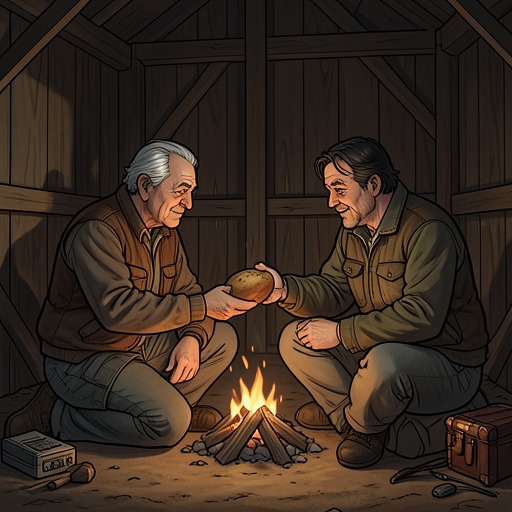
Karataev's care is concrete. He offers Pierre baked potatoes after Pierre has eaten nothing all day, cuts one into two equal halves on his palm, salts it from a rag, and shows him how to eat it. He makes shoes for Pierre from leather torn from a tea chest by a French soldier who had brought it for repairs. These acts do not arise from a plan of moral improvement. They are part of his instinctive way of handling whatever life places near him: a hungry neighbor receives food, damaged footwear is repaired, a dog is pushed away and then welcomed back, and the night's routine is completed with prayer.
His religious feeling is similarly woven into daily existence. Before sleep he prays, and he remembers Frola and Lavra as the saints of horses, insisting that animals must be pitied too. He treats the gray-blue bandy-legged dog that chooses him as its master with the same mixture of rebuke and affection that marks his treatment of human companions. In the shed, while cries and flames are visible outside, Karataev sleeps beside Pierre after the quiet exchange about prayer and food. The surrounding world has been shattered by occupation and execution, yet his regular breathing and ordered habits help Pierre feel that the world is beginning to stir again on new and unshakable foundations.
Relationship with Pierre Bezukhov
Karataev's relationship with Pierre is intimate without being possessive. He asks whether Pierre has a family estate, a house, a wife, parents, or children, and is distressed that Pierre has no parents, especially no mother. He invokes the importance of a mother and wishes Pierre a future in which he may have children and live in harmony. Yet he does not turn Pierre into a special companion whose loss would destroy him. Karataev loves the person who happens to be beside him, but not through exclusive attachment.
This absence of possessiveness is at first strange to Pierre. Karataev loves his dog, his fellow prisoners, the French, and Pierre himself, but Pierre understands that Karataev would not grieve for a moment if they were separated. Pierre gradually begins to feel the same way. The bond is therefore not founded on ownership, promise, or dependence. It is a form of immediate affection that gives full value to presence without demanding permanence.
Karataev becomes decisive in Pierre's transformation because he offers an embodied alternative to Pierre's previous search for inner harmony. Pierre had pursued peace through philanthropy, Freemasonry, the dissipations of town life, wine, heroic self-sacrifice, romantic love for Natasha Rostova, and reasoning, but each pursuit had failed. In captivity, through the horror of death, physical deprivation, and what he recognizes in Karataev, Pierre finds the tranquillity he had sought abstractly. Karataev does not explain this peace to him as a theory; he makes it perceptible through food, sleep, work, speech, sympathy, and acceptance.
Captivity, March, and Death
Karataev exists within a system that turns people into numbered prisoners and treats individual identity as administratively irrelevant. Pierre is first seen by a new guard not as a significant gentleman but as No. 17 of the captured Russians. He and the other prisoners are questioned by French authorities through formal procedures that exclude the essence of their experience and channel their answers toward conviction. The same impersonal force later appears when drums drown the groans of a sick prisoner and the corporal's familiar humanity is replaced by the cold behavior demanded by military orders.
Against this machinery, Karataev preserves a different scale of value. He remains attentive to potatoes, animals, stories, saints, family, and the moral beauty of ordinary life. For four weeks he stays in the men's shed with twenty-three soldiers, three officers, and two officials, and although the other prisoners remain indistinct in Pierre's later memory, Karataev remains vivid and precious. His individuality is not produced by rank or exceptional achievement but by the completeness with which he inhabits small acts.
After the prisoners leave Moscow, Karataev rejoins Pierre and the dog. On the third day he becomes ill again with the fever he had suffered in the hospital. As Karataev weakens, Pierre keeps away from him. He does not fully understand why, but the moaning and the stronger odor of illness make proximity difficult. This retreat is a painful limit in Pierre's response to Karataev: the man who has taught him that nothing in the world is terrible cannot prevent the ordinary human impulse to avoid sickness and death.
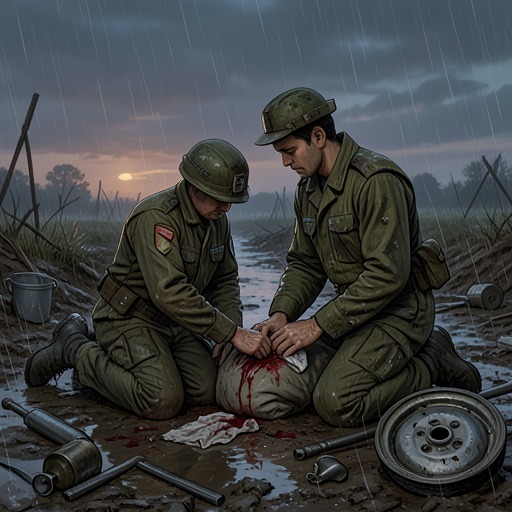
The final separation occurs on the march. Karataev sits beneath a birch tree with an expression of quiet solemnity and looks toward Pierre with tear-filled eyes, evidently wishing to say something. Pierre is not sufficiently sure of himself to approach and pretends not to notice. When the column moves on, Karataev remains behind. Pierre hears a shot, then sees two French soldiers running past, one carrying a lowered and smoking gun; behind him the dog begins to howl. Pierre continues calculating the stages to Smolensk and does not look back again. The scene refuses a consoling farewell. Karataev's death is registered through distance, evasion, the shot, and the animal's cry, while Pierre's continued movement shows how survival itself can require a morally painful failure of attention.
Narrative and Thematic Significance
Karataev's significance extends beyond his personal kindness. He stands within a novel that presents the French invasion of Russia as a catastrophe produced by vast movements of armies and circumstances rather than by a single explanatory intention. On June 12, 1812, millions crossed the Russian frontier, and crimes that would fill the law courts of centuries were committed by men who did not regard themselves as criminals. In Moscow, the French army enters in good marching order despite being tattered, hungry, worn out, and reduced to a third of its original number; once dispersed into deserted houses, it dissolves into marauders. Karataev belongs to the human cost of this historical machinery, but he is not reduced to its victimhood.
His presence also clarifies the contrast between institutional violence and lived moral relation. The executions, the prison examinations, the drums, and the marching orders reveal a callous force that compels people to kill against their individual impulses. Karataev's world works in the opposite direction: it makes a person visible through the immediate obligation to feed him, speak gently to him, repair his shoes, pity animals, and share the conditions of the night. The contrast does not imply that Karataev can defeat the military system. He is shot beside the road. It shows instead that the system's power does not define the whole of human reality.
For Pierre, Karataev's lesson is that happiness is within a person and arises from the satisfaction of simple human needs, while unhappiness comes from superfluity rather than privation. Pierre learns during the march that suffering and freedom have limits that are very near one another: bare, sore feet, damp earth, hunger, and captivity can be endured, while the anxieties of wealth, marriage, reputation, politics, and grand historical purpose lose their former authority. His intention of killing Napoleon, his calculations concerning the number of the beast of the Apocalypse, his anger toward his wife, and his fear that his name might be tarnished all become meaningless or even amusing.
Karataev therefore functions as a living recognition scene in Pierre's story. He does not provide a doctrine Pierre can simply repeat, and his contradictory proverbs resist conversion into a single formula. Instead, his rounded physical presence, his endlessly renewable routines, and his nonexclusive affection allow Pierre to recognize a form of freedom that exists inside constraint. Karataev dies as an anonymous prisoner on the road, but the memory of him remains Pierre's most vivid and precious memory of captivity: not an argument about history, but a human shape through which suffering, tenderness, faith, and endurance become inseparable.