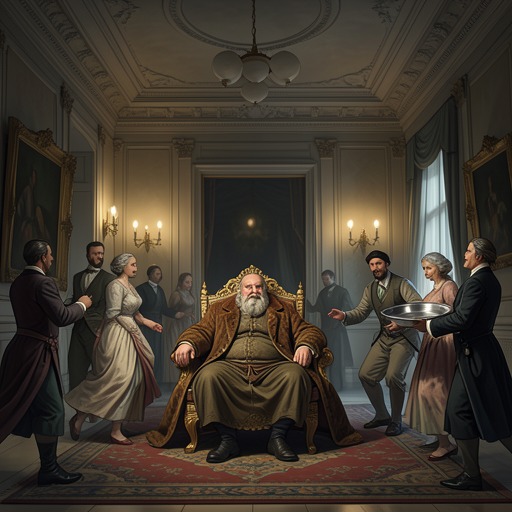
Rostopchin's killing of Vereshchagin
War and PeaceRostopchin's killing of Vereshchagin is one of the clearest scenes in War and Peace in which official power manufactures a public enemy and then releases collective violence against him. In a Moscow already threatened by the French, Count Fyodor Rostopchin seeks a victim for the city's catastrophe, names Vereshchagin as its cause, and turns accusation into execution. The scene exposes how command, performance, and panic can make a crowd participate in a killing while allowing the authority that initiated it to evade responsibility.
Causes and Political Theater
The killing begins with a crisis of authority. A turbulent crowd has gathered, demanding action against the French and shouting about treachery. Rostopchin watches it from the balcony in a fury that has not yet found a definite object. He thinks of the people as a rabble that has been roused by folly and recognizes, at least implicitly, that they want a victim because he himself wants one on which to vent his rage. The execution therefore does not arise from an established judicial process. It is an improvised answer to public fear, produced by a ruler who needs to make the disaster of Moscow appear attributable to a single person.
The arrival of the adjutant's question about Vereshchagin gives Rostopchin the object he has been seeking. Rather than investigate the accusation, he goes out to the crowd and promises that the villain will be dealt with before they face the larger political problem. His words are designed for immediate effect: he presents punishment as proof that he is still acting decisively. The crowd responds with approval because the performance offers a simple explanation for a catastrophe that is otherwise too large, impersonal, and humiliating to grasp.
Vereshchagin Before the Crowd
Vereshchagin is brought out between two dragoons in a condition that makes his vulnerability visible. His head has been partly shaved, his old blue coat is threadbare, convict trousers cover his legs, and heavy chains hamper his movement. He is emaciated, unused to work, and submissive as he takes the place Rostopchin indicates on the porch step. The physical details prevent the alleged traitor from appearing as the powerful enemy imagined by the crowd. He appears instead as a frightened young prisoner placed on display.
Rostopchin calls Vereshchagin the scoundrel by whose actions Moscow is perishing and claims that he betrayed his Tsar and country by going over to Napoleon Bonaparte. Vereshchagin raises his head as though hoping to speak or meet the count's eyes, but Rostopchin refuses that encounter. The count's accusation depends on preventing recognition of the accused as a person. His public language gives Vereshchagin a political identity—traitor, culprit, disgrace—while the narrative continues to show the weak body and hopeless face that the label suppresses.
From Command to Mob Violence
Rostopchin first tells the crowd to deal with Vereshchagin as it thinks fit, then, when hesitation follows, repeatedly commands it to cut him down. The difference between these formulations is crucial. He presents the killing as the people's judgment, but his commands direct the result; he claims to hand the prisoner over while actively pushing the crowd toward murder. His words have a performative force, yet their effect does not remain neatly under his control.
For a moment the crowd resists. It presses closer, breathes in the stifling space, and waits in fear for something unknown and terrible. Vereshchagin tries to appeal to the count by invoking the shared authority of God, but he cannot finish. The dragoon officer orders the soldiers to draw sabers, and one soldier strikes Vereshchagin on the head with the blunt side of his saber. The blow is not yet the whole killing; it is the breach through which the violence becomes irreversible.
Vereshchagin's meek cry of surprise and pain breaks the last barrier holding the crowd back. A moan of horror passes through the people, but pity is overwhelmed by the threatening roar from the rear. The crowd moves like a wave, carrying the front ranks toward the porch. Vereshchagin covers his head and rushes toward the people, while the tall youth who has stood beside him seizes his neck and falls with him beneath the struggling feet. The scene's violence is thus both commanded and contagious: an official order initiates it, a soldier's blow gives it bodily reality, and the crowd completes what no single command can fully contain.
Consequences and Narrative Significance
The episode reveals the instability concealed inside authoritarian decisiveness. Rostopchin appears to promise law to a crowd hungry for reassurance, but the punishment he stages is lawless. By calling Vereshchagin the cause of Moscow's ruin, he transforms a military and political disaster into an accusation against one defenseless body. The crowd receives an enemy it can see and strike, while the larger causes of defeat remain outside the scene's ritual of blame.
The killing also belongs to a broader pattern in which institutions make violence orderly before violence becomes chaotic. Russian soldiers at the front can maintain serene routines of cooking, mending, and preparing for battle even while punishment is administered in their midst; military discipline presents bodily coercion as moral correction. In Moscow, Rostopchin's balcony and porch provide a similar staging ground, but the formal chain of command collapses into collective assault. The difference is not the presence or absence of authority: both scenes show authority acting through the exposed body of a subordinate. The difference is that the Moscow crowd makes the mechanism visibly unstable.
The event gains additional force through its proximity to Pierre Bezukhov's experience of public brutality. Pierre witnesses a French cook accused of being a spy being flogged before a crowd and is shaken by the contrast between the victim's suffering and the spectators' attempts to suppress pity with jokes. Later, when prisoners are led to a post and a pit before French troops and a mixed crowd, Pierre feels that part of his soul has been torn away. These scenes place Vereshchagin's death within a larger wartime world where accusation, classification, spectacle, and punishment repeatedly reduce human beings to instruments of collective fear.
The killing is therefore not merely an isolated act of revenge. It is a study of how political panic seeks a body, how public speech converts suspicion into apparent fact, and how a crowd can be made to experience violence as duty. Rostopchin's authority is most revealing at the moment it seems strongest: he can point to the victim, define the crime, and give the order, but the resulting murder exposes the system of fear that made such an order possible and the moral responsibility that cannot be transferred to the mob.