Russian Imperial Army
War and PeaceThe Russian Imperial Army is the principal military institution through which War and Peace examines war as a social and material process rather than as the achievement of commanders alone. Its campaigns reveal an army shaped by inspection rituals, inadequate equipment, exhausted bodies, uncertain strategy, and the support or resistance of the population. Across the 1805 campaign and the French invasion of Russia, it survives not because its plans remain intact, but because its soldiers, officers, peasants, nobles, and townspeople contribute—often without fully understanding the historical significance of what they are doing—to a collective resistance.
Organization and Material Condition
In October 1805, the Russian army occupied Austrian villages and towns, while newly arrived regiments gathered near Braunau, the headquarters of Mikhail Kutuzov. One infantry regiment, after a twenty-mile march, was ordered to be inspected on the march. Because the order was ambiguous, the battalion commanders decided to present the regiment in parade order, following the principle that it was safer to bow too low than not low enough. The soldiers spent the night cleaning and mending themselves and their equipment instead of sleeping. By morning, two thousand men stood in precise formation, each knowing his place and duty, every button and strap in order, and every knapsack containing the prescribed articles, including an awl and soap.
This impressive appearance concealed a serious logistical failure. More than half the soldiers’ boots were in holes, not because of negligence by the regimental commander but because the Austrian commissariat had failed to issue replacements after the regiment had marched roughly seven hundred miles. The contrast between immaculate inspection readiness and ruined footwear establishes a recurring condition of the army: formal discipline can organize exhausted men, but it cannot abolish the physical limits imposed by distance, supply, weather, and transport.
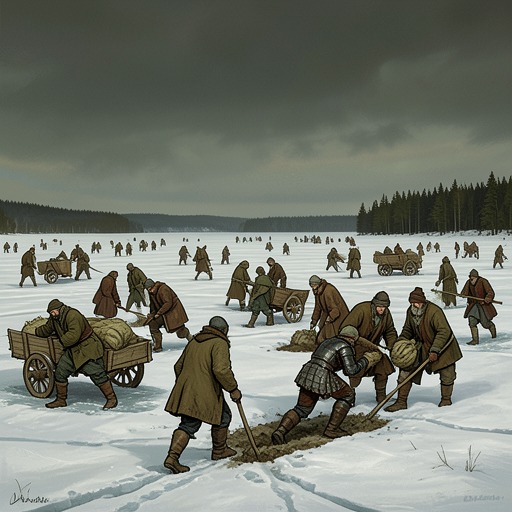
The same vulnerability appears during the Pavlograd Hussar Regiment’s service in the later campaign. Attached to Platov’s independent division, the regiment exchanged fire with the enemy, took prisoners, and even captured Marshal Oudinot’s carriages. Yet near a ruined German village, thaw, mud, broken ice, and impassable roads cut the regiment off from provisions and fodder. Soldiers searched abandoned villages for potatoes, found almost nothing, and sometimes gave their last rations to the remaining inhabitants rather than take from people who were already worse off than beggars. Although only two men had been wounded in action, nearly half the regiment was lost to hunger and sickness. Men suffering from fever or swelling caused by bad food preferred to remain on duty, since they believed death in the hospitals was certain; when spring came, they ate a plant resembling asparagus that they called “Mashka’s sweet root.”
Retreat, Command, and Military Experience
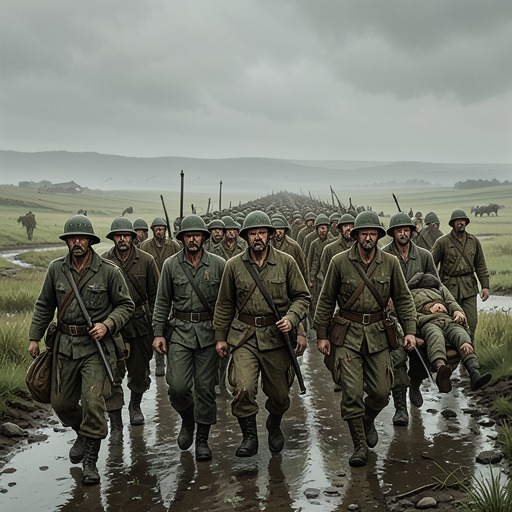
During the 1805 campaign, the Russian army of about thirty-five thousand men, commanded by Kutuzov, retreated along the Danube before a French army of one hundred thousand under Napoleon Bonaparte. The Russians faced an unfriendly population, diminishing confidence in their Austrian allies, shortages, and conditions unlike those anticipated by their strategic plans. They fought at Lambach, Amstetten, and Melk, but these actions chiefly enabled further retreat. After the Austrian troops who had escaped capture at Ulm separated from the army, Kutuzov was left with weak and exhausted forces, and the defense of Vienna became impossible.
The army’s remaining objective was therefore not a grand offensive but a junction with forces advancing from Russia, achieved without allowing the army to be destroyed as Mack’s forces had been at Ulm. After crossing to the left bank of the Danube on October 28, Kutuzov attacked Mortier’s division on October 30 and broke it up. The Russians captured banners, cannon, and two enemy generals. For the first time after a fortnight of retreat, they held the field after fighting and repulsed the French. The success did not erase their losses: the troops were ill-clad and exhausted, about a third of the army had been lost through death, wounds, sickness, or straggling, and hospitals in Krems could no longer accommodate all the sick and wounded. Kutuzov even left some casualties across the Danube under a letter entrusting them to the enemy’s humanity.
The novel places this experience beside the Russian command’s limited faith in abstract military cleverness. When Mikhail Kutuzov listens to reports and criticism of positions, he appears to regard strategic ingenuity, learning, and even patriotic eloquence as less decisive than the knowledge acquired through old age and experience. His only unsolicited instruction in the cited council concerns looting: when asked to sign a paper demanding compensation from army commanders for green oats cut by soldiers, he orders the document into the fire. The gesture links command not to administrative exactness alone but to a practical understanding of what soldiers do in the field and what forms of regulation matter amid war’s larger necessities.
By 1812, the Russian military situation again begins in uncertainty. As Western European forces moved toward the Russian frontier, Russian forces gathered in response, but at Vilna there was no general plan and no supreme commander over the three armies. Emperor Alexander I reviewed troops and attended maneuvers while plans vacillated and the court around him arranged balls, fêtes, and entertainments. The absence of unified direction contrasts with the army’s later capacity to act under pressure, suggesting that institutional survival does not depend on a single coherent design at the top.
National Mobilization and the Army’s Social Base
The Russian Imperial Army cannot be separated from the society that supplies its men, provisions, money, and moral legitimacy. At the Sloboda Palace in Moscow, nobles and merchants gathered in response to the danger facing the empire. The assembly combined a solemn expectation of national crisis with ordinary private concerns, but it nevertheless produced a concrete military commitment: the Moscow nobility and gentry resolved to furnish ten fully equipped men for every thousand serfs, as the Smolensk gentry had done. The decision shows how the army converts landholding wealth and dependent population into wartime manpower through collective obligation.
The Emperor Alexander I thanked the nobles for a devotion that had surpassed his expectations and urged them to act because time was precious. Yet the narrative resists reducing this mobilization to conscious patriotic sacrifice. During the French invasion, most people were guided chiefly by private interests rather than by an explicit understanding of the war’s general course. Those who acted unconsciously within their immediate circumstances often proved more useful than those who tried to perform heroic service for the nation. Pierre Bezukhov’s and Mamonov’s regiments, which looted Russian villages, and the young women’s lint that never reached the wounded become examples of well-intentioned action that fails because it is detached from practical conditions.
The army’s dependence on society is also visible in the treatment of Moscow. After the Battle of Borodino, the evacuation and burning of Moscow are presented not as the achievement of one official but as the consequence of a broader Russian response. Wealthier inhabitants departed, abandoning property, while poorer residents remained and burned or destroyed what was left. The movement was not simply obedience to Count Fyodor Rostopchin’s broadsheets. It expressed a latent and largely unspoken patriotism: people carried away what they could, abandoned houses and possessions, and left because their circumstances compelled them to do so, even while publicly being told that departure was shameful.
Moscow’s destruction exposes the reciprocal relationship between army and population. The French army entered a deserted wooden city, spread from the Kremlin through abandoned quarters, searched houses for valuables, and appropriated carriages and residences. Soldiers and officers alike were drawn into looting. The Fire of Moscow was consequently attributed by the French to Rostopchin’s fierce patriotism and by the Russians to French barbarity, but the narrative rejects the idea that a single person or group caused it. A wooden city without inhabitants or an effective police force, occupied by soldiers who smoked, lit fires, and cooked twice daily, was placed in conditions where conflagration was inevitable. Military occupation transformed the city’s wealth into a source of disorder, fire, and destruction for both the army and Moscow itself.
Guerrilla War and the Transformation of Warfare
The Russian response to invasion extends beyond the regular army. Scattered groups attacking concentrated bodies of enemy soldiers represent one of the clearest departures from the conventional laws of war. Rather than opposing one mass with another, such fighters disperse, strike individually, withdraw before superior forces, and attack again when opportunity appears. The Russian actions of 1812 are placed alongside guerrilla warfare in Spain and among mountain tribes in the Caucasus.
Calling this “guerrilla warfare” does not fully explain it, because the method contradicts the established tactical rule that an attacker should concentrate forces to achieve superiority at the decisive moment. Its effectiveness comes precisely from refusing that rule. The national character of the war changes the meaning of military strength: the army’s resistance is no longer confined to formations under direct command but is extended through mobile, irregular, and locally responsive groups. The regular Russian Imperial Army therefore appears as one component of a wider people’s war rather than the sole bearer of national action.
This broader military culture is contrasted with ceremonious European ideas of warfare. In the account of Russian resistance, the people do not meet invasion by saluting according to formal rules or politely handing over weapons to a magnanimous conqueror. At the moment of trial, they take up whatever weapon is available and strike until resentment yields to contempt and compassion. The image turns military action away from parade-ground decorum and toward improvised endurance, making the army’s strength inseparable from the emotional and physical resources of the population.
Collapse of the French Army and Russian Victory
The Russian army’s achievement is most visible in the destruction of the invading force. After October 28, when frost began, the French retreat became increasingly tragic. From Moscow to Vyazma, the French army fell from seventy-three thousand men, excluding the Guards, to thirty-six thousand, although no more than five thousand had been killed in battle. The army continued to diminish from Vyazma to Smolensk, from Smolensk to the Berezina, and from the Berezina to Vilna. The process is presented as a continuing disintegration rather than as a sequence determined by one battlefield, one temperature change, or one commander’s decision.
Beyond Vyazma, the French army ceased moving in three columns and compressed into a single mass. Berthier reported that the corps were almost disbanded: scarcely a quarter of the soldiers remained with their regimental standards, while the rest moved independently in search of food and a way to escape discipline. This collapse clarifies the Russian army’s strategic role. Its victory is not represented as the triumph of a flawless plan or a single stroke of genius, but as the result of sustained pressure, retreat, irregular attack, scarcity, climate, distance, and the enemy’s inability to preserve cohesion.
Historical and Narrative Significance
The Russian Imperial Army embodies the novel’s challenge to great-man explanations of history. The French invasion begins when millions cross the frontier, producing crimes, thefts, forgeries, arson, and murders on a scale that cannot plausibly be explained by one diplomatic note or one ruler’s isolated intention. Different contemporaries identify different causes—Napoleon Bonaparte’s ambition, Emperor Alexander I’s firmness, the Continental System, diplomatic mistakes, or injuries to the Duke of Oldenburg—but these explanations reveal partial viewpoints rather than a complete historical mechanism.
The army’s history likewise defeats the idea that military results can be read directly from plans. At Vilna, planning is paralyzed by competing proposals and divided command; in the field, material shortages and retreat shape conduct more decisively than theory. Boots, roads, food, horses, hospitals, and the movement of civilians determine what soldiers can actually do. The army survives through countless actions whose participants do not possess a full view of the whole, and the narrative repeatedly suggests that those most deeply involved in historical events understand their significance least.
The organization is therefore both a formal military body and a vessel for collective historical action. Its regiments display the precision demanded by inspection, endure hunger and sickness that no parade can conceal, retreat when strategic ambition has become impossible, and fight again when circumstances permit. Its endurance is reinforced by nobles who furnish recruits, civilians who evacuate or destroy property, villagers who withhold resources from the invader, and irregular groups that attack outside conventional tactics. The Russian Imperial Army’s decisive significance lies in this fusion of institution and society: its victory emerges from the accumulation of practical, often unconscious acts rather than from the will of a single commander.