Russian famine and military starvation
War and PeaceRussian famine and military starvation is one of the novel’s clearest demonstrations that military strength depends on material conditions. Russian formations repeatedly confront missing provisions, inadequate clothing and footwear, exhausted transport, impassable roads, disease, and the collapse of local supplies. Hunger reduces armies numerically and physically, but the soldiers’ responses also reveal habits of discipline, comradeship, humor, and endurance that preserve collective life under conditions designed to destroy it.
Supply, Marches, and the Physical Army
The condition appears early in the 1805 campaign, when a Russian army occupied Austrian villages and towns while newly arrived regiments settled near Braunau and burdened the inhabitants on whom they were quartered. A regiment that had marched roughly seven hundred miles reached the area with more than half its soldiers’ boots full of holes because the Austrian commissariat had not issued replacements. The regiment could still be made presentable for inspection: after a twenty-mile march, its men cleaned their uniforms, repaired their equipment through the night, and formed an immaculate array of two thousand soldiers. Yet the polished exterior concealed a basic logistical failure. The soldiers had the required articles in their knapsacks and even clean shirts beneath their uniforms, but many lacked serviceable boots, showing how ceremonial order could coexist with bodily exhaustion and inadequate supply.
The same contradiction shaped the retreat along the Danube. A Russian army of about thirty-five thousand men, pursued by a French army of one hundred thousand under Napoleon Bonaparte, was already suffering from short supplies, exhausted troops, an unfriendly population, and the loss of Austrian allies. The actions at Lambach, Amstetten, and Melk displayed Russian courage but brought no strategic relief; they merely enabled the army to retreat more rapidly. By the time the army crossed the Danube and fought at Krems, it had lost a third of its number through death, wounds, sickness, and straggling. Hospitals at Krems and in converted houses could no longer hold all the sick and wounded, while some abandoned men had to be entrusted to the enemy’s humanity. The narrative therefore treats supply and medical capacity not as background details but as forces that directly determine what an army can do.
The Pavlograd Regiment and Hunger as Attrition
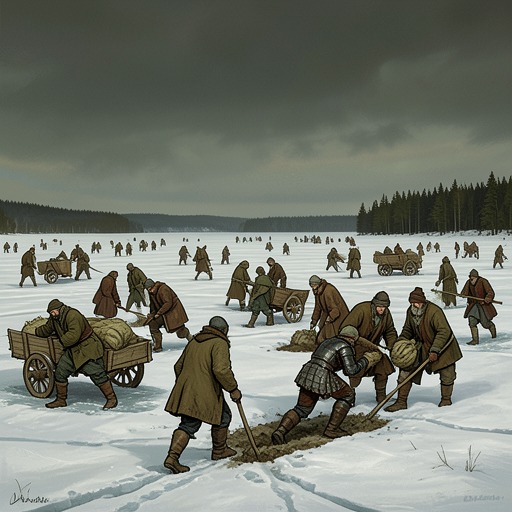
The most sustained picture of Russian starvation concerns the Pavlograd Hussar Regiment during the later campaign. The regiment had arrived too late for the first actions and was attached to Platov’s division, which operated independently of the main army. Its detachments exchanged fire with the enemy, took prisoners, and once captured Marshal Oudinot’s carriages, but its principal losses came not from battle. Near a ruined and deserted German village, a thaw made the roads impassable, the river ice broke, and transports could not reach the troops. For days neither provisions for the men nor fodder for the horses was issued.
The soldiers dispersed through abandoned villages searching for potatoes, yet almost everything edible had already been consumed and the inhabitants had fled. Even soldiers who were usually pitiless often gave the remaining inhabitants their last rations instead of taking anything from them. The regiment had suffered only two men wounded in action but had lost nearly half its men to hunger and sickness. In the hospitals, death seemed so certain that feverish soldiers and men suffering from swelling caused by bad food preferred to remain on duty; barely able to walk, they went to the front rather than enter the hospitals.
With spring, the troops found a plant that resembled asparagus and called it “Mashka’s sweet root.” Although it was bitter and had been declared poisonous by order of the authorities, soldiers wandered through the fields, dug it up with their sabers, and ate it. A new disease then appeared, marked by swelling of the arms, legs, and face, which doctors attributed to the plant. Denisov’s squadron nevertheless lived chiefly on it because the last biscuits were being distributed at only half a pound per man during the second week, while the last potatoes had sprouted and frozen. The episode makes starvation a chain of causes rather than a single shortage: failed transport produces foraging, foraging produces dangerous substitutions, and dangerous substitutions produce disease that further weakens the army.
The horses suffered alongside the men. For a fortnight they were fed on straw stripped from thatched roofs, becoming terribly thin while retaining tufts of matted winter hair. The loss of fodder threatened mobility itself, since cavalry could not remain effective without animals capable of marching and fighting. Hunger thus reaches beyond individual suffering: it erodes the means by which a regiment moves, carries equipment, maintains communications, and remains a military formation.
Discipline, Routine, and Collective Endurance
Starvation does not immediately dissolve military identity. Despite pale, swollen faces and tattered uniforms, the hussars still formed line for roll call, maintained order, groomed their horses, polished their arms, and hauled roof straw as a substitute for fodder. They sat around caldrons, rose hungry, and joked about the foul food and their hunger. In their spare time they lit bonfires, steamed themselves before the flames, smoked, baked sprouting rotten potatoes, and exchanged stories of the campaigns of Potemkin and Suvorov, as well as legends about Alesha the Sly and the priest’s laborer Mikolka.
The officers’ behavior also preserves a recognizable social structure. Senior officers tried to collect straw, potatoes, and whatever other food could be found for the men, while younger officers played cards or games such as quoits and skittles. The broader course of the campaign was rarely discussed because reliable information was scarce and there was only a vague sense that matters were going badly. In this silence, routine becomes a form of survival. Repeated acts of grooming, roll call, storytelling, and shared meals do not remove hunger, but they prevent hunger from becoming the only organizing fact of existence.
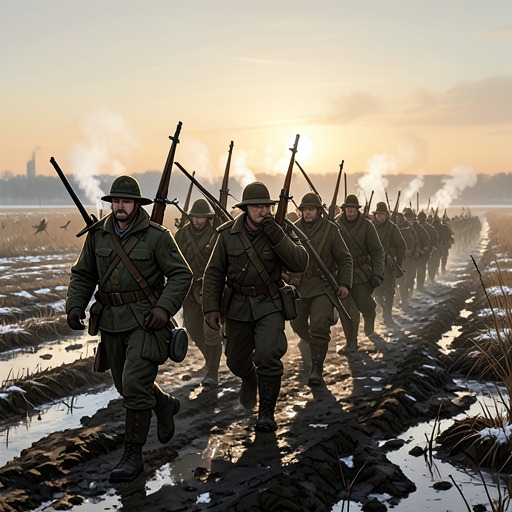
A related image appears later in the 1812 retreat, when Russian soldiers lack warm boots and sheepskin coats, have no roof over their heads, stand in snow during eighteen degrees of frost, and do not always receive full rations because the commissariat cannot keep pace. Contrary to expectation, the army appears more cheerful and animated than under the best material conditions. The explanation is selective survival: those who became depressed or lost strength had already been left behind, so the remaining force consisted of the physically and morally strongest. The cheerfulness is therefore not evidence that deprivation is harmless. It is the visible effect of an army that has been progressively stripped of its weakest members.
Hunger, Occupation, and the Destruction of Armies
The Russian experience is connected to a larger logic of wartime devastation. In 1812, millions of Western European troops crossed the Russian frontier, and war unleashed theft, incendiarism, false money, burglary, and murder on a scale that ordinary legal categories could not contain. The movement of armies consumed populations and supplies while transforming civilian spaces into sources of fuel, quarters, transport, and food. The Sloboda Palace gathering in Moscow, with nobles and merchants assembled under the portrait of the Emperor, represents the political face of mobilization; the hungry regiments and abandoned villages reveal its material cost.
When the French army entered Moscow, it was already tattered, hungry, worn out, and reduced to a third of its original number, though it remained in good marching order and still posed a military threat. Once dispersed among deserted wealthy houses, however, it ceased to function as an army and became a population of marauders. Soldiers sought food, valuables, houses, carriages, and provisions; officers who attempted to supervise them were drawn into the same appropriation. The city’s abundance did not restore the army. Instead, the famished force was absorbed by the rich and deserted urban environment, and looting helped produce the fires and destruction that consumed both the city and the army’s cohesion.
The Fire of Moscow is explained not simply by the intention of one individual or group but by the conditions created by evacuation and military occupation. A wooden city left without inhabitants and filled with soldiers who smoked, cooked twice a day, and burned Senate chairs for fuel was structurally liable to burn. In this sense, famine and military starvation belong to the same system as evacuation, requisition, and fire: once ordinary networks of residence, policing, supply, and repair disappear, the army’s need for food and shelter becomes a force of destruction.
Retreat, Attrition, and Narrative Significance
The consequences become most severe during the French retreat. After the frosts began on October 28, French soldiers froze or burned themselves at campfires while carriages carrying stolen property passed by. From Moscow to Vyazma, the French army fell from seventy-three thousand men, excluding the Guards, to thirty-six thousand, although no more than five thousand had been killed in battle. Its decline continued from Vyazma to Smolensk, from Smolensk to the Berezina, and from the Berezina to Vilna. Beyond Vyazma, the army abandoned its three-column formation and moved as one congested mass; scarcely a quarter of some corps remained with their standards, while the rest wandered away seeking food and escape from discipline.
The contrast with the Russian soldiers is revealing. Russian troops also endure cold, inadequate clothing, hunger, disease, and incomplete rations, but the surviving ranks maintain camp routines and collective identity. The French retreat instead displays an army whose cohesion has been eaten away by deprivation, occupation, loot, and the inability to separate military necessity from private acquisition. The difference is not presented as a simple triumph of courage over weakness. It arises from divergent relationships between soldiers, supplies, discipline, territory, and the population through which each army moves.
Russian famine and military starvation therefore complicates heroic explanations of war. Battles, commanders, and strategic designs matter, but their results are constrained by boots, fodder, roads, hospitals, weather, transport, and edible food. The condition also reveals the social endurance of ordinary soldiers: hunger may halve a regiment, produce disease, and kill men who refuse hospital care, yet those who remain still polish weapons, joke beside fires, share stories, and hold formation. War is consequently shown as both a contest of armies and a prolonged struggle over the physical limits of human and animal life.