Russian military discipline against marauding
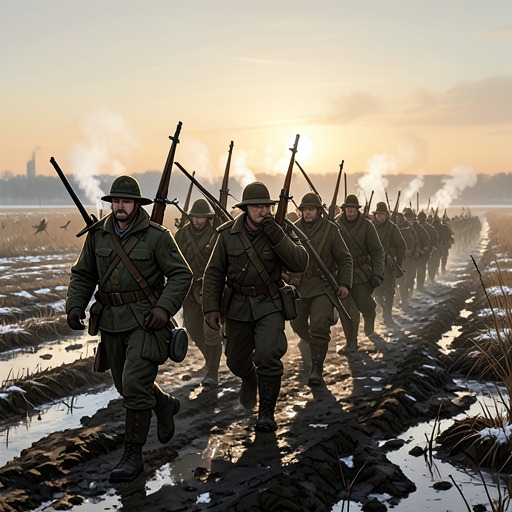
War and PeaceRussian military discipline against marauding is presented as a deliberate wartime rule rather than a matter of ceremony: soldiers are forbidden to seize food, fodder, or other property from territory being surrendered to the enemy. Its clearest purpose is to prevent retreat from becoming self-destruction. The rule protects the country left behind, restrains the army’s appetites, and distinguishes organized military movement from the uncontrolled violence of a fleeing or occupying force.
Definition and Military Purpose
The principle appears most explicitly in the Russian retreat of 1812. When Pierre Bezukhov asks why Russian troops are forbidden to take even firewood or hay while withdrawing, Prince Andrei Bolkonsky explains that the army must not lay waste to the country it is abandoning or accustom its soldiers to marauding. The restriction therefore has two connected objects: it preserves material resources for the population and prevents plunder from becoming a habit within the army. Military discipline is represented as a barrier against the transformation of soldiers into predators.
The rule also reveals a contrast between formal military order and the material realities of campaigning. A Russian regiment arriving at Braunau in October 1805 has marched roughly seven hundred miles, while more than half its soldiers’ boots are already in holes because the Austrian commissariat has failed to issue replacements. The men have spent a night cleaning themselves and their equipment for inspection, and the regiment can display two thousand soldiers in exact order, yet the damaged boots expose the distance between appearance, command, and supply. Discipline can regulate conduct, but it cannot manufacture missing equipment or erase exhaustion.
Discipline Under Retreat and Scarcity
The same tension becomes harsher in the Pavlograd Hussar Regiment’s experience during the 1807 campaign. Stationed for weeks beside a ruined German village during a thaw, the regiment receives neither provisions for the men nor fodder for the horses for days. The roads are impassable, transport cannot arrive, and the soldiers disperse through abandoned villages searching for potatoes. Yet the villages have already been stripped of food and their inhabitants have fled; when the soldiers encounter people poorer than themselves, they often give them their last rations instead of taking anything. The regiment loses nearly half its men to hunger and sickness, although only two have been wounded in combat.
This episode gives the prohibition a severe ethical and practical meaning. The army is not protected from suffering by its own restraint; indeed, restraint makes its deprivation visible. Feverish soldiers remain on duty because hospitals seem almost certain to bring death, and men barely able to walk return to the front. When spring brings up a plant resembling asparagus, the soldiers eat it and call it Mashka’s sweet root. The details of boots, fodder, potatoes, sickness, and improvised food show that military cohesion depends on supply as much as on obedience, while the ban on marauding marks the point at which necessity must not become license.
Contrast with Occupation and Pillage
The rule’s significance becomes unmistakable when set against the French occupation of Moscow. The French army enters the city reduced, hungry, and worn out, but still in marching order. Once the regiments disperse into deserted houses, however, the army ceases to function as an army and becomes a population of marauders. Soldiers occupy houses as lodgings, search cellars and storerooms, break open stable doors, and collect whatever appears valuable or useful. Five weeks later, they leave carrying their loot; their immediate aim is no longer conquest but retaining what they have stolen.
Napoleon Bonaparte’s attempts to restore discipline cannot reverse this change. Official reports state that looting continues despite decrees against it, that lawful commerce has disappeared, and that sutlers trade in stolen goods. Soldiers of the 3rd Corps are reported to have taken the last possessions of inhabitants hiding in cellars and to have wounded them with sabers. The contrast is not simply between a restrained Russian army and a disorderly French one; it demonstrates the narrative’s larger claim that an army which abandons discipline loses its military form. Once plunder becomes the organizing purpose, command survives on paper while the army becomes a mob burdened by its own acquisitions.
Discipline, Population, and Occupied Land
The prohibition also affects the relationship between armies and civilians. In the Bogucharovo district, peasants hear that French forces will pay for provisions taken from them, while Cossacks destroy deserted villages. A peasant brings back a hundred rubles in notes received in advance for hay, not knowing that the money is counterfeit. The episode shows how competing military powers attempt to shape civilian behavior through promises, threats, and the treatment of property. Russian military discipline against marauding is therefore part of a wider struggle over whether a retreating army will preserve a population’s trust or force it into flight, resistance, or collaboration.
The evacuation of Moscow is likewise portrayed as a social response larger than any individual order. Wealthier inhabitants leave with what they can carry, while poorer residents remain and burn or destroy what has been left behind. The action is not reduced to Count Fyodor Rostopchin’s proclamations; it arises from a collective sense that the city cannot safely be handed over intact. In this setting, the Russian prohibition on pillage belongs to the same moral field as the destruction of supplies and property before occupation: both deny the invader an easy use of the country, though one operates through military self-restraint and the other through civilian abandonment or destruction.
Discipline and the Limits of Command
The rule is finally tested by the impersonal force of war. Pierre Bezukhov’s arrest shows how individuals can be classified as suspects and reduced to a number, No. 17, while the authorities’ questions direct prisoners toward predetermined convictions. At the executions, drums, uniforms, and marching orders turn familiar men into instruments of a system. When a corporal who had once seemed approachable returns in marching kit and shuts the door on a sick prisoner, Pierre recognizes that the same callous force which governs executions has taken possession of ordinary acts of obedience. Entreaties no longer reach the person beneath the uniform; one must wait and endure.
This recognition complicates the ideal of military discipline. Rules can prevent marauding only while human beings remain capable of judgment within them. The French experience in Moscow shows discipline collapsing into pillage; Pierre’s captivity shows obedience becoming mechanical and destructive even without personal hatred. The Russian rule thus carries both practical wisdom and tragic vulnerability: it seeks to keep an army from consuming the land and people around it, but war repeatedly exposes how quickly institutions can be overwhelmed by hunger, occupation, fear, and command.
Historical and Thematic Significance
The principle supports the novel’s resistance to explanations that attribute war to the intentions of a few commanders. The French invasion of Russia begins with millions of people moving toward the frontier and with crimes committed on a scale no individual could fully direct. The rule against marauding does not stand outside that historical process; it is one of the concrete practices through which armies, populations, supplies, and discipline interact. Retreats are shaped by roads, boots, fodder, sickness, transport, and the availability of food no less than by plans or declarations.
Its deepest significance lies in the distinction between an army and an armed crowd. Russian troops may be exhausted, ill-clad, and materially neglected, yet their refusal to pillage the country they abandon preserves a form of collective responsibility. The French army, by contrast, enters Moscow as a battered fighting force and leaves as a marauding mob, carrying its stolen goods toward destruction. Russian military discipline against marauding therefore functions as both a military regulation and a moral measure: it records whether force remains subordinated to a shared order or has become merely organized appetite.