Russian partisan war of 1812
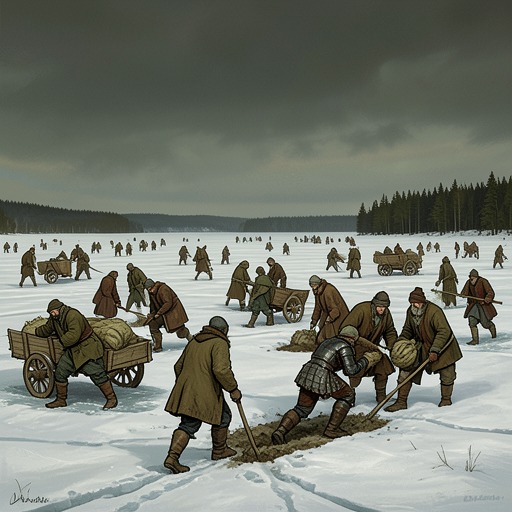
War and PeaceThe Russian partisan war of 1812 was the irregular resistance that emerged during the French invasion of Russia and became one of the principal forces wearing down the invading army. It was not a single battle or centrally uniform army, but a widening network of Cossacks, peasants, landowners, soldiers, and commanders who attacked stragglers, marauders, foragers, convoys, and isolated detachments. Its importance lies in the way it converted the population's dispersed hostility into sustained military pressure, helping turn the French advance into a retreat and reducing the Grand Armée piece by piece.
Definition and Historical Setting
The partisan war developed within a conflict that had already overturned ordinary assumptions about war. On June 12, 1812, the forces of Western Europe crossed the Russian frontier, beginning a campaign involving millions of people who transported, supplied, and accompanied the armies. The scale of the invasion made the conflict more than a contest between sovereigns or regular formations: it brought occupying troops into villages and towns, consumed local supplies, and exposed civilians to requisition, violence, and displacement. The resistance that followed therefore drew strength from the social landscape through which the French army moved.
The narrative presents the Russian partisan war as part of a broader national response rather than as the invention of one official institution. As the French advanced, Russian communities abandoned property, destroyed what could not be carried away, and refused to make occupation easy. The evacuation and burning of Moscow are described as consequences of a collective situation in which a deserted wooden city, occupied by soldiers, was highly vulnerable to fire; similarly, resistance grew from the interaction between an invading army and the population whose food, roads, homes, and local knowledge sustained it. The partisan war gave this hostility a mobile and violent form.
Methods and Departure from Conventional War
The defining feature of partisan warfare was the action of scattered groups against men concentrated in a mass. Instead of two compact armies meeting under an established tactical plan, small bands dispersed, attacked individuals or isolated groups, withdrew when faced by superior forces, and returned when circumstances offered another opening. This method directly contradicted the accepted military rule that an attacker should concentrate forces in order to be stronger at the moment of conflict. Its apparent disorder was therefore also its tactical advantage: the partisans refused to offer the French a single formation that could be surrounded, defeated, or compelled to surrender.
The war also loosened the boundary between military and civilian action. Cossacks and peasants destroyed French stragglers, marauders, and foragers before the government had formally recognized partisan warfare. The resistance was compared to dogs worrying a stray mad dog, an image that emphasizes instinctive persistence rather than parade-ground discipline. The conflict's national character made ordinary people participants in military destruction, whether or not they belonged to a recognized regiment or operated under a conventional chain of command.
Organization and Expansion
The so-called partisan war began with the French entry into Smolensk. Thousands of isolated enemy soldiers were already being killed by local forces, but Denis Davydov was the first to recognize systematically the military value of this irregular resistance. On August 24, Davydov's first partisan detachment was formed, after which other detachments received official recognition. The process did not replace spontaneous resistance; it gave one part of it a more regular structure while allowing many independent groups to continue operating beyond formal military arrangements.
By October, hundreds of detachments of different sizes and characters were active while the French army was fleeing toward Smolensk. Some adopted the methods of regular armies and possessed infantry, artillery, staffs, and material comforts. Others consisted only of Cossack cavalry. Still others were improvised groups of foot soldiers and horsemen, peasants, or landowners who remained unknown outside their local sphere. A sacristan commanded a group that captured several hundred prisoners in a month, while Vasilisa, the wife of a village elder, was said to have killed hundreds of French soldiers. These examples make the movement's breadth clear: its participants ranged from semi-regular commanders to figures whose authority arose from local initiative.
The movement passed through a learning process. At first, the partisans were astonished by their own boldness and feared being surrounded and captured; they hid in forests without unsaddling their horses, scarcely daring to dismount. By the end of October, experience had established practical limits. The fighters learned what could be attempted against the French and what could not. Large detachments with staffs still hesitated before actions that small bands, Cossacks, and peasants had already discovered were feasible. Irregular warfare thus developed not through a single plan but through repeated contact with the enemy and the gradual expansion of what resistance considered possible.
The Convoy Operations of Denisov and Dolokhov
A representative operation occurred on October 22, when Denisov and his group watched a large French convoy from a forest bordering the highroad. The convoy carried cavalry baggage and Russian prisoners and was separated from the main French army while moving toward Smolensk under a strong escort. Fyodor Dolokhov, commanding a smaller party nearby, also observed it, as did commanders of larger divisions who were preparing to attack. The anticipated convoy numbered about fifteen hundred men; Denisov had two hundred, and Dolokhov might have had roughly as many, yet the disparity did not prevent them from planning an assault.
The immediate objective was information. An earlier attack on wagons had been so hasty that all the Frenchmen with them were killed, leaving alive only a drummer boy who was a straggler and could provide no reliable knowledge of the column. Denisov judged a second attack on the wagons too dangerous because it might alert the entire convoy. Instead, he sent Tikhon Shcherbaty, a peasant in his party, to Shamshevo to seize at least one French quartermaster sent ahead. The attempt to capture a living source of intelligence shows that partisan warfare combined violence with reconnaissance: the irregulars did not merely strike at whatever appeared before them but adapted their methods to the problem of discovering the enemy's strength and movement.
Consequences and Narrative Significance
The partisan war weakened the French army by attacking the vulnerable edges created by its enormous size. Stragglers, foragers, marauders, baggage trains, and isolated groups could be destroyed without requiring the Russian army to win a conventional battle each time. The irregulars are figured as gathering the fallen leaves from a withered tree, the French army, and sometimes shaking the tree itself. The metaphor shifts attention from the celebrated decision of a single commander to the cumulative effect of innumerable local actions.
This form of warfare also completes the movement from imperial war to people's war. The invasion began as an operation initiated by rulers and armies, but its endurance depended increasingly on the actions of communities and individuals who were not waiting for elaborate orders. Cossacks, peasants, landowners, recognized officers, and obscure local leaders occupied different social positions, yet their efforts converged against the occupying force. The result was not a neatly centralized national army but a flexible resistance whose very diversity made it difficult to suppress.
The partisan war therefore challenges military narratives centered on formal strategy and heroic command. Earlier Russian operations had been shaped by retreat, exhausted troops, broken communications, inadequate supplies, and the pressure of a much larger French force. The irregular detachments added another kind of pressure, one rooted in roads, forests, villages, local knowledge, and the refusal of the population to act as a passive resource for occupation. By the time the French were retreating toward Smolensk, the resistance had become extensive, experienced, and confident enough to treat actions once considered impossible as ordinary opportunities. Its decisive contribution was cumulative: it helped ensure that the French invasion could not preserve the mass, mobility, and supply system on which its apparent power depended.