Russian retreat of 1812
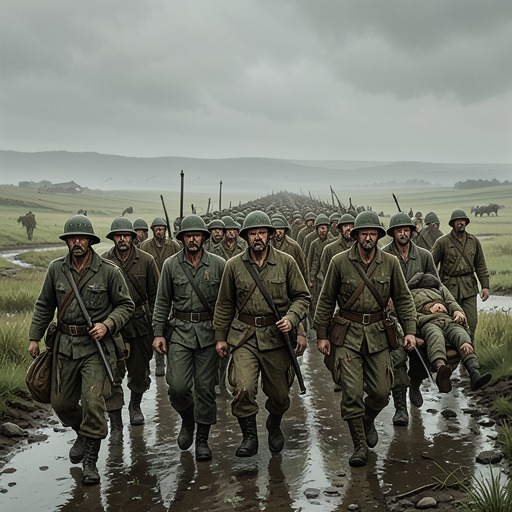
War and PeaceRussian retreat of 1812 is the prolonged withdrawal of the Russian army before Napoleon’s invasion, but it is not presented merely as a series of backward marches. It is a state of military exhaustion, logistical crisis, political resistance, and social transformation. Russian commanders repeatedly retreat because they cannot safely confront the advancing French forces, while the retreat itself lengthens the invader’s supply line, intensifies Russian hostility, empties and destroys resources, and ultimately helps produce the collapse of the French army.
Definition and Historical Setting
Russian retreat of 1812 begins within the larger catastrophe of the French invasion of Russia. On June 12, 1812, the forces of Western Europe crossed the Russian frontier, and millions of men entered a conflict whose crimes and destruction exceeded any simple explanation by diplomatic notes, individual ambitions, or official causes. The movement of armies had begun well before the invasion: Western European forces were concentrated and drawn eastward, while Russian forces were similarly assembled near the frontier. The retreat therefore unfolds as the response of an immense military machine to another immense military machine, not as an isolated decision by one commander.
The narrative explicitly challenges the later belief that the Russians deliberately planned from the beginning to lure Napoleon deep into the country. Russian historians attribute the supposed strategy to different figures, including Pfuel, Toll, a French adviser, or Emperor Alexander I, but the account insists that the facts contradict this retrospective construction. The Russian armies were initially divided, and their immediate aim was to unite rather than to retire. The Emperor joined the army to encourage the defense of every inch of Russian soil, disliked every step backward, and could not bear the thought of allowing the French to reach Smolensk, much less of abandoning Moscow. The enormous camp at Drissa was formed without an intention of retreating farther, and Alexander I was displeased when Smolensk was abandoned and burned without a general engagement beneath its walls.
This distinction between intention and consequence is central to the meaning of the retreat. What later appears as a coherent plan was, at the time, experienced as a succession of forced decisions, failures of communication, changing conditions, and attempts to preserve the army. The retreat is therefore both an event in military history and an example of historical processes that acquire apparent design only after their outcome is known.
Material Conditions of Withdrawal
The physical burden of retreat is made visible through the army’s ordinary necessities. In 1805, the Russian army’s earlier movements already revealed the vulnerability of military organization to supply. At Braunau, a regiment that had marched twenty miles through Austria was kept awake all night cleaning and repairing itself for inspection. Its two thousand men appeared perfectly ordered by morning, yet more than half their boots were full of holes after a march of roughly seven hundred miles because the Austrian commissariat had failed to issue replacements. The contrast between parade discipline and damaged equipment anticipates the later retreat’s deeper truth: outward order cannot remove the material limits imposed by roads, clothing, food, and transport.
The same constraints become catastrophic in the Pavlograd Hussar Regiment’s campaign. Stationed near a ruined and deserted German village during the spring thaw, the regiment endured mud, cold, broken ice, and impassable roads. For days no provisions or fodder arrived, and the soldiers dispersed through abandoned villages searching for potatoes, finding almost nothing because the inhabitants had fled and the available food had already been consumed. The men, usually capable of ruthless requisitioning, sometimes gave the remaining inhabitants their last rations instead. Although only two soldiers had been wounded in action, nearly half the regiment was lost through hunger and sickness. Feverish soldiers and men suffering from the swelling caused by bad food avoided hospitals, where death seemed certain, and dragged themselves back to duty; when spring came, they ate a plant resembling asparagus that they called Mashka’s sweet root.
In 1812, the retreat takes place across an increasingly hostile landscape. After Smolensk, troops march through heat and drought along a highroad covered by dust more than six inches deep. Infantry sink ankle-deep into the choking road, while artillery and baggage wagons move through dust rising to the hubs of their wheels. The cloud settles in the eyes, ears, hair, and nostrils of men and animals and enters their lungs; even at night the road offers no relief. Such descriptions delay the reader’s attention on bodily abrasion and mechanical difficulty, making the retreat perceptible not as an abstract arrow on a map but as a continuous assault on flesh, animals, vehicles, and cohesion.
The early campaign of 1805 provides another military precedent. Pursued by a French army of one hundred thousand under Napoleon Bonaparte, Kutuzov’s Russian force of thirty-five thousand retreated along the Danube, fighting rearguard actions only when necessary to save its heavy equipment. Actions at Lambach, Amstetten, and Melk did not halt the withdrawal; they produced an even more rapid retreat. Austrian troops who had escaped capture at Ulm and joined Kutuzov at Braunau later separated from him, leaving him with weak and exhausted forces. The defense of Vienna became impossible, and the remaining aim was to join the Russian forces advancing from Russia without suffering the destruction that had overtaken Mack at Ulm.
Yet even this retreat contains a temporary reversal. After crossing to the left bank of the Danube, Kutuzov attacked Mortier’s division at Krems and broke it up, capturing banners, cannon, and two enemy generals. After a fortnight of withdrawal, Russian troops had halted, held the field, and repulsed the French. They were still ill-clad and exhausted, had lost a third of their number through death, wounds, sickness, and straggling, and could no longer accommodate all their sick and wounded in hospitals. The victory therefore does not erase the retreat; it shows how a retreating army can preserve itself through limited, purposeful engagements without converting survival into a general offensive.
From Smolensk to Moscow
By 1812, the French advance gathers force precisely because the Russian army keeps yielding ground. The invading army, drawn from a dozen European nations, moves toward Moscow with increasing momentum. Behind it lie seven hundred miles of hunger-stricken and hostile country; ahead are only a few dozen miles to its goal. Each advance therefore seems to confirm its power, while every Russian withdrawal increases hatred of the enemy and allows the Russian army to consolidate.
The collision at Borodino interrupts but does not immediately reverse this movement. Neither army is destroyed, yet the Russian army retreats after the battle, moving eighty miles beyond Moscow. The French reach the city and then stop. The narrative compares the invasion to a falling body whose speed grows as it nears the earth, then to a ball that recoils after striking another body with greater momentum: Borodino does not destroy the invading force, but it deprives its advance of the force that had carried it forward.
The retreat creates a crisis of interpretation immediately after Borodino. On the evening of August 26, Kutuzov and the Russian army believed the battle had been a victory. Kutuzov reported it as such to Emperor Alexander I and ordered preparations for another conflict, not to deceive anyone but because he knew that the French had been beaten in the experience of those who had fought. Further reports then revealed losses so immense that another battle was physically impossible: half the army had apparently been lost, and time was required to gather the wounded, replenish ammunition, count the dead, and appoint officers to replace those who had fallen. The retreat thus emerges from the tension between moral victory and material incapacity.
Pierre Bezukhov’s journey toward the army gives the retreat a civilian witness. After seeing a tortured Frenchman and the crowd at Lobnoe Place, Pierre decides that he must leave Moscow and go to the army at Mozhaysk. At Perkhushkovo he learns that a battle has taken place at Shevardino; the earth had trembled from the firing, but no one could tell him who had won. Approaching Mozhaysk at dawn, he finds every house occupied by soldiers and the roads filled with Cossacks, infantry, cavalry, wagons, caissons, and cannon. The deeper he enters this moving sea of troops, the more he feels that personal comfort, wealth, and even life are negligible beside the impulse to undertake and sacrifice something. His response does not alter the army’s movements, but it shows how the retreat and impending battle transform private consciousness into a willingness to participate in collective danger.
Evacuation, Moscow, and the Social Retreat
The retreat cannot be separated from the evacuation of Moscow. After Borodino, the abandonment and burning of the city are presented as inevitable consequences of the military situation rather than as the achievement of one official. The same pattern had already occurred in towns and villages beginning with Smolensk: wealthy inhabitants departed with what they could carry, abandoning houses and property, while poorer people remained and destroyed what was left. Their conduct is described not as theatrical patriotism or obedience to public slogans but as an unobtrusive, organic response to the recognition that the city could not safely remain intact under occupation.
The city’s evacuation is therefore a social extension of the army’s retreat. Rostopchin’s broadsheets called departure shameful and represented those who left as cowards, yet people went because they understood that leaving was necessary. The first to depart were rich and educated inhabitants who knew that other cities occupied by Napoleon had not necessarily been destroyed. Their movement shows that the decision was not simply produced by official propaganda or fear of French atrocities. Property, households, and civic life withdrew ahead of the army, leaving the invader a city stripped of its normal social and economic structure.
When the French enter Moscow, the deserted city becomes an apparent reward that conceals a strategic disaster. Soldiers spread outward from the Kremlin through the city as water percolates through sand. They seize houses, quarrel over quarters, rush to abandoned stores, and search for valuables. Officers who try to restrain them are drawn into the same appropriation. In Carriage Row, generals choose abandoned caleches and coaches; the few residents who remain invite commanding officers into their homes in the hope of protection from plunder. The French army, famished after its long advance, disperses into wealth rather than finding a functioning base.
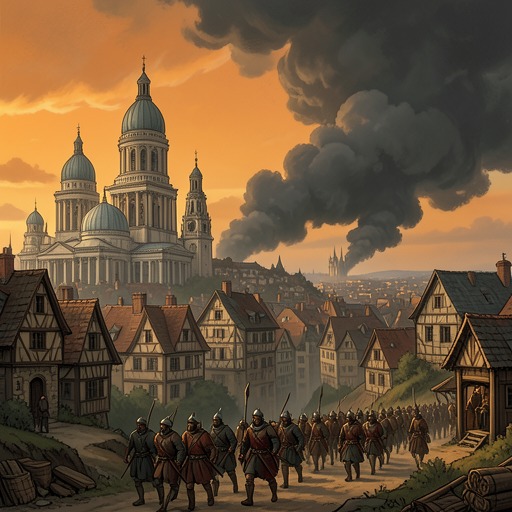
The Fire of Moscow is likewise detached from the responsibility of a single instigator. The French attribute it to Rostopchin’s fierce patriotism, while the Russians attribute it to French barbarity, but the narrative rejects both explanations as insufficient. A wooden city abandoned by its inhabitants and occupied by soldiers who smoke, build fires from Senate chairs, and cook twice a day is bound to burn. The fire is the material consequence of evacuation, occupation, combustible construction, and military disorder. In this sense, Moscow’s destruction is the urban equivalent of the retreat: a collective process in which individual intentions are overtaken by conditions created by the war.
Consequences and Historical Significance
The retreat changes the balance of the campaign even before the French begin their return journey. After Moscow, the French remain stationary for five weeks. They are compared to a bleeding, mortally wounded animal licking its wounds. When they suddenly flee toward the Kaluga road, their movement is not explained by a fresh decisive cause. At Malo-Yaroslavets the French retain the field, yet they undertake no further serious battle and retreat rapidly toward Smolensk, beyond Smolensk, across the Berezina, beyond Vilna, and farther still. The Russian withdrawal has allowed the invader to reach its goal, but the goal has become a trap without supplies, intact civic infrastructure, or a viable forward position.
The retreat also helps generate a national form of war. As regular armies withdraw and the occupation spreads, dispersed groups attack men concentrated in masses, withdraw before stronger forces, and strike again when opportunity appears. This Russian form of guerrilla warfare in 1812 violates the accepted tactical rule that an attacker should concentrate forces to achieve superiority at the moment of conflict. Its effectiveness depends on refusing the kind of organized collision that conventional military doctrine treats as decisive. The retreat therefore does not mean that resistance has ceased; it redistributes resistance from formal battlefields to scattered attacks carried out across the occupied country.
The French withdrawal reveals the cumulative consequences of the Russian retreat and the war’s material conditions. After October 28, when frost begins, the French flight becomes more tragic: men freeze or roast themselves beside campfires while vehicles carrying stolen property pass them. From Moscow to Vyazma, the French army falls from seventy-three thousand men, excluding the Guards, to thirty-six thousand; no more than five thousand of the loss is attributed to battle. The army continues to melt away at essentially the same rate from Vyazma to Smolensk, from Smolensk to the Berezina, and from the Berezina to Vilna, regardless of the varying intensity of cold, pursuit, blocked roads, or other local conditions. Beyond Vyazma, the three columns compress into one mass, and Berthier reports that the corps are almost disbanded, with scarcely a quarter of the soldiers remaining under their regimental standards while the rest scatter in search of food and escape from discipline.
The Russian retreat thus ends not in a simple restoration of the prewar balance but in a transformed military and social order. It begins against the wishes of commanders and civilians who want to defend Russian ground; it proceeds through rearguard actions, damaged boots, hunger, disease, dust, abandoned towns, and the evacuation of Moscow; and it creates the spatial depth, popular hostility, and logistical exhaustion that undermine the French advance. Its decisive significance lies in this reversal: what looks like passive loss of territory becomes an active process of denying the invader the conditions required for victory.