Russian serfdom
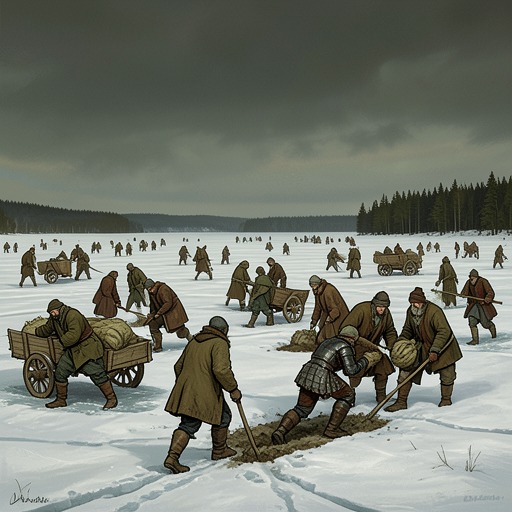
War and PeaceRussian serfdom is the system through which noble estates depend on the labor and legal subordination of peasant communities. In War and Peace, it is rarely introduced as an abstract institution; instead, it appears through fortunes measured in serfs, inheritance disputes, estate management, reformist promises, family finances, and the daily knowledge that aristocratic comfort rests on other people's constrained lives. The narrative gradually shifts from treating serfs as units of wealth to examining the peasant as a worker, judge, and person whose knowledge determines whether an estate can function.
Wealth, Rank, and Inherited Power
Russian serfdom is first visible in the scale of aristocratic property. When Count Peter Kirilovich Bezukhov's succession is discussed, the fortune at stake includes forty thousand serfs as well as millions of rubles. This calculation makes the system's human basis unmistakable: social rank and economic power are expressed through ownership of land and the people attached to it. The uncertainty over whether Pierre Bezukhov or Prince Vasili Kuragin will inherit the count's property therefore concerns not only money but control over an immense dependent population.
The same order governs the social world of Saint Petersburg and Moscow. At Anna Pavlovna Scherer's gathering, Prince Vasili Kuragin's family moves easily through the highest circles, while Pierre's illegitimate birth and foreign education are discussed in relation to the fortune he may inherit. The conversation treats the number of serfs as evidence of wealth and dynastic importance, revealing how completely the institution has been absorbed into polite society's ordinary language of marriage, reputation, and succession.
Pierre Bezukhov's Reforming Intentions
After joining the Masonic Brotherhood, Pierre Bezukhov travels to the Kiev province, where he possesses the greatest number of his serfs, carrying written instructions for the management of his estates. He tells his stewards that measures will be taken to free the serfs and, until then, that they must not be overburdened with labor. Women nursing infants are not to be sent to work; assistance is to be provided; punishments are to be admonitory rather than corporal; and hospitals, asylums, and schools are to be established on the estates.
Pierre's program exposes the contradiction between benevolent intention and inherited mastery. The stewards do not receive his announcement as a straightforward ethical transformation. Some fear that he is investigating mismanagement and embezzlement, others are amused by his lisp and unfamiliar vocabulary, and the cleverest—including the chief steward—immediately consider how his idealism can be used for their own ends. His plan thus encounters not only administrative resistance but the institutional habits created by serfdom itself: the owner imagines reform from above, while intermediaries control the information and practical power through which reform would have to operate.
The Peasant as Laborer and Judge
The later account of Nikolai Rostov's estate management gives the most sustained positive revaluation of the peasant within the supplied material. After marrying Princess Marya Bolkonskaya and moving to Bald Hills, Nikolai pays his debts, acquires additional land, and hopes to buy back Otradnoe. Farming begins as a necessity but becomes his favorite and almost sole occupation. He rejects theoretical treatises, expensive innovations, factories, costly products, and fashionable English methods, preferring to consider the estate as an integrated whole.
For Nikolai, the decisive element is not nitrogen in the soil, oxygen in the air, manure, or special plows, but the peasant laborer who makes all those instruments effective. The peasant is not merely a tool: he is also a judge of farming and an end in himself. Nikolai initially watches the serfs and pretends to direct them while learning their methods, speech, and judgments about what is good or bad. Only after understanding their tastes and aspirations, grasping the hidden meanings of their words, and feeling akin to them does he begin to manage them confidently.
This knowledge produces concrete administrative results. Nikolai appoints as bailiff, village elder, and delegate the men whom the serfs themselves would have chosen if they had possessed that right, and those appointments remain stable. Before calculating manure or entering what he ironically calls the debit and credit, he finds out how many cattle the peasants own and increases the number by every possible means. He also keeps peasant families together in the largest groups possible rather than allowing them to divide into separate households. His success therefore depends on recognizing collective experience, even though the legal structure still places the peasants under his authority.
Serfdom and the Wider Social Order
The institution connects private household life to public hierarchy. Aristocratic families organize marriages, inheritances, debts, and plans for survival around estates whose value is inseparable from peasant labor. During the crisis before the abandonment of Moscow, Count Ilya Rostov gathers rumors and gives hurried orders for departure while Sonya Rostova directs the packing and practical organization of the household. The scene centers on a noble family under pressure, but the background remains an estate-based order in which property, dependents, and family resources must be moved, preserved, or sacrificed together.
The novel also places this social order beside military and imperial hierarchies. At Braunau, Mikhail Kutuzov inspects a regiment whose general condition is praised, yet the soldiers' boots are visibly poor. The scene recalls the gap between official organization and the bodily conditions of the people who sustain it. In Petersburg, Prince Andrei Bolkonsky is welcomed by reformers partly because freeing his serfs has earned him a reputation as a liberal, while conservative circles approach him because he is the son of Prince Nikolai Bolkonsky. Serfdom thus becomes a political sign as well as an economic reality: liberation gives a nobleman social distinction, but the very recognition of the act confirms that the underlying system remains normal.
Moral and Narrative Significance
Russian serfdom is presented through a gradual defamiliarization of aristocratic wealth. At first, a fortune can be stated in the language of millions and tens of thousands of serfs, as though people were simply another measure of property. Pierre Bezukhov's reforming speech interrupts that automatic perception by naming labor limits, nursing women, punishments, hospitals, schools, and eventual emancipation. Nikolai Rostov's later practice deepens the interruption by showing that peasant knowledge is indispensable to successful management and that the peasant cannot be reduced to an agricultural instrument.
Yet the narrative does not claim that sympathetic administration abolishes domination. Pierre remains the owner issuing commands through stewards, and Nikolai's respect for peasant judgment operates within a system in which peasants do not have the right to choose their own officials. The contrast between Pierre's abstract humanitarian program and Nikolai's attentive practical knowledge therefore reveals two incomplete responses to serfdom: reform imagined as benevolent policy from above, and paternal management grounded in close observation. Together they make the institution visible as both a foundation of Russian aristocratic life and a moral problem that cannot be resolved merely by more efficient or kinder ownership.