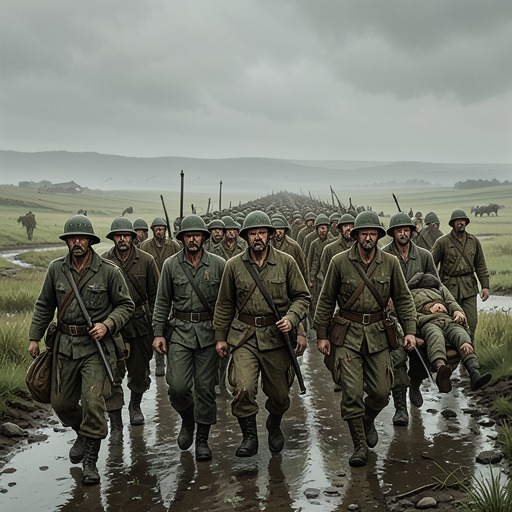
Smolensk
War and PeaceSmolensk is a Russian city whose significance in the novel extends far beyond its military position. It is a headquarters, a threatened provincial center, a place of evacuation and burning, and a marker of the widening gulf between official confidence and lived reality. Through Smolensk, the narrative turns the French invasion into a social and material catastrophe: armies consume fields, inhabitants abandon homes, hospitals overflow, and the city's destruction becomes inseparable from the wider Russian response.
Strategic City and Wartime Corridor
Smolensk appears within a war already governed by movement, supply, and retreat. In 1805, the Russian army was operating in Austria under Mikhail Kutuzov, while newly arriving regiments struggled with the practical burdens of long-distance campaigning. The army's condition was shaped by roads, provisions, clothing, and transport: the Pavlograd Hussar Regiment later lost nearly half its men from hunger and sickness despite suffering only two men wounded in action, and soldiers preferred remaining on duty to entering hospitals where death seemed almost certain. Against this background, Smolensk belongs to a geography in which strategic plans are continually tested by physical conditions.
By 1812, the Western European armies had crossed the Russian frontier on June 12, and millions of men were moving across the country. Smolensk stood along the route of that invasion and retreat, linking the fate of the field army to the fate of towns, farms, merchants, and displaced families. The city was therefore not merely an objective on a military map. Its roads carried troops and baggage trains, its fields supplied fodder, and its population absorbed the pressure of armies whose numbers and needs exceeded the capacity of the surrounding countryside.
Alpatych's Arrival and the Collapse of Reassurance
Yakov Alpatych reached Smolensk on the evening of August 4 after baiting his horses twice on the road and passing baggage trains and troops. Distant firing did not initially impress him. What arrested his attention was a splendid field of oats being mown down by soldiers for fodder. The detail exposes the war's material logic: a prosperous harvest, still standing in the field, could be transformed in moments into military supply. Yet Alpatych soon returned mentally to the orders of Prince Nikolai Bolkonsky, because for more than thirty years the prince's will had bounded his interests.
At the inn kept by Ferapontov, where Alpatych had lodged for three decades, ordinary confidence confronted unmistakable panic. People were leaving the city, but Ferapontov dismissed their fear of the French and repeated the belief that official orders would keep the enemy out. Alpatych likewise muttered that the alarm was merely women's fuss. During the night, however, troops moved constantly past the inn, and by morning cannon fire had joined the musketry. The rhythms of harvesting and lodging continued beside the sounds of battle, producing a stark contrast between routine and invasion.
Alpatych's attempt to obtain official guidance revealed how quickly authority had become defensive rather than reassuring. He delivered letters from General-in-Chief Prince Nikolai Bolkonsky to the civil administration, and the Governor told him to inform the prince and Princess Marya Bolkonskaya that he had acted only on higher instructions. He advised them to go to Moscow, but a frightened officer arrived before he could finish. The Governor then handed Alpatych a written assurance from Mikhail Barclay de Tolly declaring that Smolensk was not in the slightest danger, that Barclay and Prince Pyotr Bagration were marching to unite their forces, and that the combined armies would defend the province until victory or the death of the last soldier.
The document's confidence is immediately contradicted by the streets. Carts loaded with household utensils, chairs, and cupboards emerged from courtyards; women wailed farewell; and families prepared to abandon their homes. At Ferapontov's inn, a woman begged to be taken away with her children, while the cook reported that Ferapontov had beaten and dragged her. The city's crisis thus appears not only in cannon fire and governmental dispatches but also in domestic violence, hurried departures, and the disintegration of household security.
Abandonment, Burning, and the Civilian War
The abandonment of Smolensk becomes an epoch in Prince Andrei Bolkonsky's life. As commander of a regiment, he is absorbed in managing the men, receiving and issuing orders, and protecting the welfare of his officers and soldiers. The troops march through choking dust with handkerchiefs tied over their noses and mouths, rushing to wells when they pass villages and drinking until the water is muddied. In this setting, Prince Andrei becomes considerate and kind to the soldiers under his command; they call him "our prince," take pride in him, and love him.
His relation to the war changes because Smolensk's burning and abandonment give his anger a concrete object. He believes the city could and should have been defended, and he is further darkened by news that his sick father, his son, and his sister have fled to Moscow, leaving Bald Hills to pillage. Yet his regiment offers him a sphere of immediate responsibility distinct from the abstract questions that had once occupied him. The city therefore marks both a national loss and a personal reorientation: the destruction of a place turns Prince Andrei away from his former social circle and toward the men whose daily survival depends on him.
The narrative treats the evacuation and burning of Moscow as part of the same process already visible in Smolensk and other Russian towns and villages. Wealthier inhabitants leave with what they can carry, abandoning houses and possessions, while poorer people remain and destroy what is left. This conduct is presented not as a spectacular policy devised by one official but as an unobtrusive, organic form of patriotism. The people do not need to be persuaded by proclamations that departure is shameful; they leave because the approaching occupation makes remaining with their property impossible.
Smolensk Within the Larger War
Smolensk's significance is sharpened by the novel's rejection of explanations that assign immense historical events to a single person. The French and Russians later attribute the Fire of Moscow to opposing individual causes, but the narrative argues that a wooden city left deserted and filled with soldiers, campfires, smoking pipes, and cooking fires was bound to burn. The same logic informs Smolensk's place in the campaign: its fate arises from the interaction of armies, civilians, supplies, roads, fear, and military necessity rather than from one commander's will.
The city's role also reflects the recurring contrast between official plans and actual conditions. The Russian army's retreat from the Danube in 1805 had been forced by pursuit, hostile populations, inadequate supplies, exhausted troops, and the loss of allies; at Krems, a successful stand could restore confidence but could not erase the human cost. In 1812, the same material pressures reappear on a larger scale. Smolensk is encountered by travelers amid firing, transport columns, fleeing households, and fields requisitioned for fodder, making the consequences of strategy visible at ground level.
Later developments confirm that Smolensk is one stage in a broader cycle of military expansion and disintegration. After the French entered Moscow, their reduced and exhausted army dispersed through deserted houses, became a population of marauders, and eventually abandoned the city carrying away stolen goods. During the retreat, the army was reduced from seventy-three thousand men to thirty-six thousand between Moscow and Vyazma, with no more than five thousand lost in battle; from Vyazma through Smolensk and onward to the Berezina and Vilna, it continued to melt away. Smolensk consequently stands between invasion and retreat, a place through which the army passes but which exposes how war destroys the cohesion of the force that claims to possess it.
Narrative and Historical Significance
Smolensk functions as a threshold where familiar civic life becomes a wartime landscape. Alpatych's concern with harvests and orders, Ferapontov's confidence, the Governor's reassuring paper, the inhabitants' loaded carts, and Prince Andrei's regiment all occupy the same space, but they no longer belong to the same reality. The city makes visible the moment when administrative language loses authority and physical events take command.
Its destruction also enlarges the novel's account of national resistance. Resistance is not confined to formal battles. It includes the refusal or inability of civilians to leave useful resources for the occupier, the exhaustion of soldiers searching for food, the abandonment of homes, the burning of towns, and the gradual transformation of invasion into a struggle with distance and supply. Smolensk is therefore both a military location and a social instrument of the war: its roads carry the armies, its fields feed them, its inhabitants deprive them of shelter, and its ruin records the cost of survival.
Finally, Smolensk embodies the novel's anti-heroic understanding of history. Commanders issue confident instructions, governments assign responsibility, and armies pursue strategic objectives, but the decisive forces emerge from accumulated physical and collective actions. A city burns, a regiment weakens, a family flees, or an army disintegrates through conditions that exceed any single intention. Smolensk matters because it concentrates those conditions into one place and makes the passage from organized war to national catastrophe unmistakably concrete.