Tikhon Shcherbaty
War and PeaceTikhon Shcherbaty is a peasant from Pokrovsk near the Gzhat River who becomes an indispensable member of Denisov's partisan band. Sent to seize a French prisoner for information, he repeatedly turns danger, physical hardship, and even his own wounds into occasions for useful action and rough comedy. His importance lies not in rank or polished military discipline but in the practical intelligence and bodily toughness with which he attacks the French, gathers intelligence, captures weapons and prisoners, and survives conditions that would defeat more conventionally organized forces.
Identity and Introduction
Tikhon first appears as the kind of irregular fighter whom a formal army would scarcely know how to classify. Denisov sends him to Shamshevo to seize a French quartermaster, a “tongue,” because the partisan detachment needs information about a French convoy estimated at fifteen hundred men. Denisov has only two hundred men, with perhaps as many more under Fyodor Dolokhov, and considers a second attack too dangerous without knowing what enemy troops are present. Tikhon is therefore assigned a task in which stealth and local initiative are more valuable than numbers.
His appearance immediately distinguishes him from the mounted soldiers around him. He approaches through the wet forest with long, light steps, wearing a short jacket, bast shoes, and a Kazan hat, with a musketoon over his shoulder and an ax thrust into his belt. His wrinkled, pockmarked face and narrow eyes shine with suppressed amusement. The combination of peasant clothing, improvised weapons, and self-satisfied merriment makes him a figure of war outside parade-ground order: visibly rough, but precisely adapted to the work Denisov requires.
From Village Peasant to Partisan
When Denisov first comes to Pokrovsk and questions the village elder about the French, the elder initially gives the guarded answer customary among village elders. Once Denisov explains that he intends to kill Frenchmen, the elder identifies Tikhon as the one man who deals with such matters. Denisov invokes loyalty to the Tsar and the country and the hatred that sons of the fatherland should feel toward the French, but Tikhon answers that he and the other villagers only “fooled about with the lads for fun.” He admits that they had killed “a score or so” of Frenchmen while insisting that they had done no other harm.
The language is revealing. Tikhon does not present himself as a solemn patriot or a professional soldier. His violence begins in the practical, almost mischievous register of village resistance, and the narrative preserves that earthy scale even as the killing becomes part of a national war. After Denisov leaves Pokrovsk, Tikhon attaches himself to the partisan party and asks to remain. Denisov permits it, and the peasant's place in the detachment grows out of demonstrated usefulness rather than formal appointment.
At first Tikhon performs rough camp duties: laying fires, fetching water, and flaying dead horses. He soon proves naturally suited to partisan warfare. At night he goes out for booty, returning with French clothing and weapons, and, when ordered, with French captives. Denisov removes him from drudgery, takes him on expeditions, and enrolls him among the Cossacks. Tikhon dislikes riding and proceeds on foot, yet never falls behind the cavalry. His service thus depends on mobility of a different kind: he is most effective when moving through woods, marshes, villages, and enemy positions by means no regular formation can easily imitate.
Methods, Weapons, and Reputation
Tikhon's weapons are as improvised and versatile as his role. He carries a musketoon almost as a joke, together with a pike and an ax. The ax is not merely a tool or a symbol of peasant labor. He uses it with the adaptability of an animal, splitting logs at arm's length, carving small pegs and spoons by holding its head, and applying the same instrument to whatever ugly or difficult task the detachment requires. The weapon collapses the distance between domestic labor and combat: the implement of village work becomes an instrument of attack, survival, and capture.
The partisan band treats Tikhon as its answer to every unusually difficult assignment. When a cart must be pushed from mud, a horse pulled from a swamp by its tail, a carcass skinned, a French position entered secretly, or more than thirty miles covered in a day, the men point laughingly toward him and say that the task will not hurt “that devil,” who is as strong as a horse. His strength is therefore not an isolated physical trait; it is the collective shorthand by which the detachment recognizes the kind of work conventional military categories leave unmeasured.
His courage is matched by a capacity for self-mockery. A Frenchman once shot him in the fleshy part of the back while Tikhon was attempting a capture. Tikhon treated the wound only with internal and external applications of vodka. The Cossacks turned the injury into a continuing joke, asking whether he would do it again and whether the shot had given him a twist. Tikhon joined in, deliberately writhing, making faces, pretending anger, and cursing the French in comic fashion. The wound changed his behavior only in one practical respect: afterward he seldom brought in prisoners. Otherwise, pain became part of the humorous identity through which he remained integrated into the band.
That comic role does not lessen his military importance. He is described as the bravest and most useful man in the party. No one finds more opportunities to attack, and no one captures or kills more Frenchmen. Precisely because his effectiveness is so extreme, he becomes the buffoon of the Cossacks and hussars—and accepts the position willingly. Tikhon joins the detachment's laughter without surrendering the fearsome capability that produced its respect.
The Failed “Tongue” and Its Consequences
Denisov's mission to Shamshevo shows both Tikhon's strengths and the danger of his independence. He is sent overnight to capture a “tongue,” but instead of returning with the first Frenchman he takes at dawn, he decides that the prisoner is not good enough and goes back to find a more suitable one. Whether he has become dissatisfied with a single captive or has slept through part of the night, he ends up creeping by daylight into bushes among the French and is detected.
The French pursue him through the marsh, firing as he runs. Tikhon plunges into the stream, disappears for an instant, emerges black with wet, and escapes on all fours. From above, the esaul and Denisov watch the episode; Denisov responds with vexation, while the esaul admires the man's clever escape. When Tikhon returns, he removes his sodden hat, throws something into the bushes, and approaches with a face beaming with self-satisfied amusement. Asked where he has been, he answers boldly that he went to get Frenchmen.
His explanation makes the failed operation characteristic rather than exceptional. He says that he captured one man first, took him into the forest, judged him useless, and went to fetch a better one because he knew what sort of prisoner Denisov wanted. The decision is reckless, but it also expresses a rough form of mission-centered intelligence: Tikhon understands that the purpose is not simply to possess a captive but to obtain useful knowledge. His initiative improves the objective in theory even as it compromises the immediate operation in practice. The result is a comic clash between Denisov's need for reliable information and Tikhon's unruly confidence in his own judgment.
Narrative Role and Significance
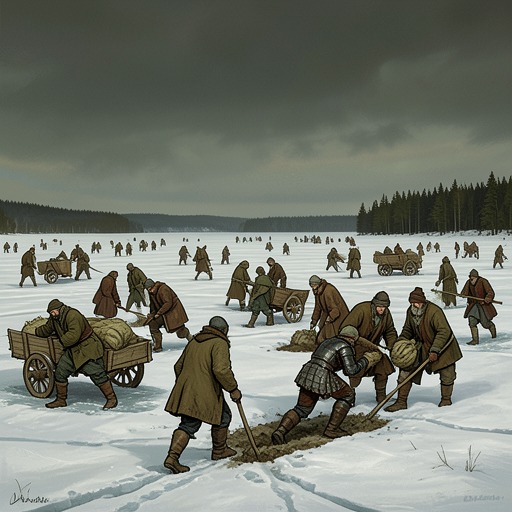
Tikhon gives the partisan war a human scale grounded in bodies, tools, hunger, mud, and improvisation. The regular Russian army is repeatedly shown under material pressure: at Braunau, a regiment can appear perfectly ordered after a twenty-mile march and an all-night cleaning, yet more than half its boots are in holes after a journey of roughly seven hundred miles; elsewhere, troops lose men through hunger and sickness when provisions and fodder fail. Against this background, Tikhon's bast shoes, ax, foot travel, and ability to operate in swamps make him a concentrated image of adaptation to wartime scarcity.
His methods also clarify the novel's contrast between formal military plans and the war actually experienced by soldiers and peasants. Large armies retreat, lose supplies, and disintegrate under conditions their commanders cannot master. The French army later melts away between Moscow and Vyazma, while the partisan detachment works through small acts of seizure, reconnaissance, pursuit, and ambush. Tikhon does not command a grand movement, but his repeated interventions help create the dispersed pressure through which an invading army is denied rest, information, and security.
The character is therefore both comic and grim. His pockmarked face, bast shoes, muscular ingenuity, drunken treatment of a gunshot wound, and willingness to become the detachment's joker make him vividly individual. Yet his tally of Frenchmen killed, his attempt to capture prisoners, and his movement through enemy territory place him within the broader violence of the Russian partisan war. Tikhon turns the peasant's practical world into a weapon, and the narrative uses his laughter not to erase violence but to show how ordinary people absorb, reshape, and survive it. He stands as a memorable embodiment of a war in which endurance and local resourcefulness can matter as much as military rank, polished appearance, or strategic theory.