dog
War and PeaceThe dog is one of the novel’s recurring animals, appearing not as a single character but as a shifting presence across aristocratic amusement, country sport, military movement, battlefield destruction, and wartime deprivation. Dogs help reveal the material conditions of human life: they are companions, hunting instruments, signs of social order, creatures exposed to violence, and survivors whose instincts continue beneath the collapse of human institutions.
Dogs in Social and Domestic Disorder
At Anatole Kuragin’s house, dogs belong to a scene of reckless male entertainment. Pierre Bezukhov arrives after cards and supper, amid empty bottles, cloaks, overshoes, alcohol, shouting, and laughter. The immediate spectacle is a young bear being pulled by its chain, while several young men crowd around an open window and place bets. Although the dog is not the central animal of this episode, the surrounding atmosphere establishes the social world in which animals are treated as instruments of amusement and danger. Human revelry, alcohol, gambling, and the handling of a chained creature merge into one noisy display of irresponsibility.
The contrast is important because elsewhere dogs are associated with trained coordination and purposeful activity. In the Kuragin episode, animal presence intensifies disorder; in the hunting scenes at the Rostov estate, dogs are embedded in a highly organized rural economy, with huntsmen, kennels, horses, calls, leashes, and carefully managed packs. The difference exposes two forms of aristocratic life: destructive diversion in the city and inherited practical ritual in the countryside.
Hunting Dogs and Nikolai Rostov’s Sporting World
The dogs at the Rostov estate are part of Nikolai Rostov’s passionate identity as a sportsman. In the autumn, the hounds have reached hard winter condition but are so exhausted that the huntsmen decide to rest them for three days before setting out toward an oak grove where wolf cubs have been left undisturbed. The setting is rendered through seasonal change: morning frost, wet earth, winter rye, buckwheat stubble, golden and red copses, half-molted hares, fox cubs beginning to scatter, and young wolves already larger than dogs. The dogs therefore belong to a complete ecological and social arrangement rather than serving as decorative background.
When Nikolai goes out onto the muddy porch, Milka, a black-spotted, broad-haunched bitch, rises, stretches, lies down like a hare, and then leaps up to lick his nose and mustache. Another borzoi rushes from the garden path, arches its back, lifts its tail, and rubs itself against his legs. These gestures give the animals distinct physical habits and a lively relation to their master. The intimacy is practical and affectionate at once: the dogs recognize Nikolai, and their bodies register the excitement of the coming hunt before the chase has begun.
The hunt is organized by sound as much as by sight. Daniel, the old head huntsman and kennelman, sends his voice through the woods in alternating deep bass and piercing tenor, while the hounds’ cry indicates that they have found the wolf. The pack divides into two groups, their voices receding, mingling, and separating again. Leashes become entangled, borzois strain forward, and the hunting party interprets small changes in the animals’ cries. The dogs turn the forest into an audible map, converting distance, direction, and pursuit into a sequence of signals understood by experienced humans.
Nikolai’s emotional investment is concentrated in the hope of taking an old wolf. Memories of Austerlitz and Fyodor Dolokhov make him feel unlucky both at cards and in war, but the hunt offers a different possibility of fulfillment. When the gray-backed, reddish-bellied wolf suddenly runs across the open field, the moment arrives without ceremony. The dogs initially fail to understand the situation; old Karay scratches for fleas and bares his yellow teeth. Nikolai whispers the hunting call, the borzois prick their ears, and then he releases them and charges downhill on horseback as they race ahead. The dogs transform his desire into motion, making the long-awaited success depend on instinct, timing, and the trained relation between animal and hunter.
Dogs Beside War and the Battlefield
Dogs also occupy the edges of military experience, where the novel repeatedly places ordinary life beside organized violence. During the Russian retreat through Austria, Russian troops cross the Enns in rain and confusion, while baggage trains, artillery, and marching columns crowd the town. The army’s movement depends on horses, wagons, roads, bridges, and human bodies, and dogs belong to this moving military environment even when they are not singled out as heroes or symbols. Their presence helps preserve the texture of a world in which warfare is inseparable from animals used for transport, food, hunting, and companionship.
The same material world becomes harsher in the Pavlograd regiment’s prolonged deprivation near a ruined German village. Men search abandoned settlements for potatoes, find almost nothing, and often give villagers the last of their rations rather than take from them. Nearly half the regiment is lost to hunger and sickness although only two men have been wounded in action. In such passages, animals and soldiers are linked by the basic demands of nourishment and endurance: military collapse is measured not only by battles but by the failure of provisions, fodder, roads, and bodily strength.
At the battery during the Battle of Borodino, animal life is caught directly in destruction. Pierre is sent toward ammunition wagons after the battery runs out of charges. A blast annihilates the wagons, scattering charred boards and rags across the scorched grass; one horse runs past with fragments of its shaft dangling behind it, while another lies on the ground uttering prolonged cries. The horse’s suffering interrupts any romantic image of battle. The explosion destroys equipment, wounds or kills animals, and leaves Pierre confronted with the physical consequences of military action rather than its strategic meaning.
The Nameless Dog in Captivity
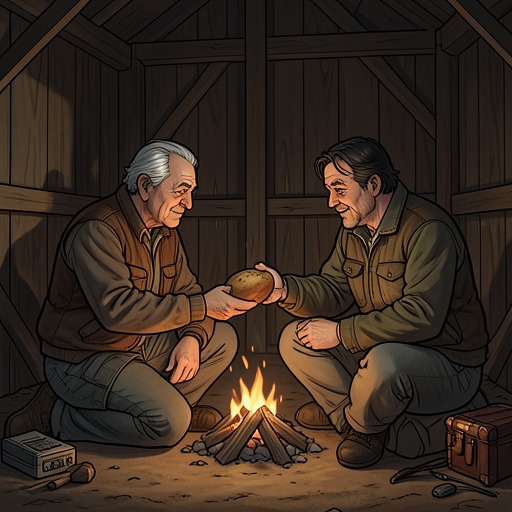
The most sustained canine presence belongs to the small blue-gray dog that lives in Pierre’s shed during captivity. It has a long body, short bandy legs, and no fixed master, name, breed, or even definite color. The French call it Azor, one soldier calls it Femgalka, and Platon Karataev and the others call it Gray or Flabby. The competing names do not stabilize the dog’s identity; instead, its lack of ownership becomes part of its condition. It belongs to nobody, yet it repeatedly returns to the shed and sleeps beside Karataev.
The dog’s behavior is presented as self-sufficient and exuberant. It rolls on its back, yelps with delight, basks in the sun with an air of importance, and plays with a chip of wood or a straw. Its plume-like tail, awkward legs, and habit of lifting one hind leg while running on three make it physically comic, but the comedy is not merely ornamental. The dog continues to experience pleasure despite the absence of secure ownership, social status, or human explanation. Its existence provides Pierre with a small, immediate object of attention amid captivity, hunger, and uncertainty.
The animal also marks Pierre’s transformation. By this point Pierre wears a dirty torn shirt, soldier’s trousers tied at the ankles with string, and a peasant coat and cap. His beard and lice-infested hair show the collapse of his former appearance, while his eyes have become calm, resolute, and alert. The dog and Pierre thus share a stripped-down condition in which former identities have lost their force. Yet the dog is not simply a mirror of Pierre: it remains absorbed in its own movements, appetites, and pleasures, offering an independent rhythm of life within the prison camp.
Survival, Death, and Narrative Significance
On October 22, during the French retreat, the same dog runs merrily beside the road, alternately hopping on three legs and racing on all four. It is sleeker and happier than it had been in Moscow because the roadside is covered with the decaying flesh of men and horses, and the passing soldiers keep wolves away, allowing the dog to eat freely. The image is deliberately unsettling. The dog’s improved condition depends on a landscape produced by mass death, so vitality and atrocity occupy the same frame.
This contrast prevents the dog from becoming a sentimental emblem of innocence. Its cheerfulness is real, but it is also ecological and bodily: it feeds where food is available, moves where it can, and survives without interpreting the catastrophe around it. Human armies disintegrate through hunger, cold, sickness, pursuit, and failed supply; the dog prospers temporarily through carrion. The comparison exposes how war reorganizes the relations between species, turning roads into feeding grounds and corpses into the basis of another creature’s endurance.
Across the novel, dogs therefore move between domestication and freedom, training and instinct, luxury and starvation. The hunting packs embody aristocratic order and inherited skill; the dogs around military life register the dependence of war on animal bodies; the nameless blue-gray dog survives the collapse of ownership and rank. Their recurring presence broadens the novel’s account of history beyond commanders and battles. Animals do not determine the war’s political outcome, but their bodies reveal its costs with unusual directness, while their persistence supplies a counterpoint to human ambitions, discipline, and ruin.