Ave Maria
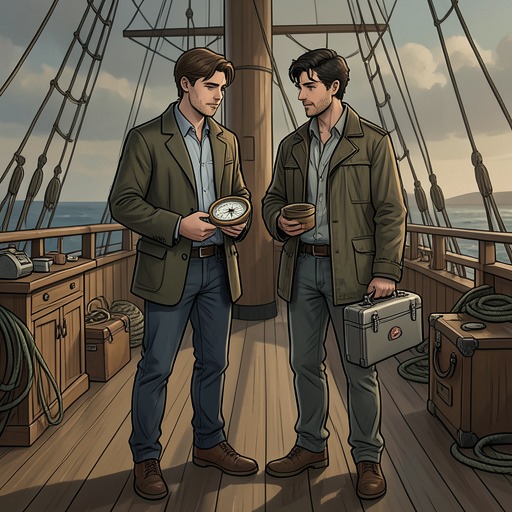
Washington BlackThe Ave Maria is the ship that takes Washington Black and Titch aboard after their Cloud-cutter comes down on its deck in a storm, turning a wreck into an uncertain route toward freedom. A heavy, English-outfitted brig reinforced for northern waters, it is at once a working vessel with its own cargo, crew, and hazards and the temporary refuge of two fugitives whose presence threatens to complicate its voyage.
The Collision and Rescue
The ship enters Washington’s account through the violence of the storm and the abrupt fact of survival: he and Titch do not die, but are hauled, soaked and gasping, from the water into the Ave Maria’s swaying hold. The vessel is already struggling with the weather. Water pours through the hatch whenever it shifts, while sailors hurry to secure ropes and work at the hatches. Their rescue is therefore not a calm arrival in safety; it is a passage from one danger into a ship trying to keep itself intact.
The collision has damaged the ship. Its captain, Benedikt Kinast, is furious that the Cloud-cutter has cracked the mizzen and damaged his provisions. He insists that the ship had been on course and that Titch fell onto it, while Titch counters that the Ave Maria destroyed his flying craft and owes him the cost of a replacement. Their argument is both material and revealing: Titch initially treats the wreck as a matter of reciprocal responsibility, while Benedikt sees two strangers who have brought damage aboard in the middle of a storm. The Ave Maria’s deck and rigging make the encounter consequential before either man knows who the other is.
A Ship and Its People
The Ave Maria is a brig-rigged vessel of one hundred and fifty tons, unusually heavy for its size. It was outfitted in England, with a hull reinforced for northern waters, and cuts a straight course through the sea. The sturdy construction gives the ship a specific place in the narrative: it is not merely shelter from the immediate storm but a vessel capable of carrying its passengers onward through colder waters.
Its crew appears to Washington as a coordinated working body. He watches sailors mop and polish, tie and retie ropes, fold and unfold sails, and handle the ship’s bolts, buckles, crates, and pulleys with concentrated efficiency. They speak little to one another, yet seem to understand what needs doing almost as if they were a single organism. Washington sketches the vessel from different positions, wandering its tarry decks, climbing ladders for views from above, and drawing among the barrels and netting below. He sets himself the task of recording the berths, small cabins, and lower hold as well as the ship’s more visible workings. The Ave Maria thus becomes both a means of travel and an object of close observation.
The Kinast brothers define the ship’s immediate human world. Benedikt is the captain: a sixty-year-old German by birth who describes himself as an Englishman by chance, with red hands, a wet beard, and an explosive command of the crew. His brother Theo is the ship’s surgeon. When the storm has not yet abated, the brothers’ work continues around the fugitives: Benedikt orders Mister Slipp to lash the barrels and commands the sailors to repair the cutter before it gives way. Their authority is practical, exercised amid a vessel in motion and at risk of further damage.
Passage, Suspicion, and Mercy
The rescue does not immediately make Washington and Titch welcome. Benedikt asks what business they have in a contraption like the Cloud-cutter and challenges their account of who they are. Titch gives his formal identity as Christopher Wilde, son of James Wilde, a Fellow of the Royal Society and recipient of distinguished scientific honors, then explains that his friend calls him Titch. Benedikt repeats the words Royal Society, registering the credential, but turns to Washington with the harder question of status: whether he is property. The ship has carried the fugitives into a conversation in which Titch’s name and associations can be offered as proof of standing, while Washington’s freedom is openly doubted.
Theo later explains the practical terms of their passage. Benedikt will carry them to the next port; the alternative is to leave them for the sharks. At Haiti, they could find a vessel back to Saint Lucia, or they could travel with the brothers as far as Virginia. Titch asks whether the ship sails the triangular trade. Theo denies that the Kinasts are illicit slavers, but offers no further explanation. The exchange leaves a real uncertainty in place: the brothers’ ship is an escape route, but Washington and Titch cannot assume that every part of its trade or destination is safe for them.
By the time they reach Norfolk, the fugitives believe their fears of the Kinasts have proved unnecessary. The brothers have apparently guessed something of their history, yet care more that they were lied to than about the substance of the lie. They ask Washington and Titch to leave the ship discreetly and not disclose its name or the brothers’ names when describing how they reached American soil. The narrator understands their restraint as a response to the fugitives’ desperation and to the brothers’ own childhood losses: they do not want to injure the two men or invite trouble upon them. Their kindness remains carefully bounded by the terms of a discreet departure.
Arrival and Narrative Significance
The Ave Maria carries Washington and Titch toward the land he associates with freedom, a destination made more powerful by the name he bears. During the voyage he sees less of Titch, who studies obscure texts in the ship’s library and speaks at length with Benedikt, apparently trying to strengthen their case with the brothers. Washington instead roams and draws, watching the crew’s labor and the vessel’s systems as the coast approaches. The journey is therefore unevenly experienced: Titch negotiates with the people who control their passage, while Washington attends to the ship as a world of work, movement, and forms to be studied.
At Norfolk, Washington encounters the city as a dense port of ships, docks, warehouses, and labor. He and Titch step from the plank into a harbor crowded with vessels, smoke, and men moving about their own affairs. The Ave Maria has delivered them to American soil, but the brothers’ request that they conceal the ship’s identity keeps their passage partly hidden. Its narrative function is consequently double: it provides the physical means of escape after the Cloud-cutter is destroyed, and it exposes the limits and conditions attached to help. For a time, the ship holds the fugitives between capture and arrival; then, with its name withheld, it disappears from their route while its rescue makes the next stage possible.