Baiji
Washington BlackThe Arctic is more than a remote destination in Washington Black: it is the place where Sir James Wilde’s scientific life ends, where Titch goes in search of his father and disappears, and where Washington’s memories of apparent freedom remain inseparable from abandonment. Its distance shapes the story before either man arrives there. It first comes into view as the vast northern field of Sir James’s research, then as the site of a death reported from afar, and finally as the cold landscape Washington carries with him after Titch leaves him behind.
A distant field of scientific ambition
The Arctic first enters Washington’s account through a conversation about the Wilde family and its estates. Titch explains that his father has already been away from Granbourne for a year on an extensive research voyage and expects to remain away for at least two more. Sir James’s absence is not a brief excursion: it is part of a life organized around scientific research, while the management of the family’s properties—including Faith Plantation—falls to his son Erasmus. That contrast places the far north at the edge of the plantation’s financial and familial world: the father pursues knowledge elsewhere, while the family’s responsibilities are managed at home and in the West Indies.
Sir James’s standing gives the destination added weight in Titch’s imagination. He is renowned for collecting specimens, donates much of his collection to Montagu House, and is a Fellow of the Royal Society who has received the Copley Medal and the Bakerian lectureship. Titch speaks of these honours with unmistakable pride. The Arctic therefore signifies not merely distance but a prestigious scientific undertaking, one closely tied to the father whom Titch admires and hopes to reach.
Its remoteness is made physical in the brothers’ work on the Cloud-cutter. Titch explains that the craft’s canopy will be attached to a frame, with a gondola suspended beneath it and navigational wings and oars to steer its course; hydrogen, rather than the wings, will keep it aloft. In this way, the project’s technical details sit beside Titch’s account of his father’s northern voyage. Flight offers a means of movement toward distant places, but it cannot protect the family from the news that comes back from the Arctic.
News of death and the decision to remember
That news arrives through Philip, who tells the family that Sir James has died in an accident at his Arctic outpost. Philip admits that he does not know the particulars and brings a letter from Granbourne containing further details. The report reaches Titch not through direct witness but through family correspondence, leaving the death distant and incompletely known. Titch blinks rapidly and asks whether Philip is telling them that their father is dead; the abrupt question registers the gap between the familiar, living father of his hopes and a death announced from far away.
After the report, Titch falls into a grey stupor. He avoids talking about his father and about England, and mourns that Sir James will never see the work of his life: the shared passion for flight brought into material form. His grief gathers around an unfinished act of recognition. The invention is made, but the person whose scientific example shaped Titch will not witness it.
Titch responds by imagining a memorial at the place of Sir James’s death. He says that someone should travel to the Arctic and erect a marker at the outpost, since Peter, his father’s assistant and sole companion there, is not given to sentimental gestures. Titch cannot accept that Sir James, who did so much to enlighten people about the world, should pass without leaving even a shudder of remembrance. The proposed marker is a small answer to the scale of the distance: a deliberate sign of care at a place otherwise reached only by reports and absence.
A journey shaped by loss and abandonment
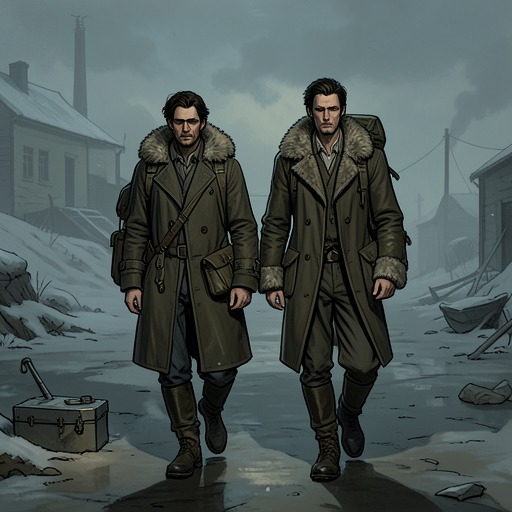
For Washington, the Arctic becomes a remembered landscape as much as a geographical one. Looking back on the months spent drifting toward it with Titch, he recalls days that turned endlessly white and a sense of freedom he could wear like a coat, a warmth drawn around himself as armour against the world. The memory gives the north a momentary protective quality. Yet Washington also says that the journey feels far away, as though a hard crust has grown over the loss of Titch. The image holds freedom and grief together: the remembered landscape offers shelter, but that shelter is formed over an unresolved wound.
The Arctic is also the setting of Washington’s most consequential experience of Titch’s departure. After years spent fleeing the man he thought had forced him from everything familiar and driven him through heat, wind, and snow, Washington finally confronts the figure he has been running from. He describes the man as a ghost whose shadow has compelled him to build a life in a vast, harsh country with little peace for him. This retrospective account frames the northern landscape as one stage in a longer flight, not a self-contained adventure. The Arctic’s snow and distance belong to the same chain of forced movement that carries Washington away from the life he knew.
The separation reaches into Washington’s later choices. When a lookalike’s resemblance to Titch proves false, the mistaken recognition leaves a stain on his thoughts, and Washington feels more strongly that he must go to Amsterdam to investigate whether Titch might be there. He tells Tanna she need not accompany him, but she insists; the possibility of finding Titch continues to exert force even after the northern journey has become a painful memory. The Arctic therefore marks neither a settled ending nor a clean break. Its unresolved absence keeps shaping the search that follows.
Return, memory, and what the north cannot resolve
When Washington finally encounters Titch again, the recognition is carried through the body and back into the remembered northern setting. Titch’s grey eyes, veined hands, long pale face, and familiar brown moles recall the cold plains and their obliterating whiteness. Their embrace is weak, smelling of wet wool, and takes Washington back to the snow. The reunion does not erase the separation; the Arctic remains present within it, making the recovered person inseparable from the earlier experience of being left behind.
The north’s meaning rests on this double movement between scientific aspiration and intimate loss. For Sir James, it is an outpost of research and specimen collection; for Titch, a place of filial longing, bereavement, and hoped-for commemoration; for Washington, both a landscape in which freedom once seemed wearable and the setting of an abandonment that continued to govern his choices. Its distance gives absence a geography, while Washington’s later memories make clear that crossing back from it cannot by itself restore what was lost.