Benedikt Kinast
Washington BlackBenedikt Kinast is the captain of the Ave Maria, a German-born sailor who became English by chance. He first appears after the ship rescues Washington Black and Titch from a storm; his suspicion of their story briefly makes their arrival uncertain, but his own history of loss and responsibility to orphaned boys helps shape a cautious decision not to expose them. His mercy is practical rather than absolute: he recognizes Washington’s fugitive status, condemns Titch for procuring him, and still allows both travelers to go ashore without creating further danger for them or his crew.
Identity and command
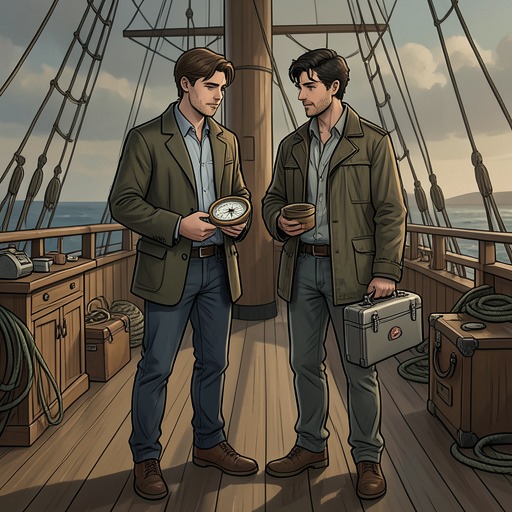
Washington describes Benedikt as at least sixty, with red hands and pronounced wrinkles. The captain hauls the soaked travelers into the Ave Maria’s hold, where sailors are securing the ship as water enters through the hatch. The rescue does not make him welcoming: he immediately confronts Titch over the damage caused when the Cloud-cutter struck his vessel, including a damaged mizzen and provisions, and insists that the flying craft fell upon his ship rather than the other way around.
Benedikt’s command is shown through brisk orders as well as complaint. When a sailor warns that the cutter is in danger, he orders the crew to secure it. Later he calls a crewman back to lash barrels fast, unwilling to risk more damage in the storm. His authority is practical and immediate, exercised amid a working ship rather than from a position of detached formality.
Recognition of the fugitives
Benedikt presses Titch to identify himself and explain why the pair were out in the storm. Titch answers with his full name, Christopher Wilde, and invokes his father, James Wilde, as a Fellow of the Royal Society and recipient of the Copley Medal and Bakerian lectureship. The captain recognizes the institutional name, but it does not settle the matter of why Titch and Washington are aboard his ship.
Benedikt already suspects the truth: he understands that Washington is an enslaved person who has escaped, and that Titch has taken him away without permission. He identifies Washington as a Black man from Barbados or Grenada and rejects the claim that the travelers came from Saint Lucia. His suspicion is not a later revelation or a secret he discovers only after landing; Washington notes that Benedikt had voiced it from the beginning. What matters to the captain is that Titch lied to him, even if he ultimately chooses not to turn that knowledge into an intervention against the fugitives.
His own past and his crew
During the voyage toward Florida, Washington learns more about Benedikt’s history from his brother, Theo Kinast. The twins’ father had served in the Hanover Foot Guards and was sent to England during the war with France. The family settled in Kent, where the boys faced hostility because of their German-accented English and appearance. After cholera killed their parents, the twins were left orphaned; a doctor who had cared for their parents eventually took them into his home.
Benedikt’s sense of responsibility also emerges in his account of the Ave Maria’s sailors. The crewmen are all orphaned boys of roughly the same age. He took them on when their orphanage closed and they faced being turned out into the streets. He recalls that five of the boys once risked themselves to save him when he was nearly drowned in a pinnace at Abu Shehr; that rescue belongs to an earlier period, and the other men from that time are now gone. The captain’s question about what this history signifies receives Washington’s quiet answer: the boys regard him well. Benedikt’s crew is thus not simply labor under his command, but a group of vulnerable young people for whom he has accepted responsibility.
Mercy, limits, and narrative role
Benedikt and Theo do not expose Washington and Titch when the Ave Maria reaches American soil. The brothers ask the travelers to leave the ship discreetly and not mention either the vessel or its owners when explaining how they arrived. They are wary of being entangled in a situation they did not choose, but Washington understands that the Kinasts have recognized something of their own childhood losses in the fugitives’ desperation and do not want to harm them or cause trouble for them.
The captain’s help remains conditional and guarded. Titch warns Washington that strangers should be trusted as little as possible, because mercy may be withdrawn. That caution defines the encounter: Benedikt offers a real opening, not protection from the wider system that makes Washington’s freedom precarious. The travelers step ashore in Norfolk without naming their rescuers, and the episode ends with Washington facing a crowded American port where men appear to move through life un compelled. Benedikt’s role is brief but consequential: he does not undo the danger of Washington’s status, yet he declines to make the rescue another occasion for capture.