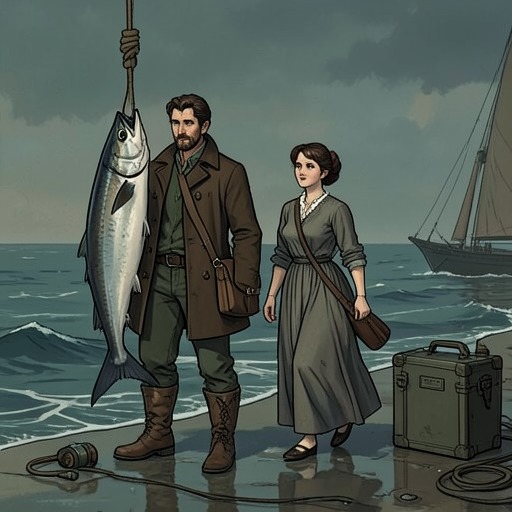
G. M. Goff
Washington BlackG. M. Goff is a celebrated marine zoologist, collector, and author whose meeting with Washington Black begins when Washington delivers a parcel to his house. Goff recognizes a kindred interest in marine life and invites Washington into his research; later, he helps bring Washington’s vision for Ocean House before a Zoological Committee. Their partnership gives Washington’s scientific imagination a public form, while revealing the racial and institutional barriers that leave the young Black naturalist’s authorship vulnerable to erasure.
Identity and Introduction
Washington first encounters Goff while working as a delivery man. Asked to bring a package for Mister Goff, he recognizes the name on the books in the house and, forgetting his errand for a moment, praises one of the volumes. He tells Goff that he has studied his marine-zoology books and admired the illustrations, especially the watercolours in Resplendence of Nudibranchia. Goff confirms his identity only after Washington names him as G. M. Goff.
The author Washington admires is not an impersonal authority on a page. He is an older, short, stocky man with a pale face and exceptionally dark, unblinking eyes. His illustrations have an unconventional shading and a threadlike clarity of line: Washington finds them strange enough to seem almost wrong, yet makes their beauty inseparable from their precision. The likeness between Goff’s work and Washington’s own habits of close observation gives their introduction the force of recognition across a difference in age and standing.
Goff is in Nova Scotia to collect specimens before returning to England. He tells Washington that he is researching crinoids, and responds warmly when Washington identifies marine life as his own area of study. Though he continues to frown, he is plainly pleased to find someone with whom he can talk about science. He says that he and his daughter, Tanna, lack kindred company in their isolation and invites Washington to join them on a boat trip to record observations for his new book.
Family and Scientific Work
Goff describes Tanna as both his daughter and a partner in his studies. She was born during his expedition to the Solomon Islands, where he had gone to study Pterois. Her mother died, and Goff says he could not abandon the child, though he had worried that taking her from the island would estrange her from her society. He remembers her mother as fiery, strong-willed, and intelligent, and says Tanna resembles her. His account casts field science as family life as well as professional work: he values the help and companionship his daughter brings to his research.
That ideal of partnership does not mean Goff is always attentive to Tanna’s perspective. During a meal, he speaks animatedly to Washington about marine animals while Tanna sits in silence, and Washington senses that Goff is oblivious to her mood. The contrast complicates Goff’s self-description of his daughter as a true partner: he recognizes her abilities and depends on her, but the narration also shows how readily his enthusiasm can occupy the conversation.
His scientific interests range across marine forms and their particular ways of living. He talks about dorids with retractable gills, the colour-changing contractions of cuttlefish, and the Irukandji whose sting he once narrowly escaped. His books and specimens establish him as a serious, widely travelled naturalist, but the novel also presents scientific observation as a practice shaped by selection: what is collected, drawn, preserved, and displayed depends on the observer’s decisions.
Washington and the Work of Seeing
Goff’s encounter with Washington’s artistic ability reaches back to the boyhood Washington spent in Titch’s household. Titch supplied him with paper and drawing leads, and Washington secretly drew by candlelight, burning each picture afterward because he feared discovery. When Titch saw his drawing of a Cassius blue butterfly, he praised its faithful rendering and called him a prodigy. Goff’s later importance belongs to this same history of looking closely: Washington’s eye had been trained through drawing before he could claim a place in formal science.
As an adult, Washington has to recover that practice after years away from drawing. At eleven, while enslaved and untrained, he had sketched tree frogs, palms, and human feet with striking force; now he must retrain his hand. Drawing again brings him calm and a renewed sense of curiosity. The continuity between illustration and marine study makes his admiration of Goff more than a novice’s deference to a famous author. Washington already understands how images can make nature visible, and how the care of the line can either clarify or distort what is observed.
When Washington objects to Tanna’s account of his survival as evidence of individual strength, he rejects the suggestion that slavery is a matter of temperament, as if some people were naturally suited to it and others were not. He calls that idea an outrage and a savagery. Tanna replies that she meant to recognize what he has made of his life after hardship. The exchange exposes a difference in their understanding of self-sufficiency: Washington insists that resilience cannot be used to naturalize the violence he survived. Goff is not the speaker in this disagreement, but his household is where Washington’s relationships and scientific work develop amid the consequences of slavery and racial hierarchy.
Ocean House: Proposal and Credit
Washington proposes a living aquatic exhibition to Goff: a large hall filled with tanks rather than benches, perhaps accompanied by open-air terrariums for toads, turtles, and lizards. Visitors could press close to the glass and learn the animals’ habits firsthand; the exhibition might function as a permanent indoor park. Tanna catches the conceit in a concise phrase, calling it a menagerie of the sea. Goff initially says such a thing is not possible, but Washington’s proposal gives their research a new public purpose: not merely to describe marine life in books, but to let people encounter living creatures directly.
Goff takes the proposal to the Zoological Committee in London. The committee accepts the plan enthusiastically, offers land, and allows an old timber building in the zoological gardens to be repurposed for the permanent exhibition, which is to be called Ocean House. Washington is astonished that an idea he feared would seem outlandish has gained official approval. He sees the project come into being as the first creation that feels fully his: unlike the Cloud-cutter, which he had worked on but understood as Titch’s vision, Ocean House begins with Washington’s own conception.
The building carries a visible history of damage and repair. Its left wing had exploded some three years earlier, scattering burning boards into the night; after months of reconstruction, it had been completed only the previous year. The timber on that side remains pale against the weathered planks, like a scar. The repaired building becomes the unlikely setting for Washington’s own work to acquire a durable public home, though the structure’s new purpose does not guarantee that its creator will be publicly recognized.
Washington anticipates that Goff, not he, will be remembered as the father of Ocean House. He does not dismiss Goff as malicious: Goff does not, in principle, like taking credit for Washington’s discoveries. But he is growing older and wants a late-career sensation, while Washington is an eighteen-year-old Black man with facial disfigurement and no formal scientific training. Washington understands that he could not readily approach the committee alone or be treated as Goff’s equal. The credit problem is therefore not reducible to personal generosity; it is built into the unequal access to scientific authority that makes Goff’s name institutionally legible and Washington’s contribution easier to overlook.
Exhibition, Preservation, and Unequal Visibility
Goff’s support continues as the exhibition takes shape. After Washington and Tanna return from Amsterdam with a two-headed porpoise, Goff is too struck by the creature to erupt over their deception. He says he has never seen such beauty in such ugliness. The group then discusses how to preserve and display it, testing methods suggested by Visser and considering whether the porpoise might become the exhibition’s centrepiece if Washington’s octopus fails to recover. Goff also maps a possible journey to Marrakesh to seek a rare squid described by another marine zoologist.
Ocean House emerges through accumulated, specific work rather than through the original idea alone. Washington sees tanks of Aesop prawns, molluscs, crabs, sea worms, and polyps, alongside a display of velvet fiddlers. He knows his labour is embedded in the exhibition: he calculated the tanks’ size and materials, selected specimens, arranged aquatic plants, and worked through exhausting mistakes and late nights. The project’s claim to teach visitors that creatures they regard as frightening are beautiful and worth understanding rests on this detailed practice of attention and care.
Pride and anguish occupy Washington at once. He is proud of the strange, exquisite place he helped create, yet he sees that his hand is everywhere while his name is nowhere. He must decide whether to make peace with that loss or leave the enterprise and the people connected with it. Goff’s assistance has helped turn Washington’s conception into an accepted institution, but assistance is not the same as equal recognition. The tension between access and credit defines the collaboration: Goff can carry the proposal into official rooms, while Washington supplies much of the work that makes the exhibition real.
Goff’s character is thus shaped by both genuine scientific fellowship and unequal authority. He recognizes Washington’s knowledge, welcomes his idea into a major project, and helps secure the committee’s approval; at the same time, Washington expects Goff to receive the public fame attached to Ocean House. The exhibition’s promise is to change how visitors see marine life, bringing them close enough to study what they might otherwise fear. Its creation also makes visible a harder question: who gets to be seen as the maker of knowledge, and whose careful work remains present in the institution without being named.