Norfolk
Washington BlackNorfolk is the American port where Washington Black and Titch first come ashore after fleeing Faith Plantation, and where the apparent promise of a new country collides with Washington’s continuing status as a person claimed as property. The city is both a threshold and a trap: its harbor opens onto a world of movement, but a posted reward, racial hostility, and the choices made there keep freedom uncertain.
Port of Arrival
Washington encounters Norfolk as a city of imposing scale and intense activity. Its docks and streets are crowded with sailors, workers, carts, horses, and ships; three-storey brick warehouses line the shipyards. The smells of tobacco, cotton, mud, and harbor refuse overwhelm him after the sea voyage, yet the city’s bustle also awakens his longing to draw what he sees. He has heard that a fire burned Norfolk in 1804, but finds no visible trace of it.
The harbor makes a powerful first impression of unconstrained movement. From the quay, Washington watches ships crowd the water and men go about their lives without compulsion. But his sense of wonder is immediately checked by the recognition that this freedom does not extend to him. He is still a fugitive from enslavement, and crossing into the United States has not changed the danger attached to his identity.
Arrival and the Kinasts
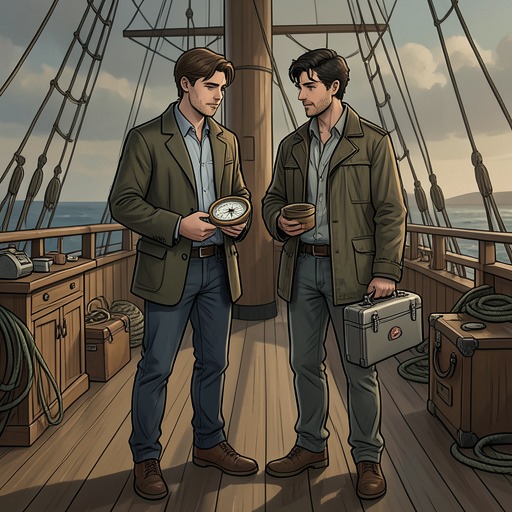
Washington and Titch come ashore after Captain Benedikt Kinast and his brother have learned enough of their history to understand that the travelers have lied about themselves. The brothers ask them to leave discreetly and not identify the ship or its owners when describing how they reached America. Their assistance is limited but consequential: they provide sailor’s clothing, salted ham, and a few coins to help the pair manage in the country.
The Kinasts’ decision not to expose them is presented as a wary form of mercy rather than a guarantee of protection. Titch cautions Washington that strangers cannot safely be trusted and that mercy may be withdrawn. At the same time, their reluctance to make trouble for the fugitives reflects their recognition of a shared history of childhood loss. Norfolk is where this precarious passage ends and the next uncertainty begins: the pair step from the ship into a crowded city without knowing whether they will be noticed.
The Bounty and the Threat of Capture
The danger becomes explicit when Titch shows Washington a notice he found posted at a postal office. Issued by John Francis Willard as agent for Erasmus Wilde, it offers one thousand pounds for the capture of George Washington Black, described as an enslaved boy for life and marked by burns. It also describes the white abolitionist traveling with him, making the pair identifiable together. The notice turns Washington’s body and appearance into instruments of pursuit and establishes that his escape has not ended the claim against him.
This public notice gives concrete force to the contrast between the harbor’s apparent freedom and Washington’s constrained position. He can look out across a city full of people moving on their own terms, yet he must travel carefully and avoid attention. The city is therefore not a simple refuge: it is a place where the machinery of capture can reach him even after the sea crossing.
A Choice and a Northern Departure
After visiting Edgar Farrow’s churchyard, Washington and Titch return to Norfolk the next morning. Titch is eager to find a charter heading for the Arctic basin, while Washington is still considering the men who could have taken him toward Upper Canada. Their proposed route offered a different possible life, but Washington has only moments to decide and ultimately chooses to remain with Titch. In retrospect, he recognizes that he experienced this as a choice, even though his youth and history of violence shaped how he understood it.
The pair eventually secure passage north aboard the Calliope, a newer, smaller vessel than the Ave Maria. Its captain, Michael Holloway, is not a slave trader but maintains a strong distinction between Black and white people; the second officer, Jacob Ibel, treats Washington more humanely and seeks his company for card games. Washington likes Ibel but trusts neither officer. Before boarding, Titch uses money from Edgar to buy clothes, provisions, and equipment. They sail at dawn, and Washington notices a short man standing on the boardwalk, watching the boats as they leave.
Norfolk’s significance lies in this unresolved crossing between legal and lived freedom. The city receives Washington as a place of arrival, but the reward notice and the need for secrecy keep him exposed; its docks also become the point from which he rejects one possible escape and continues north with Titch. The harbor’s promise is real as possibility, not yet as security.