Octopus
Washington BlackThe octopus that Washington Black discovers beneath a wreck off Nova Scotia changes the direction of his work: rather than kill a remarkable animal for display, he imagines bringing marine life to the public alive. The creature becomes the first vivid test of that ambition, meeting him in the water on its own terms, wrapping itself around his arms when he returns with it, and later falling ill in the makeshift tank. Its story joins wonder to responsibility, and public spectacle to the question of who gets to create, care for, and receive credit for Ocean House.
Discovery and encounter
Washington finds the octopus while searching the underwater wreck, upright and furred with weed, its rusted iron railings and open portholes inhabited by fish. A flash of orange against brown-red rock draws him closer. The animal seems to change before his eyes, appearing by turns slick blue, red and craggy, mottled brown, then like a vivid slash. When it rises from the rock, its orange arms spread around it and its white suckers stand out against its body. Washington notices that it is female, and the sight fills him with hope.
That hope is inseparable from a moral recoil. Washington imagines the animal being killed by Goff and crated as a specimen for the exhibition, and finds the prospect wrong. He begins to picture not only the octopus but anemones, comatulids, and nudibranchs transported alive, so that people could see marine creatures as breathing beings rather than dead objects. He recognizes how little is known about the practical problems: what could house them, which species could share a tank, whether plants could travel without rotting, and how the animals themselves could be kept alive. The obstacles do not settle the question for him; their very difficulty strengthens his conviction that the attempt is worth making.
The octopus does not simply submit to his attention. When Washington approaches, it sends a dark cloud of ink between them, then swims away and pauses with its arms unfurled and vibrating. He holds out his hands gently. After hovering almost motionless, the animal pulses toward him and swims directly into his hands. The scene gives their encounter a mutual quality: Washington is not merely collecting a specimen but waiting, watching, and responding to an animal that can withdraw or approach.
From the water to the exhibition
After the dive, Washington raises the idea of a live exhibition with Goff and Tanna. He proposes a gallery of enormous tanks, perhaps with open-air terrariums for toads, turtles, and lizards, where visitors could press their faces to the glass and learn about the animals firsthand. Tanna calls it a menagerie of the sea. The octopus is central to the idea because its living presence is what Washington wants to preserve; a dead specimen could not convey the animal he had just encountered.
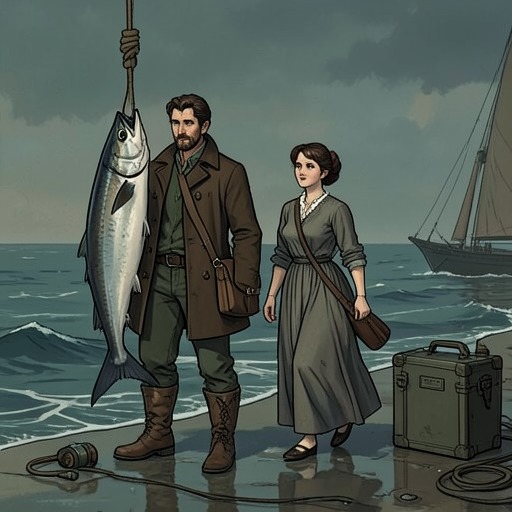
Washington brings the creature back in a cage and takes it out carefully in front of Goff. Goff compares it to Bathypolypus arcticus, but notes that it is too large to be that species. Washington points out that it inked him and that he does not think Bathypolypus has ink. As he holds the octopus, it winds itself around his arm. Its suckers feel like cold little mouths, and the intimacy of its touch startles him. When Goff observes that it likes Washington, he is crouched on deck with its arms braided over him. The cove’s late-afternoon lanterns approach in the distance; Washington feels calm, far from the harsh life he has made for himself, and begins to laugh.
The octopus also informs Washington’s understanding of what makes marine life worthy of attention. In a later conversation, he favors the octopus when asked to choose an animal. Its capacity to change color and texture, contract through a narrow opening despite its size, and play games makes it more than a curiosity to him. The description of its brain wrapped around its throat and no larger than a pea emphasizes the mismatch between its compact anatomy and its ingenuity. Washington calls it magisterial; the exchange’s playful disagreement over whether the plural is octopodes or octopi accompanies a serious insistence that the animal deserves wonder rather than dismissal as merely strange.
Ocean House and the question of credit
Goff pitches the permanent aquatic exhibition to the Zoological Committee in London, and the committee accepts the proposal enthusiastically. The city provides land and allows an old timber building in the zoological gardens to be repurposed. The building bears a history of damage: its left wing had exploded at night some three years earlier, and the reconstructed timber is still pale against the weathered boards. If work proceeds quickly, Ocean House can open the following year. The octopus’s discovery and Washington’s proposal thus lead toward a public institution designed to show aquatic life alive.
For Washington, Ocean House is not just another successful project. He contrasts it with the Cloud-cutter, which had never felt like his own creation, and regards the exhibition as something made from his own idea. Yet he expects his name to disappear from its history. He understands that Goff, rather than a young, disfigured Black man without formal scientific training, will be celebrated as its founder. His recognition of Goff’s ambition does not erase the unequal conditions that make it difficult for Washington to approach the committee or be treated as an equal partner. The living-animal project therefore carries a second question alongside its care for the creatures: whose knowledge and labor will be visible to the public?
That tension is present in the eventual working exhibition. Washington takes pride in Ocean House as a place where visitors can encounter creatures they think nightmarish and learn that they are beautiful and need not be feared. At the same time, each display recalls his calculations, late nights, mistakes, and decisions about tank size and materials, the choice of specimens, and the arrangement of aquatic plants. He sees his hand in the whole place, while knowing his name will be nowhere. Pride and anguish coexist: the living display realizes his idea, but its public success does not guarantee that its principal creator will be recognized.
Illness and continuing presence
The octopus grows lethargic in its makeshift tank, and Washington fears it may die. When he circulates its water, it no longer grasps the stick playfully. Fresh prawns lowered by their seed-like eyes draw no interest; the creature lies curled into a pale ball in the tank’s corner, one arm faintly feeling the surface. The animal that once approached Washington and swam into his hands now appears increasingly inaccessible. The change makes the practical demands of keeping marine life alive immediate rather than theoretical.
Watching it, Washington feels that the things he works for end in ashes. His memory gathers several distinct losses and threats: enslavement, flight, abandonment in the Arctic, and the possibility that the gallery of aquatic life will be taken from him. He feels an urge to reject the enterprise because the effort it requires and the knowledge that it may never be his seem to drain it of worth. The octopus no longer appears to him only as a miraculous animal; in that moment, he sees in it his own slow extinction. This is not simply disappointment at a sick creature. Its decline becomes bound up with his fear that his work and the future he has tried to build can be erased.
The octopus nevertheless remains part of the exhibition’s ongoing work. After Washington and Tanna return with a two-headed porpoise, Goff and the others discuss how to display it and test methods for preserving it over the long term, in case the Nova Scotia octopus fails to recover. The possibility is stark: the living creature Washington once wanted to save could be replaced as the centrepiece by another animal, and preservation might mean a different relation to life than the one that first inspired Ocean House. Later, among the tanks, Washington pauses by a tank holding a drifting pink jellyfish and another filled with nudibranchs, carrying forward the work of the exhibition even as its living inhabitants and his own credit remain uncertain.
Significance
The octopus gives concrete form to Washington’s insistence that marine creatures should be encountered as living, responsive beings. Its ink, changing appearance, play, intelligence, and voluntary approach resist the reduction of animal life to a static display object. At the same time, keeping it alive requires tanks, feeding, maintenance, and methods of long-term care; admiration alone cannot resolve the practical risks of transporting and exhibiting unfamiliar species. The animal’s illness makes those limits part of the story rather than a problem hidden behind the spectacle.
Its role is also bound to Washington’s own position at Ocean House. He recognizes the creature as a wonder and imagines a public learning to see unfamiliar animals differently, but he must also confront a structure in which his own scientific labor may be made invisible. The octopus’s movement from wreck to hands to tank traces the promise and vulnerability of the whole project: an encounter becomes an idea, an idea becomes an institution, and both creature and creator remain exposed to forces beyond their control.