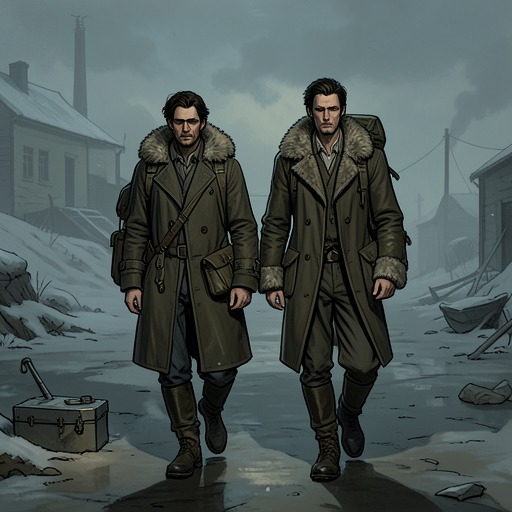
Peter House
Washington BlackPeter House is a close companion and indispensable intermediary to Sir James Wilde in the Arctic, and a quiet but decisive presence in Washington Black’s northern journey. Unable to speak, he communicates through expressive gestures; he is also the person who saves Washington from being buried in the ice, guides him to the camp, and equips him for the journey away. His loyalty links the expedition’s practical survival to its most intimate losses: he remains with James, then sends Washington onward with provisions, books, instruments, and a final gesture of affection.
Identity and Place in the Arctic
Peter House is introduced through the letters that bring Titch to doubt the report of his father’s death. At Edgar Farrow’s house, Titch compares the handwriting in a letter attributed to his father with a separate letter written by Peter and mailed alongside it. Farrow identifies the two pages as different documents, weakening Titch’s suspicion that Peter’s hand might have been mistaken for his father’s. The correspondence leaves open the possibility that James’s letter predated his supposed death and Peter only sent it later; it does not yet establish what happened to either man.
When Washington and Titch encounter Peter at an Arctic outpost, his presence supplies the answer the letters could not. He is there collecting goods, and Titch recognizes him. The two clasp hands, then communicate in elaborate gestures: Titch watches closely and responds with understanding, while Washington can only look on. Peter’s silence is not an impediment to their exchange. Titch explains that Peter does not speak and talks with his hands, making gesture both his language and the means by which he and Titch resume contact after a long separation.
The Reunion and the False Death
Peter’s appearance confirms that James Wilde is alive. As Peter takes the provisions sack and heads towards a sled, Titch tells Washington that Peter will lead them to the camp and that his father is living. The news comes not through a spoken account from Peter but through Titch’s understanding of his gestures and the reunion between the two men. Washington’s uncertainty about how Peter conveyed it underscores his unfamiliarity with this language; Titch’s fluency makes their exchange legible to him.
At the camp, Peter moves between James and the surrounding outposts, often with an Indigenous companion, bringing the goods and tools needed to sustain the isolated encampment. James and Peter’s reliance on one another is practical, but their relationship is also marked by affection. They communicate in the igloo through active hands, whose movements cast shadows in the warm light. James touches Peter readily and gently, and Peter is described as the only man with whom James seems to converse. The contrast between James’s isolation and his tenderness towards Peter gives their companionship particular weight without making it reducible to service alone.
James explains that reports of his death had reached him through letters from a colleague in Mexico and a friend in Heidelberg. He had not known that the rumour had spread to Titch and his mother, and says he would have sent word had he understood how widely it circulated. He intends to write to Titch’s mother to correct the false report. The evidence thus attributes the misinformation to a rumour that travelled across several distant correspondents, while leaving its original source unknown; James himself says he does not know who started it or how it reached the family.
Rescue and Care for Washington
Peter’s most immediate intervention is to save Washington after the young man is left in danger in the ice. When Washington asks James whether he pulled him to safety, James answers that Peter did. He adds that another hour would have left Washington buried in the ice. James’s response makes the distinction plain: Peter, rather than the father whose survival has drawn Titch north, is the person responsible for Washington’s rescue.
That act is part of a broader pattern of practical care. Peter leads Washington and Titch to the camp, carries their provisions, and helps sustain the men living in the northern landscape. After James dies and Titch is gone, Peter does not urge Washington to remain. He allows him to choose from the Wildes’ possessions and supplements Washington’s selection of a leather-bound treatise on marine life with several of James’s hand lenses. He also gives him the money Titch left for him, along with food and other provisions. These choices meet both the intellectual and immediate material needs of a young traveller leaving an unfamiliar, dangerous region.
Loss, Departure, and Narrative Significance
After James’s death, Peter gathers him up with the Indigenous men and carries him away. Washington recognizes that Peter has lost his dearest friend, yet describes him as continuing to act with stoicism and kindness. Peter’s response to grief is not presented through a speech; his care for Washington, and his efforts to prepare him for departure, become the visible form of his compassion. He embraces Washington so tightly that the breath is pressed from him, then, with Hesiod, puts him aboard a sled and sends him into the cold wastes.
At the outpost, Peter adds another gift: several compact, self-made scopes belonging to Titch, their dark gears serving as knobs. He places them in Washington’s mittens, gives him a brief, unexpected clap on the side of the head, and leaves. The sequence of gifts is precise: James’s lenses and the marine-life book support Washington’s observing and studying; Titch’s scopes carry forward the work and attachments of the person who has vanished; the money and provisions make departure possible. Peter cannot undo the deaths and absences that define the camp, but he ensures Washington does not leave empty-handed or alone in the first stages of his journey.
Peter’s role is therefore both relational and structural. His gestures resolve the central uncertainty that brought Titch to the Arctic, while his rescue and farewell shape Washington’s survival after the reunion’s promise has collapsed into loss. Because he is silent, the story gives particular force to what his actions communicate: recognition, loyalty, grief, and care. He remains a supporting character, but his interventions alter what Washington knows, where he can go, and what he can carry with him.