St. John's Church and Cemetery
Washington BlackSt. John’s is a church and graveyard in Virginia that becomes a temporary refuge and a point of passage for Washington Black and Titch. Under the care of its sexton, Edgar Farrow, the graveyard connects the visible world of church, road, and burial with a concealed chamber used to shelter people escaping enslavement. Its role brings the legal geography of freedom into the story: reaching a place from which escape north is possible offers hope, but only through secret assistance and continuing risk.
Setting and Arrival
After making land at Norfolk and entering Chesapeake Bay, Washington and Titch travel through Virginia. Titch has explained that they will be subject to American laws, and that freedom means different things to different people. Their journey brings them along a red-dirt path and then eastward from a fork in the road, where they see St. John’s: a small white clapboard church with a low spire and a graveyard enclosed by a weathered fence.
A figure in black is walking among the graves. Titch calls to him as Mister Edgar Farrow, and Farrow first responds as though the travelers might be selling something before offering them shelter for the night. Titch identifies himself as Christopher Wilde and explains that he and Farrow have corresponded about the effects of pressure shifts on the human body during ascents in aerostats. He also identifies his father, James Wilde, as Farrow’s associate in the Royal Society. The introduction establishes a scientific connection, but St. John’s soon proves to have another, concealed function.
The Graveyard and the Hidden Chamber
Farrow is the church’s sexton, and the graveyard is the threshold to a secret refuge. When Washington asks where Titch is, Farrow offers to take him to him. That night, Washington follows despite being a child, much smaller than Farrow, and distrustful of him. Farrow leads him outside among the gravestones to an opened grave. In the lantern light, Washington sees a small ladder descending into it and a coffin partly exposed at the far end; Farrow tells him that Titch is below.
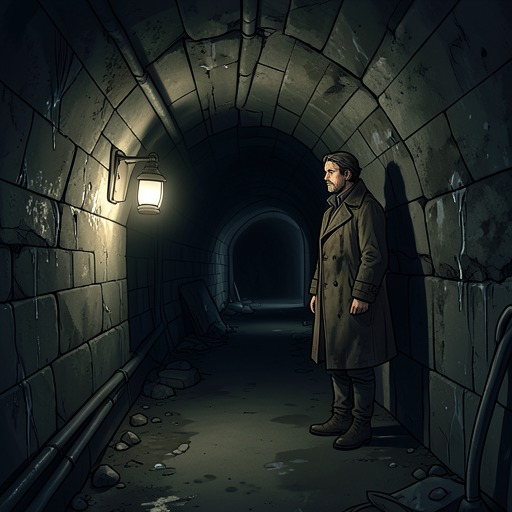
The grave does not lead to a burial alone. Beneath it is a low, narrow chamber, supported by timber, with a boarded floor. Titch and Farrow are there with two people who have escaped enslavement. Washington recognizes them through his familiarity with the signs of fear and vigilance among people who have lived under slavery. Titch tells him that they are to leave the following night, and identifies them as Adam and Ezekiel. Farrow’s use of the graveyard makes the place both a hiding place and a clandestine route into a wider network of escape.
Escape and the Meaning of Freedom
Titch expects Adam and Ezekiel to reach Upper Canada before the end of the month and describes them as men who will have their lives ahead of them. Farrow qualifies this account: under an act passed some years earlier, an enslaved person who reaches Upper Canada is freed on arrival. Freedom here is tied to crossing a boundary, rather than simply to the travelers’ presence in Virginia or to Titch’s assurances about American freedom.
Washington recognizes Farrow’s role as that of a smuggler. On Faith Plantation, he had heard rumors that barrels said to contain rum were used to conceal more than liquor, although Big Kit had treated the stories skeptically. St. John’s gives those rumors a concrete form: Farrow is helping people escape, and the churchyard’s concealed chamber is one stage of that work. The episode also clarifies the limits of legal protection. Washington is traveling under a bounty notice issued by John Francis Willard, acting for Erasmus Wilde, which labels him a lifelong slave and offers a reward for his capture, dead or alive. The promise of eventual freedom to those bound for Upper Canada does not by itself remove the danger of capture along the way.
Narrative Significance
St. John’s brings together secrecy, refuge, and uncertain safety. The church is an ordinary landmark encountered during travel, but its graveyard hides a passage where escapees can wait for their departure. The journey from the road to the opened grave and down into the timbered chamber turns a familiar place of burial into an instrument of survival, without making escape safe or freedom immediate.
The location also gives physical form to the novel’s contrast between a legal promise and lived vulnerability. The prospect of freedom in Upper Canada is discussed beneath Virginia ground, while Washington himself remains a fugitive sought by a named agent. St. John’s therefore serves not merely as shelter for Adam and Ezekiel but as a stopping point in Washington’s own passage through jurisdictions where the meaning and security of freedom change.