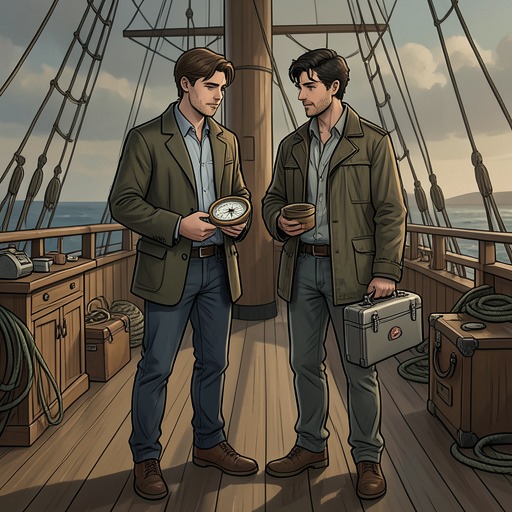
Theo Kinast
Washington BlackTheo Kinast is the ship’s surgeon aboard the Ave Maria and the identical twin brother of its captain, Benedikt Kinast. He enters the narrative when Washington Black and Titch, having fallen onto the ship’s deck, come to his cabin for treatment. Theo tends Washington’s head wound and notices the severity of his old burn; his modest act of care takes place within a larger encounter that makes plain how little protection Washington’s skill or his association with Titch can secure in a society that still sees him as property.
Identity and Background
Theo and Benedikt were born in Germany to a father serving as an officer in the Hanover Foot Guards. When George II declared war on France in 1756, their father was conscripted to cross the Channel and drill with English regiments. The twins were only months old when their mother took them to Maidstone, Kent, where he was stationed. They grew up as outsiders: their English, learned from their mother, retained the sound of German, while their frost-white hair and identical faces made them targets of local children’s mockery.
Cholera killed both parents in the final year of the war. Theo and Benedikt were left in narrow, dirty rooms and survived among street children, searching for food. A doctor who had cared for their parents learned that the twins were orphaned and took them into his grand house a week later. He and his childless wife raised the boys as their own, providing education and the opportunity to choose their futures. Theo remembers this kindness against the bleakness of his first loss: his parents were buried in a pauper’s grave, and the twins never saw them again.
Profession and Temperament
The brothers’ adult paths diverged. Benedikt wished to join the army but instead enlisted in the Royal Navy, served five years, and then entered merchant trade. Theo studied medicine in Edinburgh and later London. His interest in the human foot began in close attention to bone shape and the mechanics of walking, but the commercial realities of chiropody disappointed him. Treating plantar warts and ingrown toenails, he tells Washington, left him confronting the repetitive, unremarkable labor of a life spent at work that did not hold his interest.
That mixture of medical knowledge, dry humor, and dissatisfaction shapes Theo’s presence aboard ship. He jokes that he is the ship’s surgeon and a general source of sailors’ misery, and describes a treated wart as resembling a hideous barnacle. His fingers are missing, their stumps red and raw, a visible bodily injury the account presents without explaining its cause. Theo’s medical practice is therefore neither a grand calling nor a simple mark of authority: it is a trade he has entered, an expertise he puts to use, and a livelihood whose daily routine he finds less compelling than the anatomy that first drew him to it.
Encounter with Washington and Titch
Washington and Titch reach the Ave Maria in the aftermath of their escape from Faith Plantation. At first, Washington mistakes Theo for Benedikt: the surgeon has the same beard and a similarly damp cough, and the resemblance between the brothers is so strong that Washington is confounded when Theo opens the cabin door. Titch explains that the two men are twins. Theo himself accepts the resemblance with a weak smile, while allowing that there might be some further mystery to his origins.
Theo makes room for the fugitives and says he should at least bandage the cut on Washington’s head, since his brother would be cross if he failed to treat the boy. As he examines Washington, he remarks that the gash is slight compared with his previous injuries and registers the ghastly burn on his face. The scene puts bodily care beside the history written on Washington’s body: Theo can treat the fresh wound, but the old injury is already part of the larger violence from which Washington is escaping.
The encounter also exposes the limits of Titch’s protection. When Titch calls Washington his friend, Benedikt challenges the word by asking whether Washington is not property. Titch answers that Washington is indeed his property, presenting him as a gifted scientific illustrator and personal assistant whose aeronautical drawings deserve respect. Theo is not the speaker in this exchange, but he belongs to the shipboard household in which Washington’s status is debated. His later hospitality does not erase the fact that the fugitives depend on the Kinasts’ decision to keep them aboard.
The Kinasts’ Hospitality and Its Limits
The morning after the shipboard crisis, Theo explains that Benedikt is rough in manner but generous at heart. He tells Titch and Washington that his brother has decided they will accompany the ship to its next port; their alternative would be to be left for the sharks. In Haiti they could find a vessel back to Saint Lucia, or, if they wished, travel with the Kinasts as far as Virginia. Theo thus offers information and a possible route onward, while making clear that the men’s immediate safety rests on the captain’s choice.
Titch’s question about the triangular trade prompts Theo to deny that the brothers are illicit slavers, but he gives no further explanation. His silence leaves the nature of their trade unresolved in the scene, rather than establishing a full account of the ship’s business. Nor does his practical concern for Washington amount to a declaration that the boy is free: the exchange with Benedikt has just shown that even a temporary refuge may preserve the language and assumptions of ownership.
Narrative Significance
Theo’s brief appearance joins two forms of recognition. He sees Washington first as a patient with a fresh gash and extensive prior injuries; Washington, in turn, sees Theo through the startling likeness that initially makes him seem to be the captain. The mistaken identity gives the encounter a moment of bewilderment, but Theo’s actions distinguish him from Benedikt: he opens the cabin, offers treatment, and helps explain what choices lie ahead.
His story of orphanhood also echoes the precariousness of childhood that defines Washington’s own passage through the novel. Theo and Benedikt lose their parents to cholera, are abandoned to hunger, and survive because an adult chooses to take them in. That history does not make their circumstances equivalent to Washington’s enslavement, and Theo does not free him; it does, however, give his account of the world’s indifference to a child alone a particular weight. The surgeon’s kindness is real but bounded, part of a temporary shipboard reprieve rather than a resolution of the racial and legal forces that continue to shape Washington’s life.