
Charles and Merricat’s Contest for the House
We Have Always Lived in the CastleThis flow follows the escalating struggle between Mary Katherine and Charles over access, authority, possessions, and the right to define home.
increasing Bearing strength in each event
 decreasing
Bearing strength in each eventdecreasingA Visitor Admitted

A Visitor Admitted
Trust and alarm
Constance lets Charles into the kitchen, identifying him as a cousin. Mary Katherine has already decided that he is dangerous and feels that the house has been breached.
Competing interpretations
For Constance, the visitor is family; for Mary Katherine, he is an intruder with a familiar face. Neither interpretation can be settled by the other’s reassurance.
Their conflict begins as a contest over naming. Charles’s ability to enter depends on Constance’s welcome, while Mary Katherine’s resistance depends on refusing that welcome emotionally.
The First Supper

The First Supper
Food as a test
Charles hesitates over food because the family’s poisoning history remains present. Constance’s reassurance eventually leads him to eat, while Julian turns the meal into a discussion of the past.
Authority at the table
Charles later sits in John’s chair and treats the household’s habits as things he may evaluate. Mary Katherine watches the scene as a threat to the established order.
Meals are the sisters’ central language of care, but Charles makes them tests of trust and control. The table becomes the first sustained arena of their contest.
The Wealth Dispute

The Wealth Dispute
Money comes to the surface
Charles questions why the sisters keep money at home and shows interest in the safe. His concern may sound practical, but Mary Katherine reads it as evidence of greed.
Objects become battlegrounds
When he discovers buried silver dollars, he insists that Mary Katherine has no right to hide them. She sees his handling of the coins as another attempt to take control of her private world.
The disagreement exposes incompatible ideas of property. Charles treats money as an asset to manage; Mary Katherine treats buried possessions as protective parts of the estate.
The Demand to Leave

The Demand to Leave
A direct request
Mary Katherine approaches Charles and politely asks him to go. He refuses, turning her request into an occasion to suggest that she may be the one who eventually leaves.
An answer in destruction
Mary Katherine smashes the mirror in John’s room, trying to break Charles’s influence over the space. Charles remains, and Constance continues to question whether her old way of life was right.
The conflict has moved beyond symbols to an explicit struggle over residence. Neither a request nor a magical act can dislodge Charles while Constance accepts his presence.
The Room as Rupture
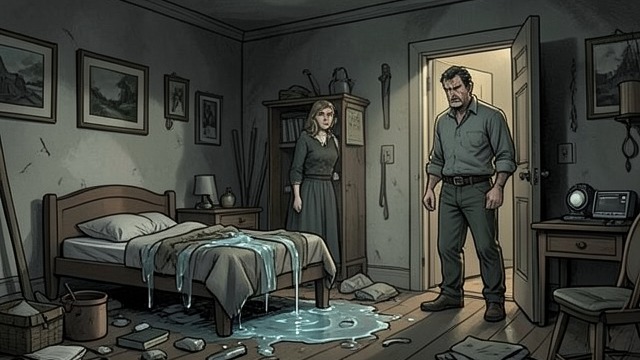
The Room as Rupture
A house transformed
Mary Katherine fills Charles’s room with debris, removes familiar objects, and pours water on the bed. She means to make the room unrecognizable and force its occupant out.
Open confrontation
Charles demands punishment and accuses the household of being crazy. Constance tries to appease him, while Julian challenges his authority and Mary Katherine finally names him as a demon.
The room’s destruction marks the end of indirect resistance. The contest has become open, unstable, and impossible to resolve through ordinary hospitality.
On the rainy Sunday Charles arrives
The morning after Charles’s first night
During Charles’s first few days in the house
Several days after Charles’s arrival
On the Thursday Charles’s stay reaches its crisis
