Blackwood family villagers
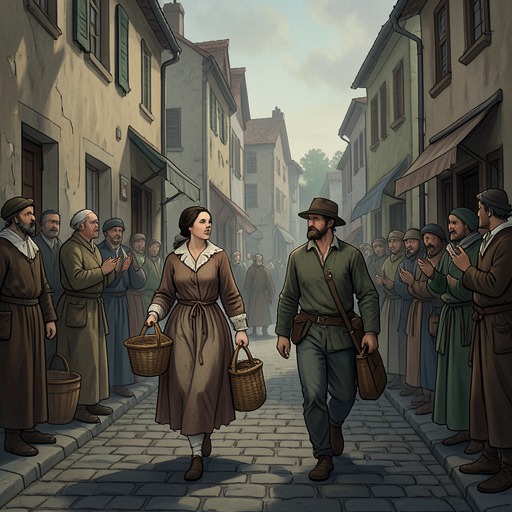
We Have Always Lived in the CastleBlackwood family villagers are a collective presence in the sisters’ story: spectators at the fire, participants in the attack on the Blackwood house, and, later, anonymous providers of food. Seen through Mary Katherine Blackwood’s account, they are never simply a single, stable community. Public laughter and violence give way to discreet acts of assistance, while the sisters continue to experience the Village as a threatening audience.
A Crowd at the Fire
As the house burns, Mary Katherine looks out through the vines at a long row of cars and the Village fire engine, all parked close to the house. The assembled crowd includes faces that seem amused and others that seem frightened. Someone nearby asks whether the women and the old man are safe; Charles Blackwood answers that they had plenty of warning. The moment holds concern and spectacle together: the crowd watches the fire, but the people inside remain exposed to its scrutiny and cannot freely leave.
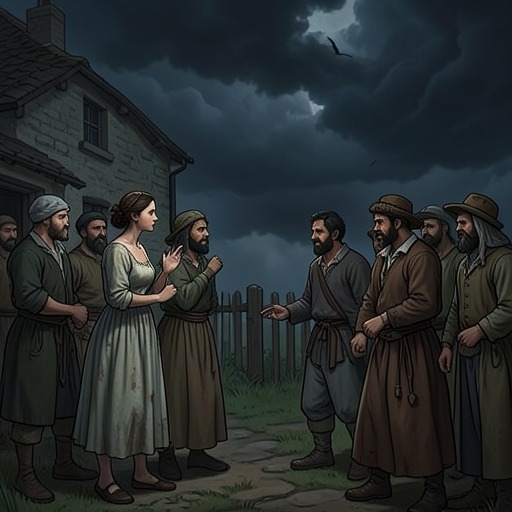
The crowd’s conduct changes sharply when Jim Donell, identified by the hat marked CHIEF, comes out of the house and announces that the fire is out. He takes off the hat, walks down the steps, and sets it on the fire engine. Then, as everyone watches, he picks up a rock and smashes one of the tall windows in the drawing room. Laughter rises behind him, and the onlookers move toward the house in a wave. The fire’s apparent end does not restore safety; the crowd’s attention turns into a collective assault on the home.
A second drawing-room window breaks from inside, struck by the lamp that usually stands beside Constance Blackwood’s chair. The detail places the damage within the room as well as outside it: the house is being attacked by the crowd, but the sisters’ familiar domestic space is already coming apart. Mary Katherine calls to Constance, who covers her eyes.
The Sisters Among the Mob
When Mary Katherine takes Constance by the hand and leads her down the steps, the two are surrounded. Someone identifies them, and the crowd presses close, pushing, laughing, and trying to see them. Constance holds Julian Blackwood’s shawl across her face. Mary Katherine tries to find a way through the gathering, but the Harris boys block one route and Stella another; she stops rather than risk Constance falling in front of the people crowding and dancing around them. The mob’s threat is physical, but it also lies in its insistence on looking at the sisters when they are trying to escape notice.
Jim Clarke, speaking from the porch, first calls for the crowd to stop. Laughter resumes after a jeer about Julian being buried ten feet deep. Jim Clarke then says plainly that Julian Blackwood is dead, and the crowd finally falls quiet. Charles Blackwood asks twice whether Constance killed him. At that accusation, people withdraw in small steps, leaving a wide space around Constance, still hiding her face with the shawl. The crowd’s movement—from pressing around the sisters to retreating—marks how suspicion can isolate them as readily as physical force can trap them.
Quiet Deliveries
After the destruction, some Village residents begin leaving food on the front doorstep, silently and in the evenings. The offerings vary: home-cured bacon, fruit, preserves, roasted chicken, cakes, pies, cookies, potato salad, coleslaw, baked beans, macaroni, and, once, beef stew. Constance takes the stew apart and puts it back together according to her own rules. She also judges the cooks by their ingredients: one bean dish contains too much ketchup, while an earlier one used more molasses. Her attention to preparation preserves her standards of domestic life even as the food arrives from outside.
The deliveries are anonymous, and Mary Katherine can only imagine how they are arranged: perhaps men carry baskets prepared by women after returning from work, and perhaps the donors come in darkness because bringing food feels shameful in public. That explanation belongs to her speculation, not to any confirmed account from the donors. Occasionally a note accompanies a basket, apologizing about the dishes, the curtains, or Constance’s harp. The sisters put the baskets back where they found them, wait until it is completely dark, and check that the front door is locked. Help enters their routine, but only through a threshold they continue to guard.
Watching the House
The sisters’ later view of the Village remains shaped by separation. They sit on either side of the front door and peer out through narrow glass panels, mostly covered with cardboard so that each has only a small peephole. Mary Katherine describes passers-by as strangers with staring eyes and open mouths. The daily watching makes the doorway both a lookout and a barrier: the sisters can observe the people who pass, while keeping themselves hidden from view.
One group of visitors—a man, two women, and two children—parks bicycles in the driveway, rests on the lawn, and lets the children run among the trees and bushes. One woman remarks that vines are growing over the burned roof and nearly conceal the marks of the fire. The visitors rarely face the house directly, instead glancing sideways, over a shoulder, or through their fingers. One calls it a former local landmark; another says it now resembles a tomb. The house has become an object of public curiosity, its damage both partly concealed by vines and continually read as a sign of what happened.
Collective Role
The villagers’ significance lies in the unresolved contrast between what they do in public and what some of them do in private. At the fire, the crowd’s watching turns into laughter, window-breaking, and the pursuit of the sisters; afterward, food and occasional apologetic notes appear at the same guarded doorstep. The evidence does not identify the donors or establish whether they were among the people who joined the attack. That anonymity prevents the sisters—and the reader—from turning communal hostility into a simple story of either universal malice or reconciliation. The Blackwood family villagers remain both a force the sisters fear and an unseen source of practical aid, with the ruined house standing between those roles.