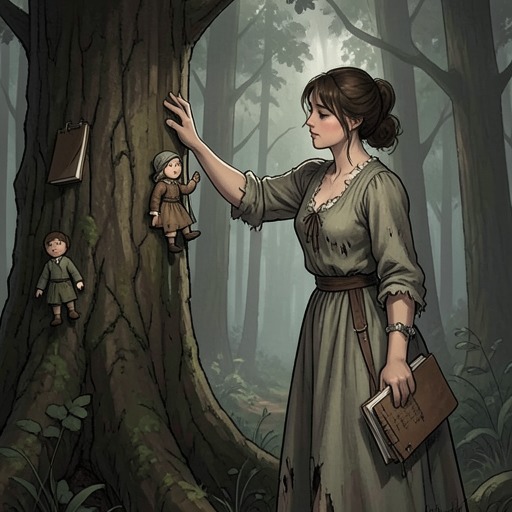
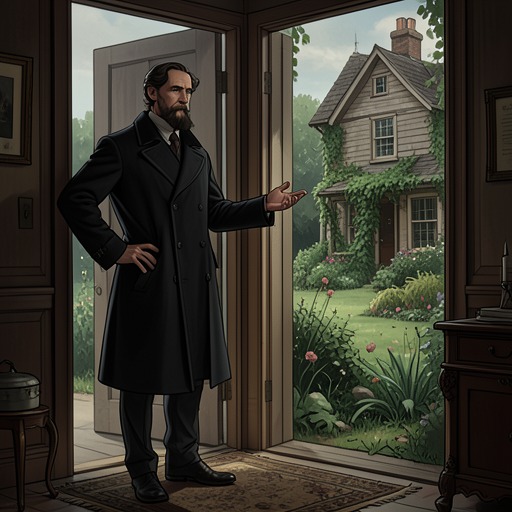
Blackwood house
We Have Always Lived in the CastleBlackwood house is both the physical center of the Blackwood family’s inherited world and the boundary that separates its survivors from the Village. Set among enclosed grounds at the settlement’s edge, it embodies a family ideal of permanence, privacy, and order. After the poisoning that leaves Mary Katherine Blackwood, Constance Blackwood, and Julian Blackwood as survivors, its rooms sustain a daily life organized around memory and care. When fire and intrusion damage the building, the sisters do not abandon it: they adapt its surviving spaces into a more guarded home.
Setting and Family Inheritance
Blackwood house stands on land between the highway and the river, reached from the Village by Blackwood Road, which circles the property. A large black rock marks the entrance to a path through the woods; the path leads to a locked gate and then home. The route places the house close to the Village in physical terms but makes access deliberate. The family’s property is not simply a setting behind the action: its roads, fences, and entrances define who may approach and on what terms.
The family’s possessions give the house a sense of accumulated history. The Blackwoods leave substantial furnishings and objects in their established places, dusting and cleaning around them rather than rearranging the rooms. The tortoiseshell toilet set on the mother’s dressing table is described as never shifting even slightly. New Blackwood wives found places for their belongings, so successive generations of possessions seemed to add weight and stability to the house. The overdue library books on the kitchen shelf belong to this same settled order: even small, temporary objects are returned to their place, while the house itself remains the family’s enduring foundation.
That inherited order is also connected to social rank. The Blackwoods own the land between the highway and river; the Carringtons own the paper mill, and the Shepherds of Old Mountain gave the Village its town hall. Families who live beyond the Village use its main road and services unevenly, while the Blackwoods’ position rests on ownership of the surrounding land. Mary Katherine observes that the Village residents greet wealthier visitors courteously, even as the Village’s annual votes reject the changes those visitors propose. The house thus sits within a divided local landscape: prominent and well supplied with inherited property, yet deliberately apart from communal life.
Boundaries and Domestic Space
The gates and fences make that separation architectural. Before the path was closed, people used it as a shortcut to the highway bus stop, passing near the front door. The Blackwood parents ended that access, fencing the property and putting up gates, locks, and signs that forbid trespassing. The main drive remains the proper approach for invited visitors; the path is marked as private. In Mary Katherine’s childhood imagining, the drive belongs to respectable guests, while Village people move along the path outside the family’s welcome. The contrast turns the house’s entrances into a map of the family’s social distinctions as well as a practical barrier.
Inside, the front of the house faces the highway and the Village, but the sisters’ shared life takes place mostly behind it. After Mary Katherine returns from shopping, she locks the front door; the family does not expect to use it again until later. The kitchen, back bedrooms, and Julian Blackwood’s small room off the kitchen form the intimate center of daily life. Beyond them lie the lawn, Constance’s flowers and chestnut tree, the vegetable garden, and the woods shading the creek. From the back lawn, the sisters are out of sight. The house’s arrangement therefore provides both a domestic routine and a form of concealment, turning the private rear of the property into their lived world.
A House Ordered Around Absence
After the family poisoning, the surviving household consists of Constance, Mary Katherine, and Julian. Constance stays within the garden, while Julian cannot make the Village trip; Mary Katherine goes out for groceries and library books. Constance’s cooking and cleaning maintain a pattern of household life in a home whose other family members are gone. Julian, dependent on Constance’s care, works among his papers on a family history. The house gives this work a setting: its preserved possessions and settled rooms stand beside an effort to reconstruct the family rupture that emptied it.
The kitchen objects also connect domestic order to the poisoning. After the deaths, Constance takes the heavy silver sugar bowl from the sideboard, empties it, and scrubs it with boiling water before the doctor or police arrive. She later explains its disappearance by saying there had been a spider in it. The bowl is treated as an ordinary household object, but its hurried removal makes it central to the unresolved account of what happened. In a separate conversation, Helen Clarke points to Constance’s role in preparing the dinner and to the fact that she did not call a doctor until it was too late. The house’s everyday work—cooking, serving, washing—therefore holds the evidence and unanswered questions of the family disaster as well as the routines that follow it.
Fire, Intrusion, and Ruin
The house’s order is later disrupted by fire. After Charles Blackwood leaves the front door open while seeking help, Mary Katherine sees the fire moving through the upper part of the house and into her father’s room. She considers whether the door could be shut to confine the fire, but flames reach the hall carpet and something falls inside the room. The fire consumes the upper rooms and attic, while the ground floor survives. What had been a complete family home is divided between burned rooms above and usable rooms below.
The sisters return from the woods to find the top of the house gone. Ash has settled among the vegetable plants, and soot marks the garden, apple trees, and marble bench. Inside, the kitchen bears the more deliberate damage of intrusion: the table is on its side, chairs are smashed, jars and dishes broken, and drawers and generations of silverware scattered. The rose-patterned sugar bowl lies with its handles gone. The pantry has been ransacked, though the cellar preserves and some staples remain untouched. Constance begins restoring a limited domestic order among the wreckage, collecting surviving food and preparing breakfast. Mary Katherine finds an unbroken cup and remembers that a Dresden figurine has made it safely onto the grass; later Constance returns it to its place beneath their mother’s portrait.
The drawing room and dining room, with their broken belongings, are closed off. The sisters shut the drawing-room door and do not open it again; they also close the shutters and lock the front door. The damaged stairway and the exposed sky mark how far the old structure has changed. Mary Katherine still understands the house as a castle, but its open roof makes that image newly vulnerable. Boards across the windows, the locked entrance, and barricades around the sides become practical replacements for the former protection of intact walls and fences.
The Ruined House as Sanctuary
The surviving rooms support a transformed version of home. Constance cleans Julian Blackwood’s room, washes his bedding, and keeps his papers in a box in the cellar. The sisters go into the vegetable garden cautiously, watching for anyone approaching, and bring back lettuce, radishes, tomatoes, cucumbers, berries, and melons. They avoid eating vegetables while ash still dirties them. Although the smoke seems to remain in the ground, the garden continues to provide food, and Constance’s care continues within the damaged house.
Over time, the boards on the windows and the barriers around the house become familiar features rather than temporary repairs. The sisters establish places for their chairs and beds, and Constance continues washing clothes and setting flowers on the kitchen table. The rooms they cannot use remain shut away, while their daily life takes shape around what survived. The house’s transformation is not a return to its former completeness; the sisters make a new pattern of living within its limits.
From outside, the building becomes a ruined structure overgrown with vines, barely recognizable as a house. The sisters watch through the obscuring growth without being seen. Children warn one another away from the steps, and one boy calls out a line from the rhyme associated with the sisters before fleeing. That night, a basket of fresh eggs and an apologetic note appear on the doorsill. The house remains a focus of fear and curiosity, but its threshold also becomes the place where the Village’s attitude can shift into an indirect gesture of aid. For the sisters, meanwhile, the locked door and boarded windows secure a chosen enclosure: Blackwood house survives not as an untouched family monument, but as a damaged refuge whose changed boundaries make continued life possible.