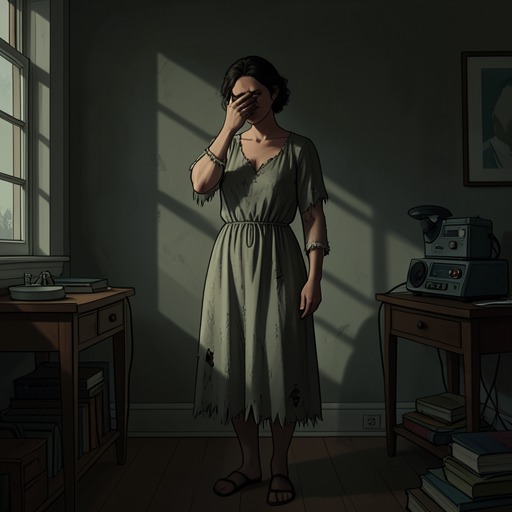
Constance Blackwood
We Have Always Lived in the CastleConstance Blackwood is Mary Katherine Blackwood’s sister, the household’s cook and caretaker, and the person whose quiet routines hold the surviving Blackwood family together. Her acquittal after the family poisoning does not settle the questions surrounding that day: Julian Blackwood recalls that she watched the others die without calling a doctor in time, and that she washed the heavy silver sugar bowl before the doctor or police arrived. Later, after the house is wrecked and Julian dies, Constance and Mary Katherine choose to remain together within its damaged walls, turning domestic care into a form of refuge from the village.
Identity and Domestic Life
Mary Katherine, eighteen at the beginning of the narrative, identifies Constance as the person she likes most. The sisters live together with Julian, whose needs Constance attends to as part of an established household routine. Food is precious to her, and she handles groceries with care. She plans meals around the people in the house: Julian is to have a softly cooked egg, a muffin, and pudding, while Mary Katherine will have a different meal. Constance also makes muffins and anticipates preserving wild strawberries from a patch near the garden.
The kitchen is her domain, but the arrangement is not simply a division of chores. Mary Katherine is not permitted to prepare food or gather mushrooms, although she sometimes brings in vegetables and apples. Constance sorts and stores supplies, cooks, and maintains the patterns through which the household continues. This practical care gives her authority over daily life while also making her routines a visible expression of the family’s preference for order and for keeping its world intact.
The Poisoning and Its Unresolved Questions
Constance’s history is marked by the deaths of the other family members and by her trial and acquittal for murder. In front of visitors, Julian points to the heavy silver sugar bowl, a family heirloom prized by his brother, and describes Constance taking it from the dinner table, emptying it, and scrubbing it with boiling water before the doctor or police arrived. The other dishes remained on the table. Constance had explained the washing by saying there was a spider in the bowl; the tea sugar used afterward came from a small rose-covered bowl.
Julian also tells the visitors that Constance saw the others dying and did not call a doctor until it was too late. His account makes the kitchen and its objects part of the family’s public history: the sugar bowl is at once an ordinary utensil, a treasured possession, and the focus of suspicion. The evidence does not establish what Constance knew or intended. Her acquittal is clear, while the reasons for her actions remain unresolved, preserved in competing accounts rather than explained away.
Family, Care, and Charles’s Arrival
Constance continues to care for Julian, whose attention is often absorbed by papers and memories of the family’s past. When Charles Blackwood arrives, she recognizes him immediately as their cousin and notes his resemblance to their father. She lets him into the house, crossing a boundary Mary Katherine has imagined as protection. Mary Katherine responds by fleeing to the creek with Jonas; Constance calls gently after her and holds out her arms, but does not force her to return.
Charles’s presence unsettles the household. When he threatens Mary Katherine, Constance tells him not to bully her and says the trouble is her fault. Later, when Charles calls the house crazy, Constance offers to clean his room and asks him not to be angry. These actions show her trying to manage conflict through accommodation and service, even as Mary Katherine experiences Charles as an intruder and remains intent on protecting her sister. Constance’s care is genuine, but it does not prevent her from giving Charles access or from becoming uncertain under his pressure.
Retreat, Loss, and the Damaged House
Constance eventually recognizes the cost of the household’s long retreat. She says she has been hiding, allowing Julian to live in the past and Mary Katherine to run wild, and acknowledges that she wanted to hide rather than face what was happening. This admission shifts her role: she is no longer only the keeper of domestic routine but someone who sees that the routine has also enabled neglect. Mary Katherine fears losing her and answers with the image of the moon; Constance echoes it, though her laughter is uneasy.
When the house catches fire, Constance says it has no right to burn after they had neatened it only days earlier. Mary Katherine takes her hand and leads her onto the porch, where they watch firefighters enter the house. After Julian’s death is announced, Mary Katherine guides Constance away through the woods to her hiding place. She covers her with Julian’s shawl, and Jonas is there with them. In that temporary shelter, the sisters’ separation from the house becomes a shared flight rather than an act Mary Katherine undertakes alone.
They return to find the kitchen overturned: furniture, dishes, food, and generations of household possessions have been broken or scattered. The little rose-patterned sugar bowl lies damaged, and Constance checks the cellar preserves. The preserved jars remain untouched; flour, salt, and potatoes also escape the destruction, although the sugar has been found. Constance begins restoring the practical order of the kitchen by preparing food from the surviving stores. The contrast between the ruined pantry and the intact cellar makes survival depend on what remains usable, not on restoring the old house as it was.
Change and Narrative Significance
Julian is gone, and Constance recognizes that the family and most of the house are gone with him. She and Mary Katherine decide to lock themselves in more securely than before. When Mary Katherine brings her their mother’s Dresden figurine, found unbroken outside, Constance holds it against her cheek and again takes responsibility for what has happened. The sisters then affirm their love for one another, making their bond the clearest surviving continuity in a household stripped of its former possessions and members.
Their seclusion becomes active work as well as withdrawal. Constance cleans Julian’s room, washes his sheets and blankets in the kitchen sink, and dries them outside. She hesitates over his papers, then decides to keep them in a box in the cellar. The sisters also use the garden: with Mary Katherine watching the barricades, they gather lettuce, radishes, tomatoes, cucumbers, berries, and melons. Ash remains on some of the vegetables, and Mary Katherine dislikes eating food while it is dirty with it, even as the sisters continue to draw sustenance from the ground around the burned house.
Constance’s arc is defined by the tension between protection and concealment. She sustains others through cooking, preserving, and care, yet comes to recognize that hiding has shaped the household’s decline. After the fire, she does not return to public life; she joins Mary Katherine in tightening the boundary against the outside world. Her character therefore links the disputed past of the poisoning to the sisters’ later domestic survival, where small acts—saving food, washing linen, keeping Julian’s papers—rebuild a life without resolving the history that preceded it.