Julian Blackwood's death
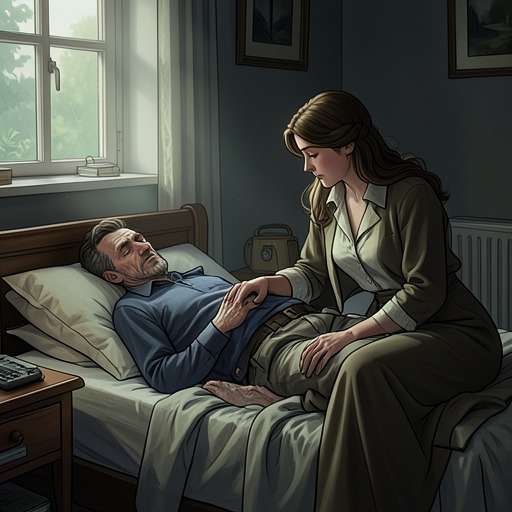
We Have Always Lived in the CastleJulian Blackwood's death is announced in the midst of the villagers' hostile gathering, abruptly breaking through their mockery and forcing the crowd to confront the loss in the house. Though Julian's death occurs offstage, its confirmation transforms the scene: Dr. Levy rules out murder, the gathering disperses, and Mary Katherine Blackwood and Constance Blackwood withdraw into the woods. In the days that follow, Julian's absence becomes tangible through his empty room and chair, a rosebush planted in his memory, and a gold pencil buried beside the creek.
Announcement and interruption
The villagers' taunting continues until Jim Clarke intervenes from the porch. He first tells them that enough is enough, but laughter rises again when someone repeats the burial taunt, “Down in the boneyard ten feet deep.” Jim then raises his voice and announces, “Julian Blackwood is dead.” The announcement changes the gathering's character: the villagers fall quiet, and their attention turns from the sisters to the death in the house.
Charles Blackwood asks whether Constance killed Julian. The crowd retreats in small steps, leaving a clear space around Constance, who stands with Julian's shawl across her face. Charles repeats the question. Dr. Levy, standing in the doorway, answers directly: “She did not,” adding that Julian died as he had always known he would and had been waiting a long time. The account gives no specific medical cause; it establishes instead that his death was expected by the doctor and was not, according to him, an act of murder by Constance.
The crowd disperses and the sisters retreat
Jim orders the villagers to leave quietly, explaining, “There has been a death in this house.” He turns people toward their cars and the driveway, physically guiding them away. Helen Clarke's “Poor Julian” is among the few words Mary Katherine hears as the crowd begins to depart. The scene's public commotion gives way to subdued movement: car doors close softly, motors start, and most of the lights turn down the driveway.
Mary Katherine leads Constance away from the gathering. She pulls her toward the darkness, past the lawn and onto the mossy path through the Woods surrounding the house. Once the trees have closed around them, she stops and embraces Constance, telling her, “It's all over,” and, “It's all right,” as if the retreat ends the immediate ordeal. The sisters' withdrawal does not undo the death or the damage to their home, but it marks their return to the privacy of the woods rather than remaining before the villagers.
Removal and belated grief
Sometime during the night, an ambulance arrives to take Julian away. Mary Katherine sees its small red light turn into the driveway and hears subdued voices and the opening and closing of doors. The callers address the sisters two or three times, perhaps asking whether they may take Julian, but no one enters the woods. Constance sleeps with Julian's shawl still around her, a remaining physical connection between the dead man and the family.
Mary Katherine sits beside the creek and wishes she had been kinder to Julian. She recalls that he had believed her dead; now he is dead himself. Her thought turns grief into a fearful warning, showing how his death registers not only as a loss but as a new danger in her private, magical view of the world. Later, when she and Constance consider what will happen next, Constance says Julian will have a funeral and be buried with the other family members. Mary Katherine says she had been in an orphanage when the others were buried, then asks to bury something for Julian. Constance answers that Julian and the others are gone and that most of the house is gone too: “we are all that is left.” The exchange places Julian's death within the larger family absence, while the sisters remain together with Jonas.
Objects of remembrance and narrative significance
After the death, ordinary household routine resumes only unevenly. Constance and Mary Katherine sit in the kitchen, eat chicken soup and bread, and place three unbroken chairs around the table. Constance turns toward Julian's closed room after thinking she hears him waking, then sits down again. The moment makes his absence recur inside a familiar domestic space; the sisters are not yet ready to explore the rest of the fire-damaged house.
Julian's room and belongings become part of the sisters' work of preserving his presence. Mary Katherine persuades Constance to wheel his empty chair into the garden and use it in a barricade. The worn places on the chair and a handkerchief beneath its cushion are what remain of his physical presence there; Mary Katherine imagines the chair's blank stare as a menace to intruders. She worries that he might vanish altogether as his papers are boxed, his toothbrush discarded, and his room loses his smell. Constance plants a yellow rosebush at his place on the lawn, and Mary Katherine buries his initialled gold pencil by the creek so that the creek will continue to speak his name. These acts do not reverse the loss: they give it a place in the altered house and landscape. The death is therefore both a confirmed event and an extended absence, announced publicly in a moment of disorder, then carried forward through the sisters' grief, their domestic hesitation, and their deliberate memorials.