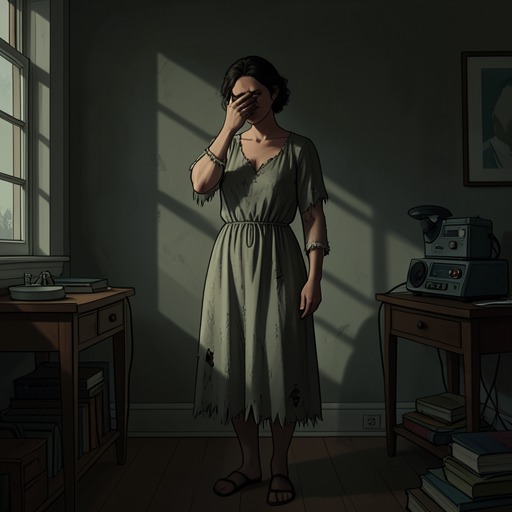
Mary Katherine Blackwood
We Have Always Lived in the CastleMary Katherine Blackwood, known as Merricat, is the eighteen-year-old narrator and surviving member of the Blackwood family whose secluded life is organized around her sister Constance and a private sense of danger. She approaches the world through rituals, protective magic, and deep suspicion of the villagers, while her eventual admission that she put poison in the family’s sugar reveals the hidden act behind the family catastrophe. Her account makes her at once a vulnerable outsider, a fiercely attached sister, and the concealed cause of the deaths that define her household.
Identity and Background
Merricat introduces herself as eighteen and living with Constance; everyone else in her family, she says, is dead. Her tastes set her apart from ordinary domestic expectations: she dislikes washing, dogs, and noise, but loves Constance, Richard Plantagenet, and Amanita phalloides, the deathcup mushroom. She also imagines that she might have been born a werewolf, connecting that possibility to the equal length of the middle fingers on her two hands. This is not presented as a literal transformation, but as one part of the supernatural framework through which she interprets herself and her circumstances.
The family’s settled habits give that outlook a material home. The Blackwoods rarely moved their possessions, and even objects that needed cleaning were returned to their established places. Their household accumulated layers of inherited belongings, kept in order as if that continuity could hold the family steady against the outside world. Merricat’s identity belongs to this closed, carefully maintained environment, but her own protective rules also suggest that order alone cannot make her feel safe.
Life Among the Villagers
Merricat states that the villagers have always hated the Blackwoods. Her account of shopping gives that hostility a public setting: she must travel from the library down Main Street and back toward the black rock marking the route home, treating the journey like a board game in which each stretch might bring danger or temporary safety. She carries library books and a shopping bag, watches her steps, and avoids looking toward the Rochester house, which reminds her that her mother was born there. She and her family no longer accept mail or keep a telephone, changes associated with the six years before the narrated present.
At Elbert’s Grocery, Merricat buys provisions for the household, including a roasting chicken, lamb for Julian Blackwood, milk, butter, eggs, and peanut brittle. The villagers’ comments make the errand an encounter with the family’s diminished status: Mrs. Donell remarks that the Blackwoods used to set a fine table, while other customers giggle or fall quiet. Merricat does not turn around to face them. Instead, she imagines that they might all die and that she could take what she wanted from the store; she does not regret these hostile thoughts, though she knows Constance has told her that hatred weakens her. Checking the shopkeeper’s arithmetic is a small way to assert control in a situation where no one offers to help carry her purchases home.
Protection, Constance, and Charles
Merricat’s protective magic gives form to her fear of intrusion. She says she had three magic words, MELODY GLOUCESTER PEGASUS, and believed that she and Constance were safe until someone said them aloud. When Charles Blackwood arrives, Constance recognizes him as their cousin and lets him into the house. His entry breaches the boundary Merricat had treated as a wall of safety. Charles addresses her as Mary and asks for a kiss; overwhelmed by his presence inside, she runs from the house to the creek, where Jonas finds her. She interprets the breach as the result of a protective book having fallen from a tree and not been put back, and resolves to find something powerful to fasten there instead.
Her bond with Constance remains the center of her choices. Even while Charles waits outside, Merricat hurries upstairs to fetch a sweater because Constance is cold, then returns to the kitchen. Later, during the conflict with Charles, she asks Constance to give Julian Blackwood a spice cookie and asks that Jonas receive one too. Her care extends across the household, but it also operates within a sharply divided world: Constance is the person whose words and needs matter, while Charles is someone Merricat believes must not be allowed to regain a hold on their home.
Conflict and the Family’s Hidden History
Merricat treats Charles’s attempts to challenge her as a threat to the household’s control. When he demands an explanation for the disorder in his room, she does not answer, believing that anything she tells him might help him regain his limited influence over the house. She calls him evil, a ghost, and a demon; Constance dismisses this as nonsense. Merricat’s language turns a family quarrel into a contest between the home’s supposed defenses and an intruder, showing how thoroughly her magical account shapes her understanding of conflict.
Julian Blackwood’s account of Merricat complicates that understanding. While working on his book, he tells Charles that his niece died in an orphanage during Constance’s trial for murder, even as Merricat is present and Charles points her out. Julian’s statement places her among the family’s unresolved history and its distorted retellings: he speaks of her as dead, but she remains the narrator through whom the scene is reported. Merricat, for her part, distinguishes herself from Julian by remembering that she buried money and he did not; she recognizes that he cannot remember Charles’s name and resolves to be kinder to him. The moment combines her practical awareness of Julian’s frailty with the unsettling gap between his story and her presence.
Admission and Significance
The clearest revelation comes when Merricat and Constance take refuge in her hiding place. Merricat has prepared it to be comfortable for Constance, with fresh leaves and a blanket, and covers her with Julian’s shawl. There, she says she will put death in everyone’s food and watch them die. Constance asks whether she means the way she did before, making plain that an earlier act lies behind the threat. Merricat later admits that she put it in the sugar. Constance says she knew at the time and adds that she never used sugar. Their exchange reveals that Merricat’s poisoning of the family was known between the sisters but had remained unspoken for six years.
That silence changes the meaning of Merricat’s protective rituals and her declaration that the rest of the family is dead. The girl who fears trespassers and imagines the villagers’ deaths has also committed the act that made her own family disappear. Yet the admission does not displace Constance from the center of her loyalties: the refuge is prepared for her sister, and the confession is spoken within their shared concealment. Merricat’s character is shaped by that unresolved conjunction of care and danger, secrecy and candor, domestic order and lethal disruption. Her magic cannot undo what happened; it gives her a language for trying to secure the fragile life she and Constance have chosen afterward.