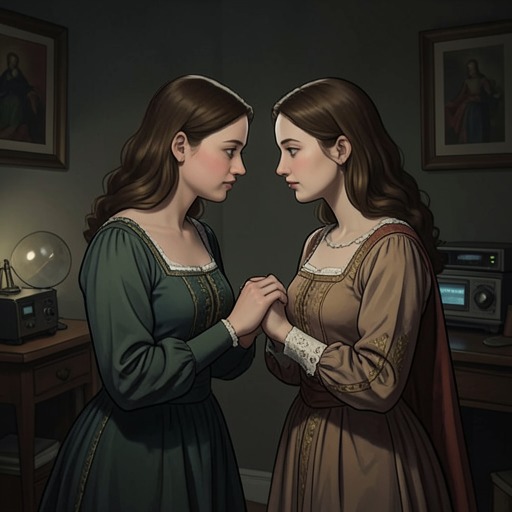
Merricat Blackwood—Charles Blackwood
We Have Always Lived in the CastleMary Katherine Blackwood’s relationship with Charles Blackwood is defined by a collision between her fiercely guarded idea of safety and his growing presence in the family home. She experiences him not simply as an unwelcome cousin but as the person who breaks through the household’s boundaries, resembles her father, and threatens her place beside Constance. Their conflict moves from wary first contact to open resistance, while Mary Katherine’s magical protections and Charles’s refusal to leave give the struggle its distinctive shape.
First Contact and the Breach of Safety
Before Charles appears inside the house, Mary Katherine relies on three protective words: MELODY GLOUCESTER PEGASUS. She believes they keep the household safe so long as nobody says them aloud. The protection is fragile even in her own account: she connects the breach to a book that fell from a tree and that she failed to replace. The logic reveals how she interprets Charles’s arrival through a private system of signs and safeguards, not that the words possess objective power.
Constance identifies the visitor as their cousin Charles Blackwood and says she recognized him because he looks like their father. Charles addresses Mary Katherine by her other name, Mary, and asks whether she will kiss her cousin. For her, the encounter is transformed by the fact that he is already inside: he is the first person to enter the house in this way, and Constance has let him in. Mary Katherine feels trapped and unable to breathe, throws down the sweater she had brought for Constance, and runs to the creek. Her retreat restores a temporary sense of distance. She sits with Jonas beneath the trees and decides she must find something powerful to attach to the tree and repair the protection she believes has failed.
Charles’s resemblance to their father recurs as an unsettling feature of his presence. At breakfast Mary Katherine cannot see him clearly, describing his face as either ghostlike or overwhelming; it turns between Constance and Uncle Julian before addressing her. Charles greets her, then proposes that he, Mary Katherine, and Jonas will become good friends. The offer contrasts sharply with her fear, but she remains withdrawn, lowering her face to Jonas. His friendly words do not dissolve her perception of him as a danger to the home or a rival for the attention and care that shape her life with Constance.
Resistance and the Contest for Place
The conflict also takes the form of a contest over Mary Katherine’s role in the household. At dinner Charles suggests that he is taking the younger cousin’s job away from her and that Constance will have to find something else for her to do. Mary Katherine answers by reciting detailed information about the Death cap mushroom: its poisons, the different speed of their effects, the delay before symptoms appear, and the possible course of illness. Charles stops eating and tells her to stop. Constance laughs and explains that she taught Mary Katherine to identify deadly mushrooms. Mary Katherine adds the timing of death, while Charles says he does not find the performance funny. Her speech serves as a calculated warning, but the exchange also exposes how little the two share in their interpretation of the threat: she presents knowledge meant to unsettle him, and he rejects it as humorless rather than engaging with its implied danger.
Mary Katherine eventually makes her opposition explicit, asking Charles to go away. He first acknowledges that she has asked, then refuses. His refusal turns her private distress into a direct confrontation and leaves her with no further words. She notices that he is wearing their father’s gold watch chain, including its crooked link, and is certain the watch is in his pocket. She imagines that he may next wear their father’s signet ring and make Constance wear their mother’s pearls. The family objects matter because she reads them as visible signs of Charles occupying a place that belongs to the household’s dead and, by extension, as evidence that his presence is expanding. After he suggests that in about a month one of them may no longer be there, Mary Katherine goes to their father’s room and cracks the mirror with a shoe.
Family History and Unequal Perceptions
The hostility carries the weight of an earlier family catastrophe, although Mary Katherine and Charles respond to that history differently. In a discussion about the old Sugar bowl, Uncle Julian emphasizes that it was a treasured heirloom and recounts that Constance emptied and scrubbed it with boiling water before the doctor or police arrived. Constance’s explanation to the police was that there had been a spider in it; another account recalls the suggestion that the family deserved to die. These recollections establish the charged history surrounding the family’s food and domestic objects. They do not establish what Charles knows or believes about the poisoning, but they clarify why household objects and questions of who may handle them carry such force in Mary Katherine’s world.
The novel repeatedly places Mary Katherine’s alarm beside Charles’s ordinary-seeming overtures. He proposes friendship with her and Jonas, but later tells her to find another occupation when he imagines her household work being taken away. He can be sociable and dismissive in close succession; she receives even a friendly approach through the danger she associates with his entry and resemblance to their father. Constance’s welcome of Charles intensifies the divide: Mary Katherine sees the open kitchen door as a broken boundary, while Constance recognizes a cousin and offers him a place at the table.
Possessions, Ruin, and the Limits of Protection
Charles’s influence becomes legible through domestic objects as well as conversation. Later, saucers from the family’s old pantry collection are scattered through the house after Constance has given them to him. One is in the bedroom, where his pipe is burning on it. Mary Katherine brushes both saucer and pipe into a wastebasket. Her response echoes her earlier attention to the watch chain: she registers Charles’s possession and use of inherited things as an intrusion into the order she wants preserved. The conflict is not only about whether he stays; it is also about who may place, use, or alter the objects through which the family’s past remains present.
After the house has been wrecked, Mary Katherine and Constance find the kitchen overturned and its stores broken or scattered. The small rose-patterned sugar bowl lies damaged, while the family silver, table linens, dishes, preserves, and cooking things have been disturbed. Mary Katherine imagines the attackers playing with the sugar, connecting the debris to the earlier history of the poisoned bowl. The scene shows the persistence of the conflict’s material vocabulary—food, heirlooms, and household boundaries—even when the damage is no longer confined to the sisters’ private dispute with Charles. It does not make Charles the agent of this destruction; instead, the ruined kitchen broadens the sense of an invaded home that has shaped Mary Katherine’s resistance to him.
Mary Katherine’s relationship with Charles therefore remains a struggle between an inwardly absolute idea of protection and an actual relative who refuses her demand to leave. Her magic words, retreats, warnings, and attacks on objects express her effort to hold a boundary that Charles has already crossed. His family resemblance, access to the household, and use of inherited possessions make that boundary feel intimate as well as physical. The antagonism matters because it turns the home’s ordinary arrangements—work, meals, welcome, and objects—into the visible terrain on which Mary Katherine tries to defend her place and her bond with Constance.