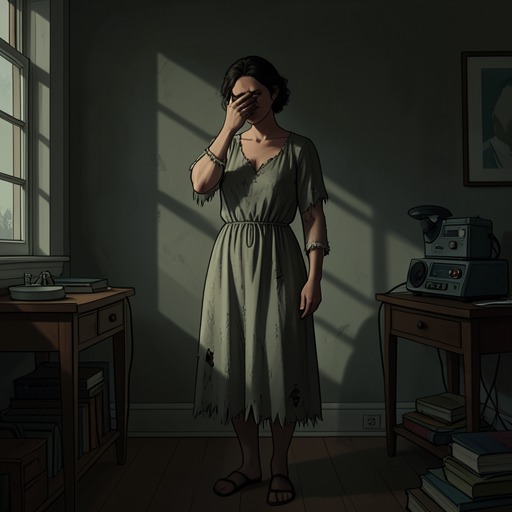
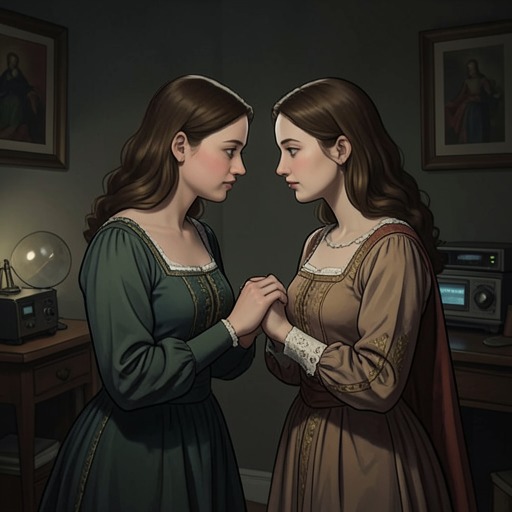
Merricat—Constance
We Have Always Lived in the CastleThe bond between Mary Katherine Blackwood and Constance Blackwood turns household care into both a language of love and a means of survival. Constance feeds, protects, and tends the people around her; Mary Katherine watches those acts closely, seeks ways to return care, and ultimately insists that the sisters face catastrophe together. Their intimacy is not free of guilt or strain: the poisoning shadows their shared life, and Constance’s responsibility for the household can be exploited by Charles Blackwood. After the villagers wreck their home, the sisters’ renewed declarations of love and decision to remain together make their relationship the surviving center of the family’s world.
Care as a Daily Practice
Constance’s affection is repeatedly expressed through food and attention to need. When she sorts groceries, she handles them with quiet respect, and plans distinct meals: a soft egg, muffin, and pudding for Julian Blackwood, and something lean, rich, and salty for Mary Katherine. Mary Katherine is forbidden to prepare food or gather mushrooms, though she can carry vegetables from the garden or apples from the old trees. The division makes Constance the household’s principal provider, while Mary Katherine’s attention to what others need becomes one of her ways of participating in care.
Constance’s care for Julian Blackwood is especially precise. She trims his toast into small, hot squares because food that looks difficult to eat may be left untouched, and brings hot milk in a jug painted with yellow daisies. His nights can be painful and wakeful; on some mornings, drowsiness after an extra pill leaves him unwilling to drink, but he wants to know that Constance is nearby in the kitchen or garden. Mary Katherine hopes to be kinder to him, imagines him in the sun, and asks Constance to make him a little soft cake. The sisters’ shared concern is conveyed through small requests and routines rather than declarations.
Charles Blackwood disrupts that arrangement by belittling Julian’s need for attention. While Charles eats a large breakfast in the kitchen, Julian lies drowsing over his hot milk; Charles tells Constance not to go whenever Julian calls and dismisses the care as indulgence. When Mary Katherine asks Constance to make Julian a cake, Charles answers for her, and Constance says she has too much to do. Mary Katherine points out that Julian is going to die. In this exchange, Charles’s presence does more than unsettle the sisters: it challenges the ordinary acts through which they have cared for Julian and one another.
Shared Guilt and Unequal Knowledge
The poisoning forms a concealed wound within the sisters’ closeness. Julian’s account of the aftermath emphasizes that Constance washed the heavy silver sugar bowl before the doctor or police arrived, while the other dinner dishes remained on the table. Constance explained that there had been a spider in it, and the bowl was replaced for tea by a small rose-covered one. Her immediate act of cleaning is thus both practical and conspicuous, a gesture the family’s later life cannot make innocent simply by leaving it unexplained.
The outside judgment of Constance sharpens the contrast between public accusation and private intimacy. Helen Clarke recalls that Constance cooked the dinner and set the table, then describes her as the person who watched the family die without calling a doctor in time and who washed the bowl. Constance repeats the spider explanation. Mary Katherine’s relationship to her sister is formed in the space between those accusations and the domestic life they continue to share: the household’s meals persist, but their familiar work carries the knowledge of what happened.
Later, Constance apologizes for having reminded Mary Katherine of why the others died. In the ensuing exchange, Mary Katherine confirms that she put it in the sugar; Constance responds that they will never speak of it again. The exchange does not undo the act or erase the memory. Instead, Constance’s refusal to reopen it establishes a boundary around their shared past, and her kindness reassures Mary Katherine without turning the confession into a public reckoning. Their love can coexist with the fact they agree not to discuss.
Intrusion, Protection, and the House
Charles’s arrival unsettles the sisters’ accustomed closeness by placing pressure on Constance and threatening Mary Katherine. When Charles intimidates her, Constance intervenes, telling him not to bully her sister and saying that it is all her own fault. Mary Katherine recognizes this as Constance’s new way of thinking. She tries to help by reciting the names of poisonous plants, but Charles tells her to stop. The episode shows the sisters defending one another in different registers: Constance directly challenges Charles, while Mary Katherine reaches for knowledge that might turn the balance of power.
Their attachment is also bound to the house and its things. Mary Katherine objects when Constance gives Charles old saucers that belong in the pantry; she later finds one scattered in his room beneath his burning pipe and removes it. Her concern is not only for an heirloom’s physical safety: the saucers should be put away, not displaced through the house. The disturbance of household order becomes part of the larger conflict over who may alter the sisters’ life and claim its possessions.
When the villagers attack the house, Mary Katherine asks Constance to run with her. Constance cannot immediately move, and Mary Katherine pulls her away just before a dining-room window breaks. As they flee, Constance covers her face with Julian’s shawl. The scene makes Mary Katherine’s protective urgency physical: she takes Constance by the hand and leads her out through the noise, while Constance’s first response is paralysis. Their escape depends on one sister acting when the other cannot.
The Bond After the Destruction
Returning to the house, the sisters find the kitchen overturned: broken dishes and food cover the floor, jars of preserves are smashed against the walls, and generations-old silverware lies bent and scattered. The rose-covered sugar bowl has lost its handles. Yet the cellar preserves remain untouched, along with flour, salt, and potatoes hidden from the intruders. This wreckage strikes at the domestic world Constance built, but it does not wholly erase the resources with which she can begin again.
Mary Katherine finds their mother’s Dresden figurine outside, unbroken against the roots of a bush, and carries it to Constance. Constance holds it to her cheek and says that the destruction was somehow all her fault. Mary Katherine answers with a declaration of love, and Constance returns it. When Mary Katherine asks again for the pink-frosted cake, Constance does not immediately promise it; she stands and says she will clean the kitchen first. Care resumes as work, not as a denial of what has happened.
The sisters’ recovery remains marked by loss. They sit in the damaged kitchen with chicken soup and buttered bread, uncertain how much of the house is still theirs. Mary Katherine asks what will happen to Julian, and Constance answers that there will be a funeral; Mary Katherine says she was in the orphanage when the others were buried. Later, they sleep on the kitchen floor, Constance near the stove and Mary Katherine beside her familiar stool, with Jonas nearby. Constance observes that she has cared for the kitchen so faithfully that it must welcome her there. The joke rests on a changed reality: the room once kept orderly is now their refuge in a ruined house.
Their continuing attachment is expressed through practical vigilance as well as affection. They leave the kitchen door open while gathering vegetables so they can watch for anyone approaching the barricades and run back if necessary. Constance cleans Julian’s room, washes his bedding in the kitchen sink, and decides to keep his papers in a box in the cellar. Their world has narrowed, but its old patterns of watching, tending, preserving, and deciding together remain. The relationship’s decisive change is not reconciliation with the outside world; it is the sisters’ renewed reliance on each other as the household they shared becomes a shelter they must maintain together.