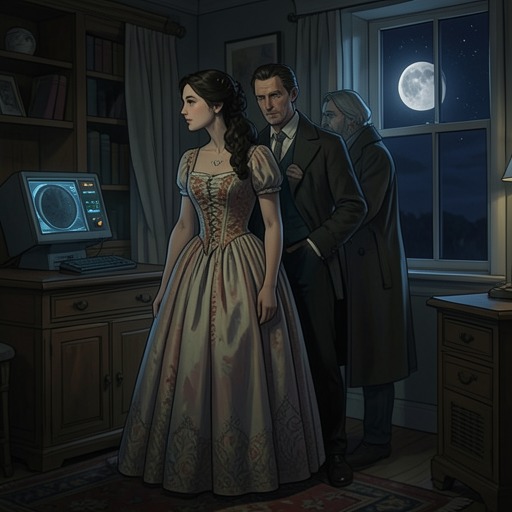
Merricat’s imagined refuge on the moon
We Have Always Lived in the CastleMary Katherine Blackwood’s imagined refuge on the moon gives shape to her wish for a world beyond the village’s ridicule and threat, where her household and the people she loves could be safe. It begins as a private mental retreat during a humiliating encounter and gathers details of its own: a blue house, a garden, an otherworldly language, and a life without ghosts or failing health. When Constance Blackwood joins the imagining, the moon becomes more than a hiding place in Mary Katherine’s thoughts; it offers the sisters a shared vocabulary for comfort, even as its impossible promises make clear how unsafe the world below feels.
Refuge from the Village
The moon first appears as an act of inward withdrawal while Jim Donell holds Mary Katherine back in Stella’s shop and mocks the Blackwood family’s private estate and declining fortunes. As he repeats his remarks, she refuses to follow his rhythm of repetition: she resolves never to think anything more than once and imagines herself on the moon, alone in a little house. The contrast is immediate. In the shop, other people control the conversation and her passage; in the imagined home, she belongs to herself.
The fantasy follows her outside without removing her from danger. After leaving Stella’s, Mary Katherine imagines a blue house with a fireplace and a garden, where she will eat lunch outdoors. She passes the town hall, whose workers issue dog licenses, count traffic fines, and send notices about water, sewage, garbage, leaf-burning, and fishing. These ordinary municipal powers crowd her awareness, but her lunar distance makes them seem remote: she thinks there is nothing to fear from them unless she fishes out of season. The thought of catching scarlet fish in lunar rivers turns a local restriction into one more element of a world she can mentally remake.
That retreat is tested when she sees the Harris boys gathered in their yard. She considers turning back by the highway and crossing the creek, but the groceries, the late hour, and the difficulty of wading in her mother’s brown shoes keep her on the direct route. As the boys call to her and line up by the fence, she imagines them suffering, while outwardly pretending not to understand their language. Her moon is thus not a literal escape from the encounter: it is a counterworld she summons while walking through it, a place from which the boys’ taunts cannot define her inward life.
A World Rebuilt in the Imagination
Mary Katherine’s lunar home is not a vague distant refuge. She furnishes it with a fireplace, a garden, and a blue house, then wonders what could grow there and plans to ask Constance. Its brightness and odd colors distinguish it from the familiar village. Even the imagined garden answers a practical desire: she wants to eat outside among plants, beyond the boundaries that shape her ordinary movements.
When the boys recite a taunting rhyme about Mary Katherine and Constance, she imagines that people on the moon speak a soft, liquid tongue and sing in the starlight while looking down on a dead, dried world. The contrast converts the boys’ words into something she does not have to accept on their terms. Their rhyme invokes a graveyard; her imagined language and starlit perspective place her somewhere else. The moon does not erase the insult, but it gives her a way to refuse its authority over her imagination.
Safety, Magic, and Care
The refuge also touches Mary Katherine’s protective magic. In one morning ritual, she chooses three powerful words that must not be spoken aloud if no change is to come. She writes the first, “melody,” in apricot jam on her toast with a spoon handle and eats it quickly, declaring herself one-third safe. This is a distinct protective practice, but it belongs to the same pattern as the moon fantasy: security is made through private rules, objects, and acts of imagination when the world feels uncertain.
Her concern for Julian Blackwood gives the moon a more tender purpose. When Constance reports that he has eaten little breakfast and is tired, Mary Katherine imagines flying him there on a winged horse so he could be more comfortable. Constance plans instead to take him into the sunshine and perhaps make eggnog. Mary Katherine’s response, “Everything’s safe on the moon,” turns the fantasy from solitary shelter toward a wish for her uncle’s well-being. The image of the moon matters not only because it removes her from danger, but because it can hold those for whom she fears.
Constance Joins the Vision
Later, while Constance talks about the prospect of picking lettuce in the warm weather, Mary Katherine begins, “On the moon,” and stops. Constance catches the thought and asks whether lettuce might grow there all year. Her response is small but consequential: the private refuge has become something the sisters can briefly inhabit together, through a question about an ordinary garden crop.
Mary Katherine expands the shared picture into abundance and protection. The moon has lettuce and pumpkin pie, cat-furred plants, and horses with wings; all its locks are solid and tight, and there are no ghosts. Its comforts are domestic as well as fantastic: Julian Blackwood would be well, the sun would shine every day, and Constance would wear their mother’s pearls and sing. The secure locks answer vulnerability with enclosure, while the garden and food make safety feel like a continuation of the sisters’ household life rather than an escape from it.
Constance says she wishes she could go to Mary Katherine’s moon, then returns to the practical matter of starting gingerbread before Charles is late. Mary Katherine answers that she will be there to eat it. The exchange holds fantasy and routine together: the moon promises permanent sunshine and freedom from fear, while the conversation returns to baking and the expected meal. That return does not cancel the refuge. Instead, the imagined place draws its force from the care and domestic rituals the sisters already share, and from the contrast between that intimacy and the exposed, hostile world outside.