The Blackwood house fire
We Have Always Lived in the CastleThe Blackwood house fire begins with Charles Blackwood’s pipe and turns a domestic accident into a rupture in the sisters’ isolation. As smoke spreads through the house, Mary Katherine Blackwood and Constance Blackwood leave their familiar rooms for the porch, where they watch firefighters and villagers enter a home they had tried to keep closed to the outside world. The blaze is put out, but the house’s sanctuary does not simply return: the Village’s presence and the destruction of the kitchen make the aftermath a second assault on Blackwood family order.
Causes and Background
The fire breaks out while Charles Blackwood is living in the house and pressing into its routines. Before the smoke appears, Mary Katherine finds him upstairs with a pipe burning on a saucer. The saucers are old family pieces, kept on a pantry shelf and not meant to be scattered through the rooms. She brushes the saucer and pipe into the wastebasket, but the incident foreshadows the danger that soon becomes unmistakable. At dinner, Charles notices smoke. When Constance goes to investigate, he turns toward Mary Katherine and suspects she has caused it; Constance then identifies his pipe, and Charles runs upstairs. The episode locates the fire’s immediate cause in Charles’s smoking, not in the accusation he directs at Mary Katherine.
The family’s earlier poisoning gives the Sugar bowl a charged place in this domestic setting. After the poisoning, Constance had taken the heavy silver heirloom into the kitchen, emptied and scrubbed it with boiling water before the doctor or police arrived. She explained that there had been a spider in it; the account also records that she gave this explanation to the police. Helen Clarke voices the harsher public inference: Constance had cooked and served dinner, watched people die without calling a doctor in time, and washed the bowl. The fire does not resolve that history, but it makes a room full of family objects newly vulnerable. The sisters’ house is both their refuge and the material setting of a secret that outsiders continue to judge.
Smoke, Flight, and Rescue
When Charles first reports smoke, Constance checks the kitchen and finds that the stove is not responsible. Mary Katherine asks whether the pipe could start a fire; a scream from upstairs answers the question before Charles comes rushing down. He announces that the whole house is burning and points out that the sisters have no phone. He then tries to get out through the front door, urging Constance not to carry the safe and saying he will fetch help. His alarm contrasts with Julian Blackwood’s measured concern for his papers: Julian resists running and insists there is time to collect them. Constance helps him toward his room while Mary Katherine looks up the stairs.
The fire is already visible inside their father’s room. Mary Katherine watches it move upward and initially sees no need to hurry; to her, the flames do not seem to be rushing. When a tongue of fire reaches into the hall and something crashes upstairs, that illusion of distance ends. She and Constance go out through the open front door. Constance says the house had been put in order only recently and shivers with anger as well as fear. Mary Katherine takes her hand and leads her toward the vines at the porch corner, a darker, more sheltered place to watch from.
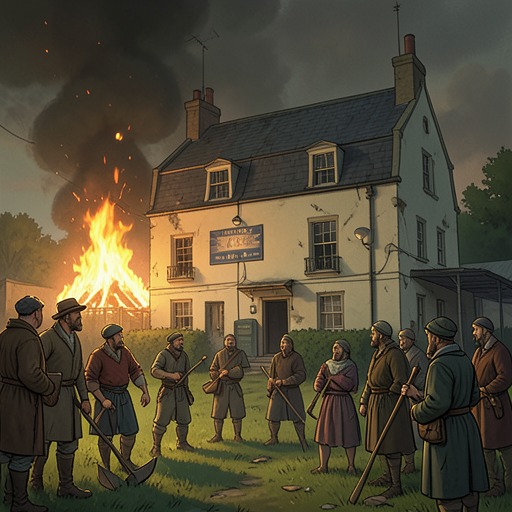
The arrival of the fire engine brings light, noise, and people across the threshold. Jim Donell is the first firefighter to run up the steps; he pushes past the sisters and enters the house. The two women retreat along the porch and press into the vines as men drag hoses across the doorsill. Under the lights, the front of the house appears exposed in a way it had never been before. Charles, now among the people outside, repeatedly calls for the family safe to be brought out of the study. For Mary Katherine, the fire is not only a threat to the building: the voices and movement of the response fill the house with the disorder of the outside world.
The Fire Is Contained
Mary Katherine interprets the blaze as Charles’s fire and imagines that, once the firefighters have finished, she and Constance can go back inside and begin cleaning. She believes Julian may forget the fire if he becomes absorbed in his papers, and thinks Jonas is probably watching from the trees. These expectations belong to her effort to preserve an ordinary, private world even as the house burns and the driveway fills with cars. Constance, meanwhile, sometimes watches the men and sometimes covers her eyes.
The crowd’s response carries a different meaning. A woman calls for the house to be left to burn; others laugh about the damage and say the old place ought to have burned down years earlier. The remarks turn the emergency into an occasion for the Village to express its hostility toward the Blackwoods. The firefighters continue working, and the voices inside grow steadier as the fire loses force. Someone reports that it is going out; another says it is under control. Charles’s attempt to direct the rescue and the villagers’ wish to see the house destroyed coexist in the same scene, while Constance and Mary Katherine remain outside, unable to control who enters or what happens within.
Damage and Aftermath
The fire is contained, but the house’s ordeal is not over. When the sisters return, the kitchen doorway is obstructed by a table turned on its side. Inside, chairs are smashed, dishes and glasses lie broken, food containers are ruined, and papers have been torn from the shelves. Jars of preserves have been hurled against the walls. The sink where Constance washed dishes is filled with broken glass; drawers and generations of Blackwood silverware have been pulled out and scattered or bent. Table linens, repeatedly mended and cared for, have been ripped from the sideboard and dragged across the room. The damage is deliberate and domestic: it attacks the objects through which the house’s routines and inherited history had been maintained.
The small rose-patterned Sugar bowl lies near Mary Katherine with its handles gone. She thinks the intruders found the sugar and imagines them throwing it at one another, a bitter echo of the poisoning that had already made sugar and the bowl inseparable from suspicion. The cellar, however, has not been searched or disturbed. Constance finds that the preserved food remains intact and brings jars of soup, jam, and pickled beef upstairs; she also discovers that flour, salt, and potatoes have been missed. This contrast between ransacked shelves and untouched stores gives the sisters the means to resume feeding themselves, even as the familiar kitchen has been transformed into a scene of violation.
The damage extends into the garden’s daily use. Mary Katherine and Constance can gather vegetables only while watching their barricades and remaining ready to run back indoors; the lettuce they bring in is grey with ash. Mary Katherine dislikes eating produce marked by soot and thinks the smoke has entered the ground and may remain there. Constance cleans Julian’s room, washes his bedding, and decides to keep his papers in a box in the cellar. These small acts of retrieval and care follow the public emergency: the sisters restore what they can, but the fire and the violence around it have altered the conditions under which their household life continues.