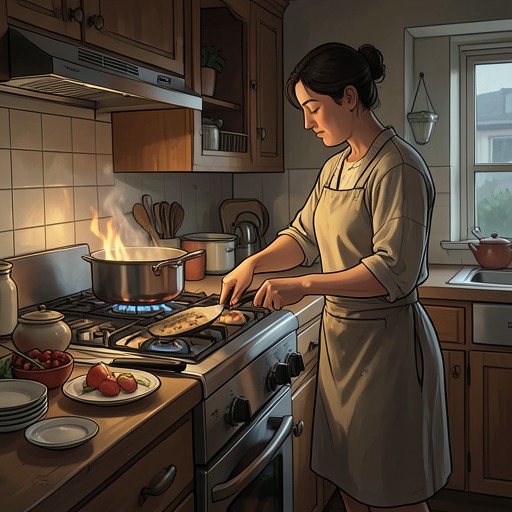
The family rule forbidding Merricat from preparing food
We Have Always Lived in the CastleThe family rule forbidding Merricat from preparing food is a practical boundary within the Blackwood household, assigning Constance authority over food preparation while limiting Merricat’s participation. It does not exclude Merricat from every task connected with food: she carries produce from the garden and tends Constance’s tools. But the repeated prohibitions on helping in the kitchen, handling knives, and gathering mushrooms make the boundary unmistakable. Its significance lies in this contrast between restricted domestic labor and the knowledge Merricat nevertheless possesses about what can be eaten—and what can kill.
Identity and Scope
The rule is presented through Merricat’s account of what she is and is not permitted to do. When she and Constance return with groceries, Merricat explains that she cannot help prepare food. Constance unpacks the provisions and decides what each person will eat: Uncle Julian is to have a soft egg, a muffin, and pudding, while Merricat is promised food suited to her own preference. Merricat can ask whether Uncle Julian may have peanut brittle, but Constance determines when he may have it. The scene places Merricat near the food and its distribution without giving her control over its preparation.
The restriction has clear limits rather than amounting to a ban on all assistance. Merricat says she may carry vegetables in from the garden and apples from the old trees. On Saturday mornings she helps Constance with garden work, keeps the tools clean, and carries flowers or vegetables that Constance has picked. Yet Merricat is not allowed to handle knives, and she is specifically barred from gathering mushrooms. The household thus permits her some work at the edges of food production while reserving the transformation of ingredients into meals for Constance.
Household Practice and Care
Constance’s authority over food belongs to a larger pattern of daily care. She prepares Uncle Julian’s meals with close attention to what he can manage: his toast is cut small, his hot milk placed in a yellow-daisy jug, and his tray carried to him when he has spent a difficult night. On better mornings she brings him into the kitchen to eat at his desk among his papers. Merricat’s requests show her concern for him, including asking Constance to provide peanut brittle or a soft cake, but the requests do not make Merricat the person who cooks. When Charles is present, he comments that Constance is overworked; Constance herself says she has too much to do to make the requested cake. The rule therefore operates within a household where food preparation is both practical labor and a principal expression of Constance’s care.
Food also carries a family history that reaches beyond the daily menu. The cellar contains preserves made by generations of Blackwood women, alongside Constance’s more recent jars. The family keeps its own new preserves for eating but does not consume the older stores; Constance warns that eating them would be fatal. This separate restriction reinforces the household’s careful distinctions around food: who prepares it, which supplies may be used, and which inherited provisions must remain untouched. Merricat’s occasional garden labor does not dissolve those distinctions.
Knowledge and Contradiction
The rule’s sharpest contradiction appears when Merricat speaks about poisonous mushrooms. At dinner she recites the effects and timing associated with Amanita phalloides, including the delay before symptoms and the possible progression toward death. Constance explains that she taught Merricat to identify deadly mushrooms after pointing out mushrooms in the fields and by the creek. Merricat is forbidden to gather mushrooms, but she has nonetheless been taught how to recognize them and can describe their danger in precise terms. Knowledge and permission are not the same: the rule restricts her practical participation, not what she has learned.
That distinction matters in a family marked by poisoning. Julian recalls that Constance washed the heavy silver sugar bowl before the doctor or police arrived, explaining that she had said a spider was in it. Helen Clarke also recounts the accusation that Constance saw the family dying without calling a doctor in time and that she washed the bowl. These recollections attach danger and suspicion to food and its handling, but they do not establish that Merricat’s restriction caused, prevented, or explains the poisoning. Rather, the rule makes kitchen access part of a wider household order in which the preparation, cleaning, and trustworthiness of food have become charged questions.
Disruption and Significance
After the villagers wreck the kitchen, the familiar arrangement of food and domestic work is materially disturbed. The kitchen table has been overturned; dishes, stores, and cookware have been scattered or broken, and the rose-patterned sugar bowl lies damaged. The cellar preserves, however, remain untouched. Constance begins putting together food from those stores, while Merricat notices the sugar on the floor and imagines that the intruders have sought it out. The scene makes the kitchen’s vulnerability visible without showing the household’s division of labor simply disappearing: Constance still retrieves food and begins preparing breakfast, while Merricat remains beside her as they confront the damage.
Later, the sisters go to the vegetable garden with a basket, keeping watch for anyone approaching their barricades. They bring back lettuce, radishes, tomatoes, cucumbers, berries, and melons. Merricat dislikes eating produce still dirty with ash, even though most soot has blown away and the garden air is clean. The episode connects food to a damaged home and to the sisters’ guarded return to ordinary routines; it does not say that Merricat takes over cooking. Across these scenes, the rule marks both a division of household authority and a limit on Merricat’s role in caring for the family. Her proximity to the garden, her attention to what others should eat, and her knowledge of poisonous plants make that exclusion more complex than simple unfamiliarity with food. The boundary is maintained amid care, suspicion, and upheaval, even as the evidence leaves its origins and full rationale unstated.