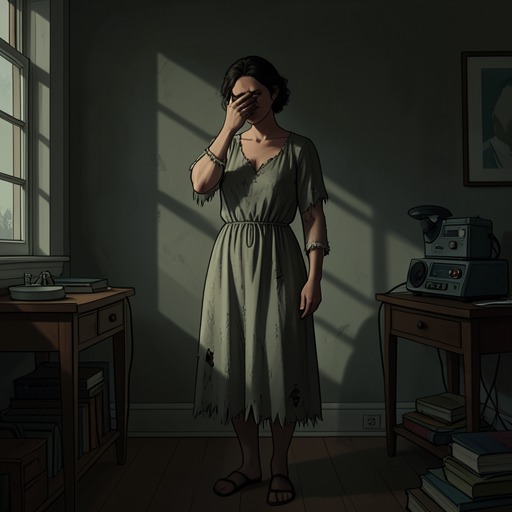
The sisters seal themselves inside the ruined house
We Have Always Lived in the CastleThe sisters’ decision to seal themselves inside the ruined Blackwood house is both a response to the destruction around them and a choice about the life they will lead afterward. Constance Blackwood and Mary Katherine Blackwood lock doors, shut away rooms, cover windows, and decline an offered way out. Their precautions make a damaged home safer from intrusion, but they also turn isolation into a daily practice: the sisters organize their movements, routines, and view of the outside world around keeping other people at a distance.
Background: A House Made Vulnerable
The sealing begins after the Blackwood house has been left partly burned and ransacked. The kitchen, once the center of Constance Blackwood’s work, is obstructed by an overturned table and littered with broken dishes, smashed chairs, shattered jars, torn food boxes, and scattered silverware. Generations of family possessions lie damaged together. The attackers have broken the little rose-patterned sugar bowl, while sugar itself has been found among the pantry goods they scattered. The disorder is not abstract: it reaches into the utensils, preserves, linens, and serving pieces through which the sisters’ domestic life had been maintained.
That domestic space already carried the weight of suspicion. After the family poisoning, Constance Blackwood washed the heavy silver sugar bowl before the doctor or police arrived, explaining that there had been a spider in it. Helen Clarke later emphasized that Constance had watched family members die without calling a doctor in time and had washed the bowl. These are accusations and explanations preserved in the story, not a new verdict supplied by the sisters’ retreat. They do, however, establish how household acts and objects have become charged with public scrutiny. Later, before the fire, Mary Katherine Blackwood found Charles Blackwood’s smoking pipe resting on an ancestral saucer that Constance had given him; she returned the saucer to the wastebasket. The family’s objects repeatedly cross the boundary between private ritual and outside disruption.
After the destruction, Constance Blackwood first checks what remains usable. She searches the cellar and finds that the preserves are untouched, bringing jars of vegetable soup, strawberry jam, chicken soup, and pickled beef upstairs. The flour, salt, and potatoes are still available, although pantry goods have been scattered or trampled. This recovery gives the sisters the means to resume meals, but not the house as it was. Their new refuge has to be made from what survives.
Closing the House
Constance Blackwood states the plan plainly: the sisters will lock themselves in more securely than before. The announcement comes alongside the realization that Julian Blackwood and the other family members are gone, and that the sisters are all that remain. Constance also rejects the ordinary social calendar that had persisted in the house: Helen Clarke is due to come for tea, but Constance says, “Not again. Not here.” The refusal marks more than a missed visit. It is the first clear declaration that the damaged house will no longer receive the visitor who once came to tea.
The sisters begin by deciding which parts of the house they can still inhabit. Constance restores the Dresden figurine to its place beneath their mother’s portrait in the drawing room. For a brief moment, the arrangement makes the shadowy room feel whole again; then the damage reasserts itself. Their father’s safe remains unopened near the doorway, too heavy to have been carried away. Above, the roof has opened to the sky, and the upper rooms are burned or exposed. Mary Katherine Blackwood thinks of the lost rooms and possessions, including their father’s watch and their mother’s dressing set. The house can still be called a castle, but it is now open overhead and marked by ruin.
Instead of trying to restore every room, the sisters establish boundaries within the wreckage. They close the drawing-room door and never open it again. They sweep rubble into the dining room, clear a passage from the kitchen to the front door, and shut the dining-room doors permanently. Constance scrubs the kitchen floor and sets out the surviving cups and plates. The sisters choose usable pieces from the broken china, including a green cup for Mary Katherine Blackwood and a white cup with orange flowers for Constance Blackwood. Constance recalls how the household’s china had moved from best dishes to everyday use and then to the pantry shelf; now the surviving cups allow them to keep eating at a table, “like ladies.” Domestic order returns in reduced form, through selection and reuse rather than repair of the whole house.
Once the kitchen and passage are cleared, the exterior doors are locked and bolted. The sisters drink milk at the kitchen table while Jonas drinks from a pan. When knocking begins at the front door, Constance Blackwood goes down to the cellar, and Mary Katherine Blackwood checks that the kitchen door is bolted before following. They listen from the cellar stairs as Helen Clarke calls for them. Their retreat is no longer simply an attitude: the locked doors and concealed position make it physically difficult for anyone to reach them.
Refusing Rescue and Blocking the Windows
Helen Clarke circles the house and knocks at the kitchen door. Because its upper half is glass, the sisters know she may be able to see inside, but they remain hidden on the cellar stairs. Helen Clarke says she can see something cooking on the stove and asks them to open the door. She offers to take Constance Blackwood and Mary Katherine Blackwood to her home until others can decide what to do. She presents the offer as reassurance, saying that everything can be forgotten. The sisters do not answer. Jim Clarke refuses Helen’s suggestion that he break down the door and tells her, “Leave them alone, Helen, they’ll come out when they’re ready.” His intervention leaves the locked threshold intact, but the scene also confirms that help and intrusion are difficult for the sisters to distinguish.
Mary Katherine Blackwood then makes the barriers less permeable. She takes apart a heavy cardboard carton and nails pieces across the glass in the kitchen door and the two kitchen windows. She suggests letting the windows grow dirty if that would make them less conspicuous; Constance Blackwood objects that she would not live in a house with dirty windows. The exchange sets the sisters’ different needs against each other: Mary Katherine Blackwood prioritizes concealment, while Constance Blackwood still wants the brightness and cleanliness of a functioning kitchen. The cardboard solves one problem at a cost. The room is clean but dim, and Constance is displeased that the sunshine she loves has been shut out.
The sisters briefly consider leaving the door open while keeping watch for cars. Mary Katherine Blackwood intends to find a way to barricade the sides of the house so that no one can approach from the back. When a car later stops, the sisters fall silent and check that the kitchen door is bolted. The visitors first knock at the front, then try to find their way around the house in the dark. Jim Clarke and Dr. Levy reach the back, where they discover that the house is boarded up. Mary Katherine Blackwood welcomes the obstacle as protection; she had thought only of cardboard, but there are real boards in the tool shed. The failed approach teaches her that the available defenses are stronger than she had supposed.
Seclusion as a Daily Routine
The barriers do not end the sisters’ contact with the world so much as regulate it. Once they can see whether anyone is approaching the barricades, they leave the kitchen door open to go to the vegetable garden. They carry back lettuce, radishes, tomatoes, cucumbers, berries, and melons, though Mary Katherine Blackwood dislikes eating produce still dirty with ash. Most of the soot has blown away, but she thinks the smoke remains in the ground. Food gathering is therefore both a practical continuation of household life and a reminder that the fire has entered the soil around the house.
The sisters also resume care for what the household has lost. Constance Blackwood cleans Julian Blackwood’s room, washes his sheets and blankets in the kitchen sink, and dries them outside. She keeps his papers in a box and plans to put it in the cellar. Yet the sisters’ permitted range contracts: Mary Katherine Blackwood is no longer allowed to go to the creek, where Julian Blackwood is, and does not go farther than the edge of the woods; Constance Blackwood goes only as far as the vegetable garden. Mary Katherine Blackwood is forbidden to bury anything more or touch stone. The restrictions turn the house’s defenses into rules governing the ground beyond it as well.
At the front door, the sisters watch through narrow peepholes and monitor the people who pass. Mary Katherine Blackwood checks the boards across the kitchen windows for cracks and nails more boards over them; each morning she makes sure the front door is locked, while Constance Blackwood washes the kitchen. The sisters see children playing and people walking past, whom Mary Katherine Blackwood describes as strangers. One group of cyclists rests on the lawn and driveway; a woman remarks that vines almost hide the burn marks on the roof and that the house was once a local landmark. The house remains visible enough to be discussed, but the sisters’ narrowed openings let them observe passersby without being seen clearly in return.
Meaning and Aftermath
The sealing of the house does not produce complete separation. People from the Village later leave food baskets silently on the doorstep in the evenings, sometimes adding notes that apologize for damaged dishes, curtains, or a harp. The sisters wait until darkness before bringing the baskets inside and then return them to the same place. This quiet provision complicates the boundary: the sisters refuse direct visits and do not open the door to those who come calling, yet food enters their lives through the threshold they guard. Their seclusion is maintained through a combination of refusal, watchfulness, practical dependence, and small acts of care offered at a distance.
The ruined home becomes a sanctuary through repeated acts of closure: a room is shut and not reopened, a passage is cleared, a door is bolted, a pane is covered, and a crack is boarded over. At the same time, the sisters preserve fragments of the domestic world—cups, meals, washing, gardening, and the care of Julian Blackwood’s belongings. The result is neither a return to the former household nor an escape from it. It is a narrower life constructed inside the damaged house, where security depends on controlling access and where every surviving household ritual helps the sisters inhabit what remains.