The village mob vandalizes Blackwood House
We Have Always Lived in the CastleThe village mob’s destruction of Blackwood House begins only after the fire is declared out: Jim Donell, the local fire chief, breaks a window, and the assembled villagers follow his act by invading and wrecking the house. The attack turns the sisters’ home from a threatened building into the object of communal spectacle. Mary Katherine Blackwood and Constance are driven out, while the objects and rooms that organized their private life are broken, scattered, or soiled. Their later return does not restore the house to its former order; it establishes the damaged home as the setting for their continuing seclusion.
Background and Turning Point
The attack unfolds at the fire’s end. Onlookers remark that it is a substantial fire, and one calls on Jim Donell to let it burn. Donell instead raises his hands to quiet the crowd and announces that the fire is out. He then takes off his hat marked CHIEF, walks to the fire engine, sets the hat on its front seat, and searches for a rock. In full view of the crowd, he throws it through a tall window of the drawing room. The deliberate sequence—from ending his official role to breaking the house’s window—marks the change from watching a fire to participating in the assault.
The villagers’ hostility also draws on the Blackwood family poisoning and its aftermath. Earlier, Constance had washed the family’s heavy silver sugar bowl before the doctor or police arrived, explaining that there had been a spider in it. Helen Clarke later repeats the accusation that Constance saw the family members dying without calling a doctor in time and had washed the bowl. At the house, the crowd turns the family’s association with poison into a taunting refrain, linking the old suspicion to the present attack. The narrative presents those words as part of the mob’s conduct, not as a new finding about what happened at the dinner.
The Assault on the House
After Donell breaks the first window, laughter rises behind him and spreads through the crowd as it moves toward the house. A second drawing-room window breaks from inside, struck by the lamp that usually stood beside Constance’s chair. A Dresden figurine is thrown against the porch rail and breaks; another falls intact and rolls across the grass. Constance’s harp is knocked over, and a chair is smashed against a wall. These are not simply damaged possessions: the attack reaches into the rooms and familiar arrangements that had made the house a protected domestic space.
The destruction broadens from the drawing room to the house’s other contents. The mob smashes dishes, glasses, silverware, and cooking pots, while people inside call for help with the safe. A little girl comes out carrying Constance’s spice cookies, but her mother stops her and makes her drop them. The moment places even food made in the household within the disorder surrounding the house. Later, Mary Katherine finds that some of the family’s old saucers have been scattered through different rooms after Constance gave them to Charles; one has held a pipe without cracking. The contrast between their former storage in the pantry and their new, careless dispersal reflects the larger displacement of household objects during the attack.
The Sisters’ Escape
Mary Katherine calls to Constance, who covers her eyes and cannot leave at first. When someone inside calls to her through the refrain, Mary Katherine pulls her away just before the dining-room window breaks. Constance covers her face with Uncle Julian’s shawl. They head for the steps and the woods, but cannot move without crossing the illuminated lawn. A car arrives as the crowd continues throwing the household’s possessions out or breaking them inside. Jim Clarke enters the house, condemning the people wrecking it, while Helen Clarke remains outside, staring at the scene. Dr. Levy arrives and asks for Uncle Julian; a woman answers with a taunt about his burial.
The sisters try to descend slowly because Mary Katherine fears Constance may stumble. They are spotted before they reach the bottom of the steps, and villagers gather around them, laughing and keeping just out of reach. Constance continues to hide her face beneath the shawl. The crowd’s chant mingles with singing and shouting; the repeated words turn the sisters’ private family history into a public performance. Different groups block the routes Mary Katherine tries: Jim Donell’s wife and Mrs. Mueller stand in front of them; Stella and the Harris boys cut them off; Elbert the grocer and his wife halt another attempt; and Jim Donell steps into their path. Mary Katherine repeatedly turns and tries another direction, but the crowd closes around them again.
The sisters are not described as being struck, but the crowd’s numbers and movements leave them surrounded and unable to reach either the woods or the house. Mary Katherine stops when Constance stumbles, unwilling to risk her falling amid the press of people. At last, they find an opening and run toward the trees. The attack therefore produces an immediate reversal: the estate that had kept the sisters apart from the village cannot protect them once the crowd crosses its boundary, and escape requires abandoning the house.
Return to a Ransacked Home
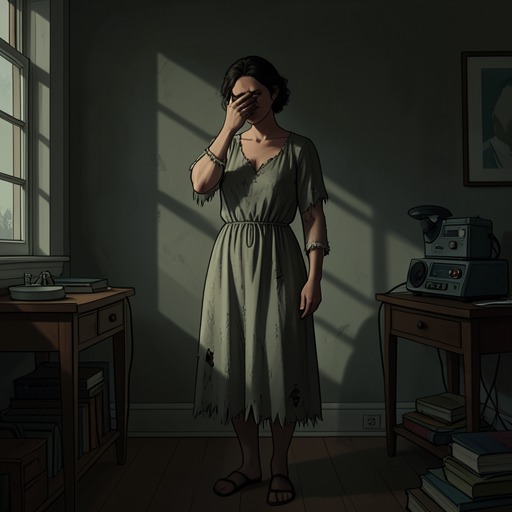
When the sisters return, the kitchen door is obstructed by a table turned on its side. Inside, two chairs are broken; dishes, glasses, food boxes, and papers cover the floor. Jars of jam, syrup, and catsup have been smashed against the walls. The sink where Constance washed dishes is filled with broken glass, and drawers of silverware and cookware have been pulled out and broken. Silverware handed down through generations of Blackwood women lies bent and scattered; tablecloths and napkins, repeatedly washed, mended, and kept, have been dragged across the kitchen.
The rose-patterned sugar bowl lies near Mary Katherine with its handles gone. Constance picks up a silver spoon, recognizes its pattern as their grandmother’s wedding pattern, and sets it on the table. She then checks the cellar. The preserved food there has not been touched, though much of the pantry has been disturbed: the villagers reached the cereals, spices, and canned food, and sugar is scattered across the floor. Flour in a barrel, salt, and potatoes remain undiscovered. That difference between the damaged kitchen and the untouched cellar stores gives the sisters supplies with which to resume household routines, even as the mess records how thoroughly their space has been invaded.
Aftermath and Significance
Constance begins again with practical care: she washes her hands, sets about breakfast, and brings jars of soup, jam, and pickled beef from the cellar. The sisters later gather vegetables from the garden, including lettuce, radishes, tomatoes, and cucumbers, but Mary Katherine dislikes eating produce still dirty with ash from the burned house. The soot has mostly blown away from the garden, yet she thinks smoke remains in the ground. The fire’s effects thus persist beyond the night of the attack, marking even the place from which they obtain food.
The episode does not end with the sisters reclaiming an intact home or reconciling with the villagers. Rather, the house’s destruction gives their withdrawal a new physical basis: they return to a damaged interior, take stock of what remains, and carry on with the domestic work that the crowd tried to disrupt. The communal laughter, the broken heirlooms and kitchen goods, and the ash in the garden make the contrast sharp between the sisters’ guarded household and the village outside it. The mob’s violence changes the condition of their refuge without ending their attachment to it.