The village’s rejection and persecution
We Have Always Lived in the CastleThe village’s rejection and persecution is the social pressure against which the Blackwood sisters’ isolation takes shape. It appears not as a single confrontation but as a pattern of exclusion: village gossip, wary encounters in shops, public taunts, and resentment of the family’s land and money. Mary Katherine Blackwood experiences these acts as a continuous threat, while the novel’s competing perspectives leave room to distinguish what the villagers do from what her fear leads her to expect.
Background and Social Divisions
The hostility has a history that predates the sisters’ daily encounters. The Blackwoods possess extensive land between the highway and the river, and their father enclosed the road around it with a wire fence. Their position is marked by wealth and distance: the family has enough money to buy what it needs, does not accept mail or keep a telephone, and has long resisted ordinary contact with the Village. The residents’ resentment is sharpened by the contrast between the Blackwoods’ property and the poorer houses along the main highway and Creek Road. The village’s old local families, including the Clarkes, Carringtons, and Shepherds, participate in public affairs, while the Blackwoods remain set apart from village life.
Mary Katherine also sees a double standard in how the residents behave toward prominent households. They greet the Clarkes and Carringtons when those families pass through town, although the Blackwood house is no less fine than the Clarkes’ newer home and the Blackwoods own far more land. At town meetings, the Clarkes, Carringtons, and Shepherds vote on changes to the village, but the residents defeat their proposals. Such details complicate any simple picture of the Blackwoods as the only powerful family: they have wealth and land, yet the village controls the everyday social space they must cross to shop.
The book’s critical framing connects the sisters’ experience to the wider motif of small-town New England persecution, while describing the novel’s treatment as a personal fable rather than only an objective social critique. Within the story, the Blackwood poisoning remains the history through which the family is publicly identified. The villagers’ account circulates independently of the sisters’ own, turning a family catastrophe into a shared local story and a basis for continued scrutiny.
Exclusion in Everyday Encounters
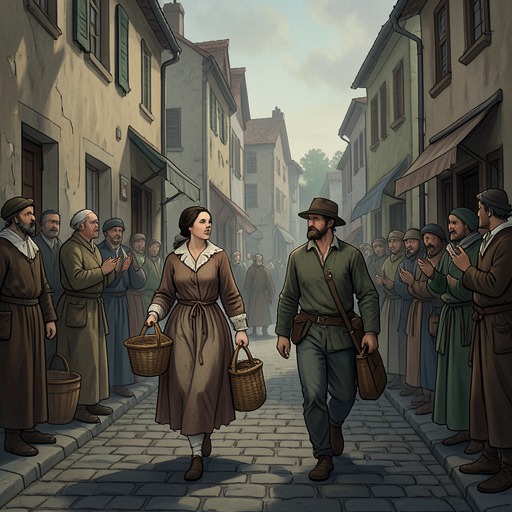
Mary Katherine’s shopping trips make rejection a repeated ordeal with practical stakes. She must leave the protected route through the Blackwood land, pass into the center of town, and return with groceries and library books. Since the Harrises have stopped delivering dairy goods to the family, she now carries milk and butter herself. The household still has money, but money cannot make the trip welcome or secure anyone’s assistance. Mary Katherine takes out her purse at Elbert’s Grocery partly to make clear that the store cannot refuse her business.
The shop’s apparent service does not amount to social acceptance. Mr. Elbert or his wife comes to wait on her, but other customers watch and remain still until she leaves. On one occasion, Mrs. Elbert pulls a child who is unfamiliar in the village away from Mary Katherine so roughly that the child cries; the shop falls silent before Mrs. Elbert resumes serving her. Mary Katherine stands rigid when children approach, imagining their mothers as a danger, and she avoids turning to look at the watching women. The tension is therefore conveyed through small acts of avoidance and scrutiny, not merely through open insults.
A remark about the Blackwoods’ good table exposes the social force of their reputation. Mrs. Donell’s observation draws a giggle and a warning hush from the other customers. Mary Katherine hears the comment against the accumulated history of gossip and answers it inwardly with anger. She recalls Constance Blackwood’s advice not to show that she cares, but that counsel cannot make her indifference genuine. Her resentment is part of the scene’s evidence: rejection has become so familiar that an ordinary purchase calls up an imagined reversal in which the villagers lose the power to exclude her.
Public Taunts and the Journey Home
Outside the store, the antagonism becomes more direct. Men make remarks about the Blackwood land, joking about its potential value to a farmer while alluding to how securely the family keeps it. Their comments treat the property as an opportunity for someone else and the family’s seclusion as an affront. Mary Katherine does not answer them. She concentrates on her route and on a domestic scene she invents for later: lunch in the garden, yellow dishes, strawberries, and a shawl for Julian Blackwood because it is early spring. The imagined meal offers a counterpoint to the public space she has to cross and recalls the care and routine of home.
Children repeat the family’s history as a taunt. When Mary Katherine passes a group of boys near the fence, they call her name together; other voices mock the Blackwood girls and comment on the land. The schoolyard singsong about Mary Katherine and Constance Blackwood turns the poisoning history into a refrain children can use to mark her as an outsider. She imagines that adults have taught them what to say, although the narration presents that as her speculation, not as an established fact. On another passage, she walks steadily while hiding inwardly from the boys’ attention. Her movement is controlled, but the repeated calls make even the walk home feel staged for an audience.
The pressure is especially tangible because the route is both familiar and difficult to avoid. Mary Katherine counts her progress through town as if playing a board game, with the library as her starting point and the black rock near the path home as her goal. A good trip is possible, but she expects danger and has previously dropped her groceries when the villagers shouted at her. She gathered what she could and made herself continue rather than run. The broken eggs and spilled milk give the hostility a material consequence: the taunting threatens not just her composure but the food she must carry back to Constance and Julian Blackwood.
Conflicting Accounts and Significance
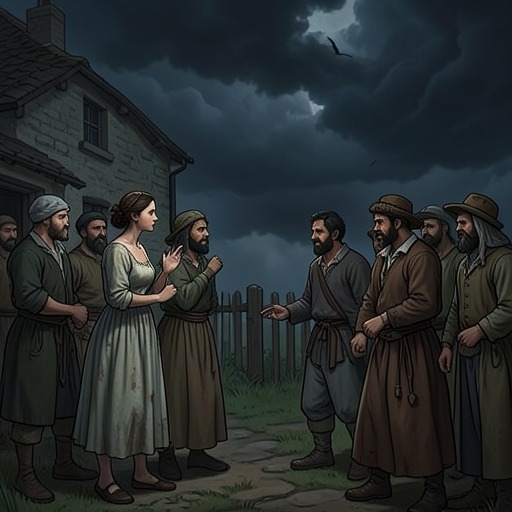
The novel does not make Mary Katherine’s interpretation the sole measure of village conduct. During a visit with Helen Clarke and Mrs. Wright, Mary Katherine proposes inviting people from the Village and says the villagers hate the Blackwoods. Helen Clarke counters that Mary Katherine exaggerates the feeling and suggests that a friendly effort would prevent gossip. Yet Helen also acknowledges that there was some hostility in the past, and she notes that the Blackwoods did not traditionally socialize with the villagers. Her reassurance therefore does not erase the divide: it frames it as partly real and partly intensified by Mary Katherine’s expectations.
That uncertainty is central to the concept. The villagers’ staring, gossip, taunts, and refusal to help are concrete features of Mary Katherine’s experience, while her descriptions also reveal how thoroughly she anticipates attack. Her hostile fantasies and magical refuge on the moon do not prove that every feared threat is real; they show the mental strategies through which she endures the trips. The novel’s social portrait consequently holds external exclusion and inward distortion together rather than resolving one into the other.
The village’s rejection helps explain why the sisters’ home can function as a sanctuary and why ordinary contact carries such weight. Constance Blackwood’s domestic care sustains a sheltered life, while Mary Katherine’s necessary journeys repeatedly expose the family to the community’s gaze. The pattern also gives the poisoning story a continuing social afterlife: although the original catastrophe belongs to the past, local gossip and children’s taunts keep it present in the sisters’ public identity. Their isolation is thus both a response to the Village and a condition that allows its hostility, as Mary Katherine perceives it, to remain a constant force.