The villagers as “strangers”
We Have Always Lived in the CastleThe villagers as “strangers” describes both a real social division and the sisters’ way of making that division feel like protection. During the fire, the villagers gather to watch, wreck Blackwood house, and surround Mary Katherine Blackwood and Constance Blackwood; afterward, outsiders approach the ruined property while the sisters observe them from behind boards and vines. The word “strangers” reverses the usual direction of scrutiny: the community makes the sisters objects of rumor, while Mary Katherine’s narration casts the outside world as faceless, dangerous, and unable to reach them.
The crowd at the fire
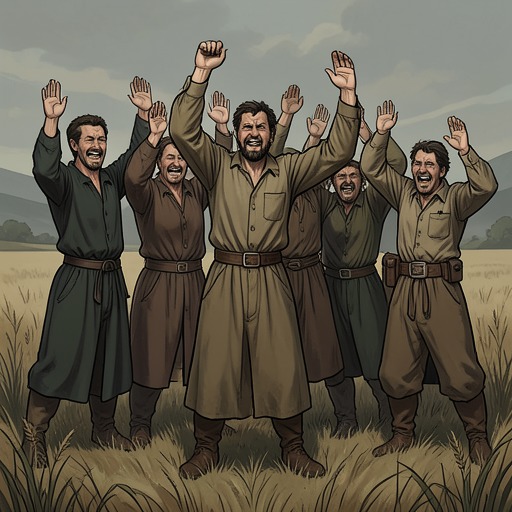
As the house burns, villagers arrive in a long row of cars alongside the village fire engine. Their faces register laughter and fear, but their attention is fixed on the spectacle. When someone asks whether the women and the old man are safe, Charles Blackwood answers that they had warning. The scene offers no simple division between rescuers and spectators: the crowd watches while the firemen concentrate on the stairs and upstairs bedrooms, and Mary Katherine cannot find a route out that would avoid being seen.
Once the fire is declared out, the crowd’s presence turns openly hostile. Jim Donell removes his chief’s hat, sets it on the fire engine, finds a rock, and smashes a window in the drawing room. Laughter rises behind him and the villagers move toward the house in a wave. Another window breaks from inside when the lamp beside Constance Blackwood’s chair is thrown through it. The violence is communal rather than confined to the first act: a remark that the house should have burned years ago is followed by the sharper wish, “And them in it.” Mary Katherine understands that the threat includes the sisters.
The crowd then closes around them. Villagers push, laugh, and try to get near enough to see; Constance holds Julian Blackwood’s shawl over her face. When the sisters attempt to run toward the trees, people repeatedly block their way: groups of women, the Harris boys, the grocer and his wife, and Jim Donell. The attackers circle while carefully keeping out of reach, turning the sisters’ efforts to escape into a public performance. The boys chant “Down in the boneyard ten feet deep,” making the phrase a taunt rather than a private family rhyme.
Death, accusation, and retreat
Jim Clarke finally interrupts the harassment by announcing that Julian Blackwood is dead. The crowd falls quiet, then Charles Blackwood asks whether Constance killed him. The question briefly changes the villagers’ posture: they withdraw in small steps, leaving a clear space around the sisters. The doctor answers that she did not; Julian died as he had long been expected to. The exchange exposes how quickly the crowd’s ridicule can give way to suspicion, and how the sisters remain objects of judgment even at the moment of escape.
The women do reach the trees, but the episode leaves them with the village’s laughter and hostility as the immediate terms of their separation. Helen Clarke is among the witnesses; she is seen crying beside her car, but the sisters are hemmed in by the crowd. In Mary Katherine’s account, the villagers are not a single speaking character so much as a shifting wall of faces, voices, and blocked routes. Their collective presence makes physical movement perilous and public visibility itself a threat.
Watching from behind the boundary
Afterward, the pattern of daily life takes shape around watching without being seen. Mary Katherine checks that the front door is locked, and the sisters watch the people who pass from behind narrow peepholes in the cardboard-covered door panels. When children play on the lawn, she imagines them as agents sent by their parents and calls them children of the strangers. Constance answers that they have eyes; Mary Katherine replies, “Pretend they are birds. They can’t see us.” Her language converts ordinary visitors into an unknowable outside population while asserting that the sisters’ hiddenness will endure.
People do come close. A group of cyclists parks in the driveway, rests on the lawn, and lets the children run among the trees and bushes. Their conversation supplies an outside view the sisters can overhear: vines nearly conceal the fire damage, the old house was once a local landmark, and now it looks like a tomb. The visitors rarely look directly at the house, instead glancing sideways, over shoulders, or through their fingers. That oblique attention mirrors the sisters’ own watching through cracks and peepholes. The house lies halfway between the village and the highway, but its position on a public path does not make its interior accessible.
Rumor and reciprocal invisibility
The visitors’ talk turns the sisters into local stories. One woman says that nobody knows whether anyone is inside and that local people tell tall tales. Another warns a child away from the steps with stories that the women hate children or hunt them at night; a man agrees that he does not want the children going near the house. The contrast is pointed: the community’s account makes the hidden women predatory, while the sisters’ own account makes outsiders faceless strangers whose eyes cannot penetrate the house.
The community’s curiosity does not disappear, but the sisters’ concealment changes what can be known. From outside, the burned structure is overgrown with vines and barely recognizable as a house; from within, Mary Katherine watches passersby without letting them see the sisters’ eyes. Children repeat warnings to one another, and one boy eventually dares to stand at the foot of the steps and recite the tea-rhyme addressed to Mary Katherine. That night, a basket of fresh eggs and an apologetic note appear on the doorsill. The encounter complicates the boundary: fear and mockery circulate around the house, but so does a small, indirect gesture of consideration.
Meaning of “strangers”
“Strangers” is therefore not simply a name for hostile villagers. It is a reciprocal category shaped by exclusion, fear, and limited sight. The village turns the sisters into a rumor and a spectacle; Mary Katherine, in turn, interprets the people outside as threatening figures who cannot see or understand them. The image is not wholly literal: people do look toward the house, and the sisters hear their conversations. What they cannot do is establish ordinary contact across the locked door and boarded windows.
At the end, Mary Katherine pities the strangers for having so much to fear, while Constance says she is afraid of spiders. The exchange makes the sisters’ secluded happiness coexist with an awareness of the fear their home inspires. Their refuge depends on distance, but the village’s stories ensure that distance is never neutral: to the people outside, the house is a tomb and its unseen occupants a source of danger; to the sisters, the people outside remain strangers whose fears can be watched from safety.