Uncle Julian’s invalidism
We Have Always Lived in the CastleJulian Blackwood’s invalidism is presented as a lasting consequence of the family poisoning and as a condition that organizes his everyday life. It restricts his mobility, varies in severity, and makes him dependent on Constance Blackwood’s attentive care. At the same time, his illness keeps him from the witness stand while his records preserve an intimate account of the case, placing physical vulnerability beside a persistent ambition to document what happened.
Identity and Background
Julian Blackwood identifies himself as a survivor of the poisoning and says he has never been well since. Because he lived in the house and knew the victims and the accused intimately, he regards his experience as unusually valuable. He has collected newspaper clippings and written exhaustive notes, making his condition part of a life shaped not only by illness but also by the work of remembering and recording.
His health is consequential in the public aftermath of the case. He explains that he did not give evidence at the trial because his condition could not withstand the questioning. Yet he says he wanted to testify and believed he would have presented himself well. The distinction matters: he is not indifferent to the proceedings or without information; his physical limitations prevent him from bringing his knowledge into court. His notes and recollections therefore stand alongside, but do not replace, the testimony he hoped to give.
Daily Life and Fluctuating Health
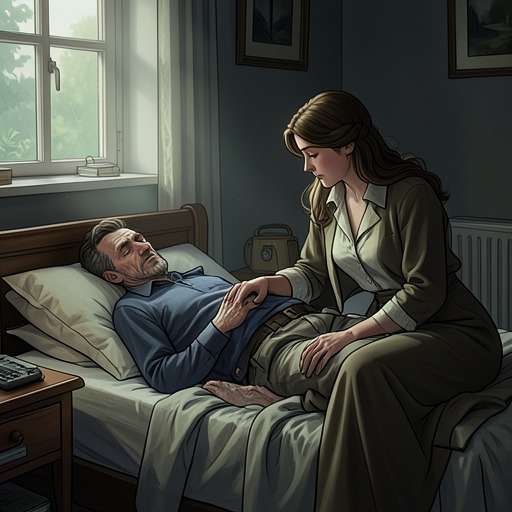
The narrative shows invalidism through recurring practical details rather than a named diagnosis. Julian uses a wheelchair, sleeps painfully, and may lie awake through the darkness waiting for morning. His condition is not constant in its effects. On some mornings he is drowsy and dull, especially after taking an additional pill when his heart hurts, and may be unwilling to drink the hot milk set beside him. On better mornings he can come into the kitchen for breakfast and sit at his desk.
The food prepared for him is adjusted to his needs. Constance carries his breakfast on a tray, pours hot milk into a yellow-daisy-painted jug, and cuts his toast into small, hot squares because he tends to leave food that looks difficult to eat. The tray is more than a meal: its arrival marks the morning comfort he waits for, and knowing Constance is nearby in the kitchen or garden can matter even when he cannot manage to eat. His health thus shapes the household’s schedule and the scale of its ordinary tasks.
His capacity to participate outdoors also depends on the day. When he asks whether he is warm enough to go outside, Constance brings him a shawl and wraps it around his shoulders before reassuring him that he can go into the garden. She describes the sunlight and a planned lunch to encourage him, while he remains uncertain about what he will be able to eat. On another morning he has left most of his breakfast and is too tired, a small setback that contrasts with the more hopeful plan for fresh air and food.
Care, Work, and Relationships
Constance’s care is steady and specific: she brings the tray, watches what Julian can manage, and accompanies him between his room, the kitchen, and the garden. Her attentiveness does not erase his dependence; instead, the narrative makes dependence visible through the repeated work of preparing food, adjusting his clothing, and remaining within reach. Julian’s reassurance can come from her presence even when his strength or appetite is diminished.
The kitchen routine also places his illness beside Merricat’s concern for him. She hopes he will enjoy breakfast and later sit in the sun, and imagines that a winged horse could carry him to the moon, where he might be more comfortable. The fantasy acknowledges how limited his ordinary comfort seems to her, while her wish that he have breakfast and a day outdoors remains grounded in the practical care Constance provides.
Records and the Limits of Testimony
Julian turns his enforced distance from the trial into a documentary project. He keeps clippings and notes, studies his papers at the old desk when he feels well enough to eat in the kitchen, and intends to write a book if his health permits. If he cannot complete it, he wants the notes entrusted to someone skeptical enough not to be overly concerned with the truth. The remark complicates his role as a recorder: he values the record, but recognizes that its eventual author may shape how the case is told.
His repeated return to the poisoning also meets resistance. Helen Clarke objects to further discussion and insists that Constance should look toward the future; Julian nevertheless resumes recounting details, including the washing of the family sugar bowl before the doctor or police arrived. His persistence makes the past present in conversation, while his illness limits the formal public role he once wanted. He can narrate, collect, and interpret, but could not take the stand.
Aftermath and Significance
After the house is damaged, Constance cleans Julian’s room, washes the bedding, and considers what to do with his papers. She decides to keep them together in a box and put it in the cellar. The archive outlasts the daily routines that once surrounded it: his tray, desk, and care belong to a household life that has been disrupted, while the notes remain available to preserve his version of events.
The narrative presents invalidism as lived circumstance rather than as a complete explanation of Julian. His weakness narrows what he can do, makes comfort dependent on others, and keeps him from a public hearing; it does not remove his appetite for intellectual work or his wish to shape the record. The contrast between his fragile mornings and the formidable accumulation of papers gives his survival a double meaning: he is physically constrained, yet remains a determined witness whose testimony survives in written form.