Village
We Have Always Lived in the CastleThe Village is the narrow, hostile world through which Mary Katherine Blackwood must pass to bring food and books home, and the community whose resentment eventually erupts against Blackwood house. Its main street is also a state highway, its civic order is shaped by unequal neighboring families, and its residents’ scrutiny follows the sisters from ordinary errands to the aftermath of The Blackwood house fire. In Mary Katherine’s account, the Village is not merely a setting: it is an antagonist made of roads, shops, watching eyes, gossip, and a crowd.
Setting and social geography
The Village lies astride the main highway across the state. Its stores form a grey row, with their owners living in pale-curtained apartments above them; Mary Katherine sees the place as drab and resistant to change. Beyond it, the Clarkes and Carringtons have built newer homes along Hill Road and River Road, while the Shepherds live on Old Mountain. Their habits mark a divide: the Clarke children and Carrington boys attend private schools, food for the Hill Road kitchens comes from towns and cities, and residents of the outlying roads often conduct their business elsewhere. Yet these families still drive through the Village, and their visible distinction does not give them control over its public life.
The town hall, a white building on a green lawn with a cannon in front, embodies that divided civic order. Once a year the Clarkes, Carringtons, and Shepherds attend the town meeting and vote to remove the Harler family’s junkyard from Main Street and the benches outside the general store. The villagers outvote them each time. A proposal to clear the shacks on Creek Road and make the settlement resemble the town hall also comes to nothing. Mary Katherine speculates that residents may have expected the Blackwoods to attend town meetings if the Village changed, but the text offers that as her conjecture, not as an established reason for the failure.
The route home
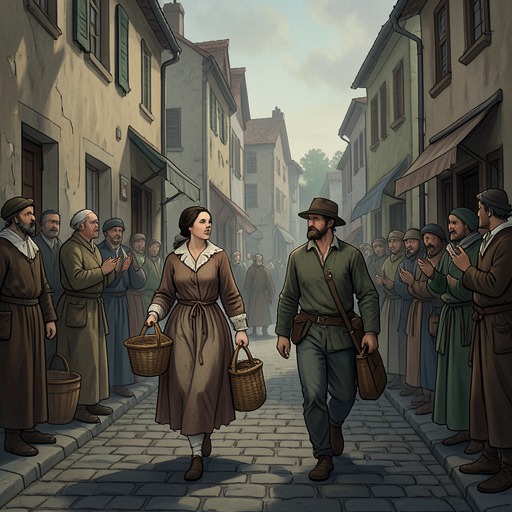
The Village is unavoidable because Constance Blackwood does not go beyond her own garden and Julian Blackwood cannot make the trip. Mary Katherine therefore goes in twice a week for library books and groceries, carrying Constance’s shopping list. Friday and Tuesday errands become an ordeal of route planning: from the library she can cross Main Street immediately, but that would take her past the general store and the men who gather outside it. Instead she walks past the post office and the Rochester house, crosses nearer the grocery, and must still pass the general store on her way home.
Her homeward route has a clear boundary. Past the town hall, Blackwood Road circles Blackwood land, enclosed along its length by a wire fence built by the sisters’ father. A large black rock marks the path entrance; Mary Katherine unlocks the gate, locks it behind her, and goes through the woods to reach home. She turns the shopping trip into a mental board game, with the library as the starting point and the rock as the goal. A safe stretch of sidewalk counts as progress; the men outside the store and the children gathered near the town hall make the return feel dangerous. The fence and gate give the journey a literal threshold between public exposure and the family’s protected grounds.
Shops, scrutiny, and resentment
Mary Katherine says that the people of the Village have always hated the Blackwoods. Her account is shaped by her own fear and hostility, but it also records particular acts of social exclusion. She believes that residents resent the family’s money: the Blackwoods have withdrawn their funds from the bank, and she imagines villagers gossiping about hidden heaps of gold. To make clear that she can pay, she takes out her purse in Elbert’s Grocery. The shopkeepers serve her promptly, but she watches their conduct for signs of contempt and checks their arithmetic even though she says Mr. Elbert never makes a mistake.
The grocery’s treatment of children intensifies her unease. On one visit Mrs. Elbert pulls a little girl away from Mary Katherine so roughly that the child screams; a long, silent pause follows before the shopkeeper resumes serving her. Mary Katherine stands rigid when children come near, afraid that contact might bring their mothers down on her. She also interprets the men’s muttered remarks outside the general store as a performance directed at the Blackwood sisters: they comment on the land, its locked boundaries, and the possibility of making money from it, while speaking around rather than to her. The combination of property resentment and public mockery makes an ordinary walk through town feel like a repeated trespass against her dignity.
The Village’s visible weariness also becomes part of Mary Katherine’s hostile picture of it. She notices the junk piled around the Rochester house, once a fine home with a walnut-panelled library and ballroom, where her mother was born. She resents seeing the place in its diminished condition and thinks it should have belonged to Constance. She describes the Village’s ugliness as a kind of inward rot and wishes that suffering upon its residents. These judgments reveal how thoroughly she has made the town into the opposite of the ordered Blackwood household; they also make her narration an account of social antagonism filtered through a fiercely defensive perspective.
The crowd at Blackwood house
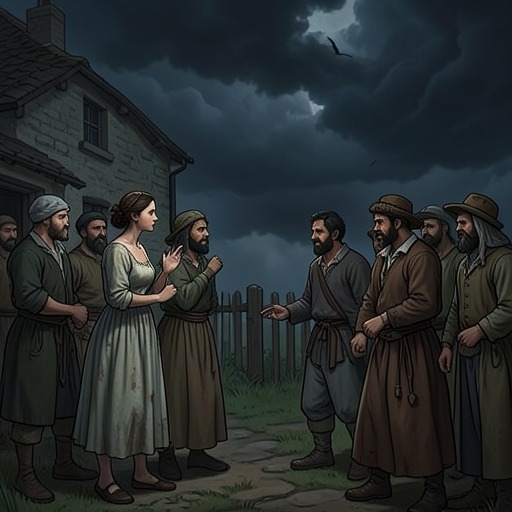
The Village’s hostility reaches its most consequential expression during the fire at Blackwood house. Cars and the village fire engine gather as close as possible, and the residents assemble to watch the burning building. From hiding, Mary Katherine sees faces that are laughing as well as faces that look frightened. Someone nearby asks what has happened to the women and the old man; Charles Blackwood shouts that they had warning and are safe. The crowd is thus not simply a distant audience: it is present at the sisters’ crisis, looking toward the house and discussing the family while the fire is still in progress.
After the fire is declared out, Jim Donell, identified by his large build and hat marked CHIEF, removes his hat and sets it on the fire engine. He then picks up a rock and smashes it through a tall drawing-room window. Laughter rises behind him, and the boys, men, women, and younger children move toward the house together, like a wave. The sequence turns an emergency gathering into collective vandalism. The broken window makes the crowd’s hostility physical, crossing the boundary that the Blackwoods’ fence and gate had previously defined.
The ruined house and the watchers
When Mary Katherine and Constance return, the damage has entered the domestic spaces that had represented continuity and care. The kitchen table blocks the door; chairs, dishes, boxes, food, and cooking utensils have been smashed or scattered. Generations of silverware lie bent on the floor, and the small rose-covered sugar bowl is broken. The cellar preserves have escaped destruction, but pantry food has been disturbed, and Mary Katherine thinks the intruders searched for the sugar. In the aftermath, the sisters salvage what they can and resume household routines within the wreckage, making the ruined kitchen both evidence of the attack and the setting for their renewed life together.
Later, vines grow over the burned roof. From the outside, strangers see a ruined structure barely recognizable as a house, halfway between the Village and the highway. A group of visitors rests on the front lawn and discusses the building as a former local landmark, now resembling a tomb; they say that no one knows whether anyone is inside and that local people tell stories about it. Children warn one another not to go near the steps because the ladies might get them. On one occasion a boy calls out the familiar rhyme about Merricat and Constance, then runs away with the others. That night, a basket of fresh eggs and an apologetic note appears on the doorsill. The sender is not identified, leaving a small, uncertain gesture of care against the Village’s record of watching, rumor, and violence.
The Village’s role changes from the setting of compulsory errands to the source of an assault and, finally, a place from which the sisters can observe without being clearly seen. Their house becomes a hidden ruin at the midpoint between town and highway; the visitors can look toward it, but cannot see the sisters’ eyes behind the vines. That reversal does not reconcile the family with the community. Instead, the physical distance that the road, fence, gate, fire, and overgrown walls successively mark becomes the defining relation between them: the Village remains outside, while the sisters make the damaged house their refuge.