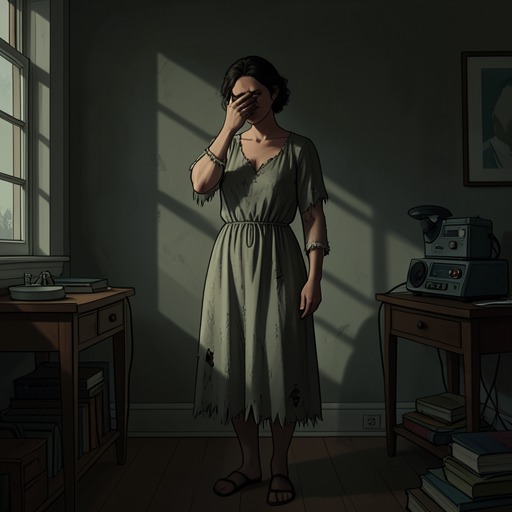
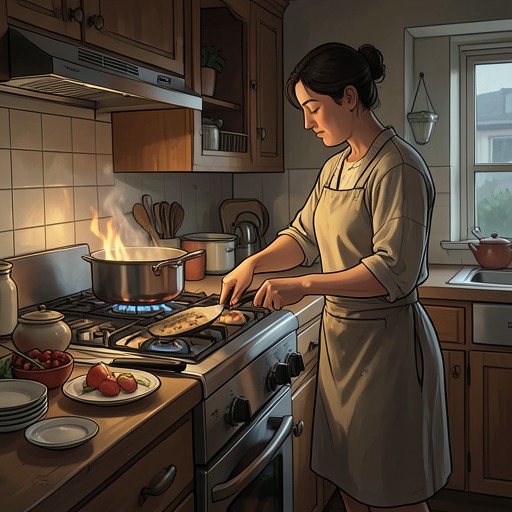
Villagers secretly bring food to the Blackwood sisters
We Have Always Lived in the CastleVillagers secretly bring food to the Blackwood sisters in the aftermath of the fire and the wrecking of Blackwood house. The neighbors’ offerings provide practical help, but their manner makes the help inseparable from fear, guilt, and continued separation: baskets are left silently at the locked front door, and the sisters wait until darkness before bringing them inside. The exchange changes what food means in a house marked by poisoning and invasion, without restoring ordinary contact between the household and the Village.
Arrival at the Door
The first delivery comes while Mary Katherine Blackwood and Constance Blackwood are eating dinner. A man addresses them softly from outside, checking whether they are near enough to hear and apparently looking about to avoid being seen. He says he has brought a chicken roasted by his wife, along with cookies and a pie. He does not ask the sisters to answer or come outside. Instead, he leaves the basket on the step and walks away.
Constance and Mary Katherine listen until his footsteps have receded. Constance wonders whether to open the door; Mary Katherine insists on waiting until it is fully dark, when no one can see them. Only then does she unlock the door, retrieve the basket, and secure the entrance again. Constance carries the food to the kitchen. The pie is blueberry and still warm, as are the chicken and the rest of the offering. Constance infers that the wife prepared the food after dinner and wrapped it while it was still warm. She handles the items tenderly, though she judges the cookies insufficiently crisp.
Even receiving the gift remains governed by the sisters’ precautions. Constance stops Mary Katherine from returning the basket immediately: she wants first to wash its napkins, concerned with what the giver might think of her otherwise. Their response makes hospitality possible only in a tightly controlled form. They accept food while keeping the door locked, concealing their movements, and avoiding a face-to-face meeting.
A Repeated Practice
The single basket becomes a recurring evening custom. The neighbors leave home-cured bacon, fruit, preserves, roasted chicken, cakes, pies, cookies, potato salad, coleslaw, beef stew, baked beans, macaroni, and homemade bread. Roasted chicken is the most common offering. The variety suggests contributions from a number of households, and Constance distinguishes the cooks through their recipes: she notices, for instance, when a bean dish contains too much ketchup or a different one too much molasses. She also compares the neighbors’ preserves with her own, which she considers better.
The baskets are always set on the front doorstep quietly, and the sisters do not open the door until complete darkness and the assurance that no one is nearby. They return the baskets to the place where they found them. In this repeated arrangement, giving and receiving are carefully separated: the villagers provide food without entering, while the sisters take it without appearing in public. Constance likens the abundance to a large church supper, a communal meal transformed into a series of private deliveries.
Some baskets carry brief notes apologizing for particular damage, including broken dishes, damaged curtains, and harm to a harp. One man directly acknowledges that he broke one of the sisters’ chairs and says he is sorry. These admissions connect the deliveries to the violence that preceded them. The food is not an abstract gesture of kindness; it arrives alongside evidence that at least some of those bringing it recognize their part in the household’s suffering.
Food, Damage, and Remorse
The deliveries acquire particular force against the sisters’ recent experience of food and domestic space. During the poisoning investigation, Constance had taken the heavy silver sugar bowl from the dinner table, emptied it, and scrubbed it with boiling water before the doctor or police arrived. She later explained the washing by saying that there had been a spider in it, the same explanation she gave the police. In the accusations surrounding the deaths, the sugar bowl and Constance’s failure to call a doctor became signs used against her. After the house was ransacked, Mary Katherine finds the rose-patterned sugar bowl broken, its handles gone, amid the wreckage of the kitchen.
The destruction reaches well beyond the bowl. The kitchen table has been turned over; chairs, dishes, glasses, food boxes, jars, silverware, and household linens are broken, scattered, or torn. The pantry has been rummaged through, and sugar is strewn across the floor. Against this material record of intrusion, the later deliveries bring food prepared in other kitchens and left at the threshold rather than forced into the sisters’ space. The contrast does not erase the earlier harm, but it makes the doorstep a boundary where remorse can be expressed without requiring the sisters to admit anyone inside.
Aid Without Reconciliation
The villagers’ behavior remains divided. They have helped make the house uninhabitable and have left the sisters with barricades and a strict watch on the doors and windows; now neighbors bring meals and apologize indirectly or in person from outside. The deliveries suggest that communal hostility has not simply given way to open friendship. Those carrying the baskets appear to avoid recognition, and Mary Katherine suspects that bringing food may feel shameful to them in public. That interpretation belongs to her account, but the secrecy of the arrivals is plain in the repeated practice itself.
The sisters accept the aid without answering the door or abandoning their seclusion. They wait, listen, collect the baskets only after dark, and lock the entrance again. Constance’s attention to warm food, recipes, and washed napkins restores familiar domestic judgments to a household whose kitchen has been violated. Yet the act of care remains cautious and one-sided in its form: the villagers can leave something useful, and the sisters can receive it, while the barrier between them stays in place. The recurring food baskets therefore mark a limited change in the sisters’ circumstances, not a return to ordinary life or an open reconciliation.