A-Rab
West Side StoryA-Rab is a member of the Jets whose few recorded appearances move between comic defiance, fear, and aggression. He trades barbs with police, waits anxiously with Baby-John after the deadly fight, and later helps assault Anita at Doc's drugstore; together, these scenes show how the gang’s joking bravado coexists with vulnerability and violence.
Identity and Introduction
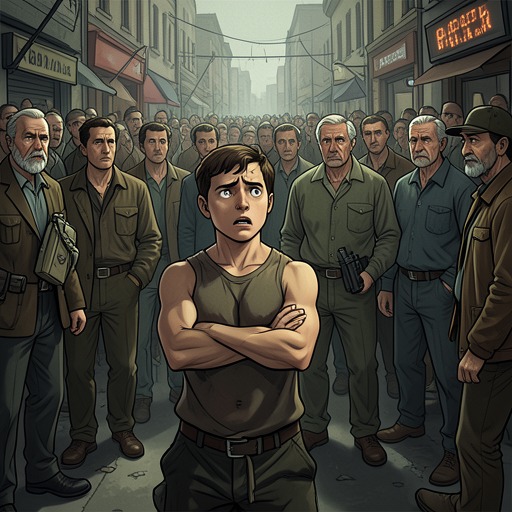
A-Rab is introduced in an exchange with Schrank, the veteran police officer confronting the Jets. When Schrank threatens the boys and singles out A-Rab’s expression, A-Rab answers that it is simply his natural look and asks, with mock politeness, how he might acquire another. The joke lets him answer an authority figure without openly backing down, even as Schrank’s threat makes clear the risk behind the banter.
Schrank’s later treatment of the Jets shifts from issuing orders to making personal, ethnic, and class-based insults. He tells the group to remain on its own block and stop obstructing the sidewalk, then taunts A-Rab about his father’s drinking and his mother’s sex life. The text records the insult, but not A-Rab’s response. Schrank’s remarks reduce him to a stereotype of family disorder, while the earlier exchange presents him as quick-witted enough to turn a threat into a joke.
Encounters with Police
The police presence shapes A-Rab’s surroundings even when he is not the person being addressed. Schrank grips Riff’s shoulder painfully while announcing that the Jets must confine themselves to their block. Later, at the café, Schrank uses his badge to order Bernardo and the other Puerto Ricans out, then tries to discover where the Jets and Sharks intend to fight. A-Rab is among the young people caught in this atmosphere of surveillance and hostility, in which the officer’s claims of wanting to clean up the streets accompany threats and racialized abuse.
The contrast between official power and gang bravado is especially sharp in Schrank’s confrontation: he presses for information about the planned fight, while the boys avoid answering. The evidence does not show A-Rab disclosing anything or taking a leading part in the exchange. His presence instead locates him within a group being threatened and collectively classified as a public menace.
After the Fight
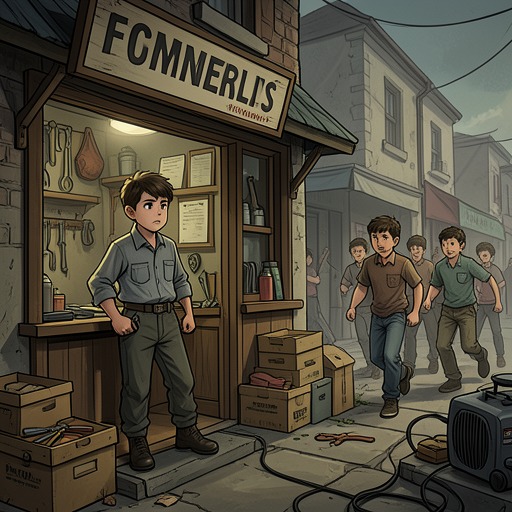
After the deadly confrontation, A-Rab is in a truck with Baby-John. When Baby-John whispers to announce himself, A-Rab tells him to be quiet and go back inside. The curt response offers no comfort, but Baby-John remains glad to find someone there; he has just described encountering Krupke and Schrank on the street and fearing he was caught.
A-Rab is impatient and asks for a cigarette, whether the other boys have been seen, and whether anyone has seen Tony. Baby-John gives him his last cigarette. A-Rab is trembling from withdrawal, a physical detail that cuts through the tough manner of his questions. He is waiting for the rest of the Jets, but Baby-John can only hope they will arrive; they may have gone home. A-Rab’s concern for Tony and the missing boys is expressed as urgent checking rather than consolation, amid uncertainty over who has survived or where the group has scattered.
That uncertainty becomes immediate when a police siren sounds outside the dark scrapyard, accompanied by running footsteps. A-Rab flattens himself against the ground while Baby-John crouches in the darkest corner. A patrol car speeds past, and Baby-John thinks he hears an officer threaten to use his gun unless the fleeing person stops. A-Rab crawls toward Baby-John and asks what they should do. The earlier joking answer to Schrank has given way to concealment and fear of an armed police pursuit.
Assault at Doc's Drugstore
At Doc's drugstore, A-Rab is among the Jets confronting Anita as she tries to deliver a message to Tony. After Diesel tells her to leave, Anita insists that she knows Tony is there and asks to pass the message to him. A-Rab pins her against a row of shelves. When she tries to direct her appeal to Diesel, A-Rab turns the encounter into a sexualized taunt, rubs himself against her, and asks whether she likes to mambo and wants to dance. Anita attempts to strike him.
The scene marks a stark change in the kind of confrontation represented by A-Rab’s earlier jokes. His mockery of Schrank was verbal resistance to a threat; here, he uses physical force against Anita and turns her effort to communicate into an occasion for harassment. The account establishes his direct participation in the assault, without making him the sole actor in the group’s treatment of her.
Characterization and Narrative Role
A-Rab is not given an extended personal history or a sustained interior account. Instead, brief actions establish a shifting presence: he deflects a police insult with a joke, waits tensely for absent companions, asks after Tony, trembles while needing a cigarette, hides from a patrol car, and later helps assault Anita. The contrast is consequential: the boy who is vulnerable to withdrawal and police pursuit is also capable of exerting violence against someone more exposed in the moment.
His appearances also register the pressures and harms surrounding the Jets without making those pressures an excuse for his conduct. Schrank’s threats and degrading stereotypes frame the gang as an object of police hostility; A-Rab’s assault shows that the boys can also direct coercion outward. The character is rendered less through explanation than through these reversals between bravado, fear, and aggression.