American identity and assimilation
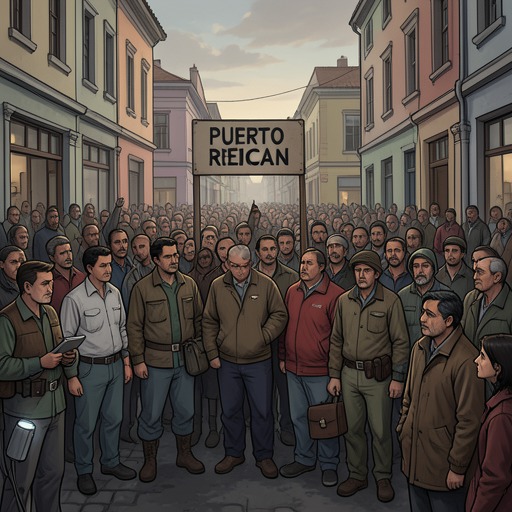
West Side StoryAmerican identity and assimilation are among the novel’s central disputes: belonging is imagined as a promise, pursued through language and work, and withheld through ethnic prejudice and unequal power. Maria Nunez wants to become American without surrendering her hope of loving others, while Bernardo and the Jets experience the same city as a place where Puerto Ricans are treated as unwanted intruders. The conflict is not simply over who can claim America, but over who gets to define that claim and whose voice counts.
Belonging Under Pressure
The novel places this dispute in a city where poverty and crowding sharpen ethnic hostility. On Manhattan’s West Side, ordinary residents have little affordable housing to choose from, while landlords can subdivide apartments and profit from Puerto Rican tenants without maintaining their buildings. Politicians live elsewhere and, the narration observes, do not speak for local renters. In that vacuum, the Jets use their voices and fists, presenting themselves as defenders of a neighborhood whose residents feel ignored. Their claim to protect the community coexists with intimidation and violence; the narrative explains the appeal of their local standing without making their methods harmless.
The arrival of Puerto Ricans gives the gangs a target. The narration bitterly describes how the city seems safer for everyone except Puerto Ricans, who are blamed for the disasters directed at them because they supposedly arrived uninvited. The circular logic is plain: hostility is framed as a response to outsiders, and that hostility then makes the outsiders’ presence appear to be the source of disorder. The possibility that Puerto Ricans might leave or be driven out exposes the instability of this arrangement: the gangs’ conflict would not thereby resolve the conditions that produced it.
Maria’s American Future
Maria’s sense of America is aspirational and personal. Newly reunited with her parents in New York after years apart, she sees a city of abundance beside memories of poverty in Puerto Rico. The contrast makes the move intelligible in material terms: her family had left for a place with more opportunities and necessities. Yet Maria does not treat arrival as the same thing as belonging. She studies English and longs to speak it with what she imagines are American consonants and vowels. Watching a plane cross the city, she wonders whether it has come from Puerto Rico, while recognizing that the people around her may speak Spanish or English in a way she experiences as still marked by Spanish.
Her desire to become American is also a moral choice. Maria believes there is already too much hatred in New York and would rather love than hate, even if that meant giving up what the city offers and returning to Puerto Rico. When Bernardo’s hostility makes him regard Americans as enemies, she challenges the assumption that hatred must govern relations between groups. Her resistance is not a denial that prejudice exists: it is an insistence that prejudice should not dictate what she feels or whom she recognizes as belonging.
The dance becomes a small but vivid expression of that hoped-for future. While Anita Palacio alters Maria’s white dress for the evening, Maria says the occasion marks the real beginning of her life as a young American. She wants to dance repeatedly, even after the music stops. The excitement attaches assimilation to movement, self-direction, and a public life beyond the restrictions she associates with childhood. At the same time, her family’s arrangements for her future and Bernardo’s supervision limit her freedom. Her aspiration is therefore not an abstract declaration; it is bound to the practical question of whether she can make choices for herself.
Language, Work, and Everyday Claims
Language exposes the distance between wanting to belong and being able to choose how belonging sounds. While helping Maria with her dress, Anita scolds her in Spanish; Maria asks her to speak English. Anita replies that she prefers thinking in Spanish, especially about love. The exchange gives the two languages different intimate meanings without reducing either woman to a simple position: Maria treats English as a route toward American identity, while Anita claims Spanish as a language of thought and feeling. Their disagreement takes place during a private act of friendship, not a formal test of national loyalty.
Work offers another measure of who can advance. Chino Martin describes a path from his job as a laborer to delivery work, then toward becoming an assistant and eventually a full union member. Bernardo counters that Tony Wyzek could reach the union ahead of Chino and earn more simply because Tony is American. This is Bernardo’s claim about unequal treatment, not a neutral account of a hiring decision; the scene shows how racialized expectations shape his view of opportunity. Maria rejects the idea that Tony is foreign on account of his Polish background: in her view, being born in America makes him American, and even someone born elsewhere can belong through choosing to live there.
The argument reaches beyond the characters’ individual plans. At the dance, Anita insists that girls in America have the right to enjoy themselves and dance with whom they choose. Bernardo answers by asking whether she speaks as if Puerto Rico were not part of America. Their exchange exposes incompatible definitions of inclusion: Anita invokes American freedom as a standard that should govern conduct, while Bernardo objects to the way that standard is applied as if Puerto Ricans stood outside it. The discussion of dancing also reveals that claims to American liberty are entangled with gender: Maria’s and Anita’s room to act is policed by Bernardo even within their own community.
Competing Definitions and the Limits of Assimilation
Bernardo’s conflict with the Jets gives his fear of displacement a territorial form. He gathers Puerto Ricans around him and, as Riff Lorton understands it, appears to be seeking control of the neighborhood. Riff imagines that a Puerto Rican victory would force white residents to move and interprets it as another victory for Puerto Ricans. The account of this fear is itself shaped by hostility: Riff’s language degrades the Sharks and treats their presence as a threat to white possession. The neighborhood’s competition over territory thus turns belonging into a zero-sum contest, even as the wider housing crisis and political neglect go unaddressed.
Maria and Bernardo make the contrast especially sharp. He sees American society through resentment and anticipates that Tony Wyzek will treat Maria as an easy target because she is Puerto Rican. She counters that national belonging cannot be denied by origin or ancestry alone. Neither sibling’s position erases the pressures visible elsewhere in the novel: Maria’s wish to participate does not dissolve discrimination, and Bernardo’s anger does not create safety for the people he wants to defend. Their disagreement gives the theme its human scale: assimilation may promise acceptance, but it cannot by itself guarantee equality or settle who has the authority to call someone an American.