Anita's grief and anger over Bernardo's death
West Side StoryAnita's grief and anger over Bernardo's death shape her response to the discovery that Maria is involved with Tony, whom Anita accuses of killing Bernardo. Her mourning is not separate from the conflict that follows: the loss makes Maria's relationship seem to Anita like a betrayal, while Maria's determination to find Tony leaves Anita to carry her grief into a consequential confrontation and, later, a deceptive message to the Jets.
Discovery and accusation
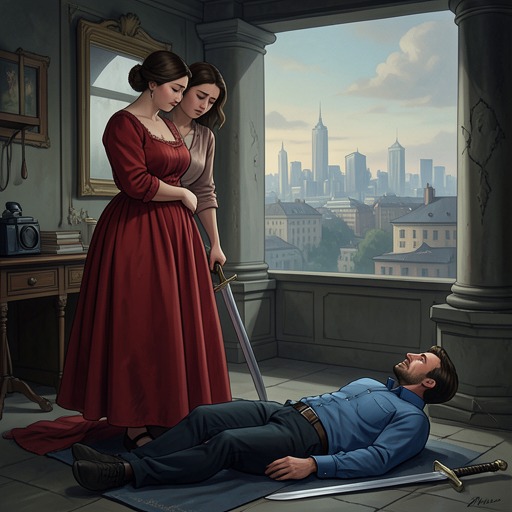
Anita enters and looks first toward the bed and then the window before noticing Bernardo's sister, Maria, barefoot and wearing a combination. The room's details make the discovery immediate: Anita sees the private space and the two people in it before speaking. Her anger focuses on Maria's involvement with Tony, and Anita accuses her of rewarding the man she holds responsible for Bernardo's death. She extends the accusation into hypothetical questions about what Maria would do if Tony killed her parents. The questions turn Anita's grief into a moral indictment: in her view, Maria's relationship does not merely cross a boundary between the rival groups but dishonors the dead Bernardo.
The force of Anita's response rests on a painful contrast. She has lost someone she loved, while Maria appears to have chosen intimacy with the person Anita blames for that loss. Anita does not approach the scene as an occasion for weighing Maria's feelings; she sees Maria's conduct through the immediate fact of Bernardo's death. The accusation therefore expresses both anger at Maria and an insistence that Bernardo's death should impose limits on what Maria can do next.
Grief and the interrupted wish
Anita acknowledges directly that she loved Bernardo. Her recollection of the night gives that statement a second register: she had worn Black Orchid, waited eagerly, watched the first star, and made a wish. The wish is not disclosed, and the passage does not identify what Anita hoped for. Its importance lies in the abrupt change between expectation and aftermath. The night that had held a moment for anticipation now leaves Anita needing a black dress for Bernardo's funeral.
That turn from a wish beneath the first star to the practical prospect of funeral clothes makes her grief concrete without explaining it away. Anita says that nothing that happened that night made sense. Her confusion does not cancel her certainty that she loved Bernardo, nor does it soften her anger at Maria. Instead, the two responses stand together: she is trying to comprehend a night transformed by loss while reacting to what she sees as Maria's betrayal of the person they both knew. The funeral dress becomes a measure of how decisively the night has changed.
Maria's decision and Anita's divided position
Maria asks Anita to try to understand. Anita's reply, as Maria interprets it, is the shouting itself: Maria says that Anita does understand, and that this is why she is shouting. The exchange leaves no easy reconciliation between them. Maria recognizes the depth of Anita's feelings but does not accept that those feelings should determine her own choice.
Maria then declares that she will leave to find Tony at Doc's. She adds that anyone who tries to stop them will have to kill her too, and asks Anita whether she will repeat this to Chino. Anita is thus placed between Maria's stated intention and the people to whom Maria expects her to carry the message. The immediate conflict has shifted: it is no longer only about what Anita saw, but about whether she will help communicate Maria's decision despite her own grief and anger.
The false message and its consequences
Later, Anita gives Diesel and A-Rab a message for Tony, whom she identifies as Maria's American boyfriend. She tells them that Maria will never meet him and that Chino learned the truth about the couple and killed her. This is false: Anita claims Maria is dead when she is not. The lie turns her earlier outrage into an action with consequences beyond the confrontation in Maria's room. Rather than deliver Maria's intention to Tony, Anita sends him a report designed to make him believe that Maria has been killed.
Anita's delivery of the message is marked by her laughter as Diesel and A-Rab move away. The contrast with her earlier confession of love for Bernardo is sharp: the grief she had expressed through confusion and the prospect of a funeral now accompanies a deception that redirects Tony's understanding of events. The evidence establishes what Anita tells the two Jets and that her claim about Maria's death is false; it does not establish every thought or motive behind her decision. What is clear is that the message gives Anita's anger a new form, replacing the question of whether she will repeat Maria's words with a deliberate falsehood.
Narrative significance
Anita's grief is presented through specific, changed expectations rather than through an extended account of mourning. Black Orchid, the first star, and an undisclosed wish belong to the night as Anita had anticipated it; the black dress belongs to what the night has become. Against that movement, her declaration that she loved Bernardo anchors the scene in bereavement even as her argument with Maria focuses on loyalty and choice.
The sequence also connects private loss to the widening conflict among the characters. Anita's accusation makes Bernardo's death a measure by which she judges Maria's relationship with Tony. Maria's plan to find Tony brings that disagreement into the open, and Anita's later lie carries it outward to the Jets. The result is not a resolution of grief but its conversion into a message that further isolates the lovers. Anita's pain and anger therefore matter both as personal responses to Bernardo's death and as forces shaping what others believe.