Baby-John
West Side StoryBaby-John is a fourteen-year-old Jet whose comic bravado masks both his wish to belong and his fear of what belonging demands. The Sharks’ attack leaves him physically marked and makes him a target for retaliation; later, the deaths of Riff and Bernardo force him to see the mortal cost of the toughness he admires. In hiding, he briefly becomes less dependent on imagined heroes and volunteers to keep watch, a small but consequential movement from aspiring gang member toward someone trusted with responsibility.
Identity and Belonging
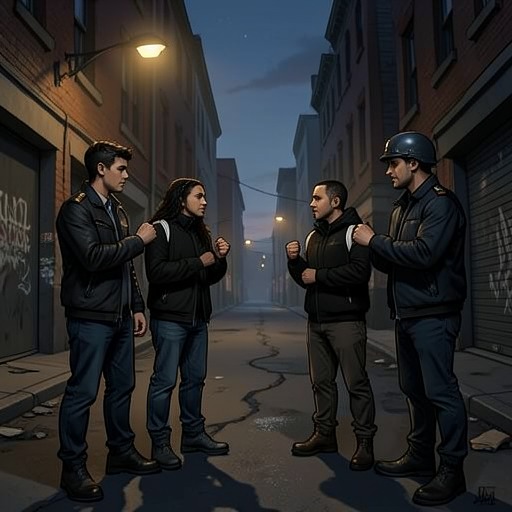
Baby-John is the youngest figure in the circle described here: he is fourteen, while he estimates that Riff and Bernardo were about eighteen. The difference matters to his understanding of gang life. He admires Riff as a model of toughness and treats membership in the Jets as a source of recognition and purpose, but other members do not regard him as an obviously dependable recruit. Action doubts that the boy’s nickname and manner fit someone who can be counted on when a fight turns serious. The chapter’s early image of Baby-John roaring and then diving away from Action’s reaching hand catches the mixture of performance and vulnerability that follows him.
His place in the gang is not simply settled by being present. Tony Wyzek had argued that boys often began by hanging around the Jets at thirteen or fourteen, while a boy who was not one of them might remain outside street life altogether. Baby-John’s case exposes the uncertainty in that welcome: membership offers a way to belong, but the group measures belonging against readiness for violence. Action’s doubts about him persist even as he is included among the boys whose loyalty and courage are being tested.
The Mark and the Call for Retaliation
After four successive nights in which the Sharks had gained the advantage, they retaliate for the Jets’ provocations by attacking Baby-John during an afternoon movie. Pepe and Nibbles press an ice pick into his back and warn him not to make a sound, take him to the men’s room, gag him with toilet paper, beat him in a stall, and nearly drown him in a toilet. Pepe then cuts Baby-John’s earlobe and sends him back with a message: the Sharks will fight the Jets, but will not tolerate attacks on older people. The cut is both an injury and a public mark meant to carry the opposing gang’s warning.
Baby-John initially recasts that humiliation as an achievement. When Riff announces to the assembled Jets that the war is on because nobody can beat Baby-John without paying for it, the injured boy boasts that he is a victim; A-Rab counters that he is marked and, in effect, the Sharks’ property. Later, Baby-John has stolen another ice pick from a hardware store and made a sheath to wear at his back. He boasts to Tony Wyzek that he intends to go after Pepe and Nibbles, even imagining that he will pierce their ears in return. His scabbed earlobe keeps the earlier attack physically present while his proposed revenge shows how the gang’s response turns victimization into pressure to perform aggression.
Fear, Fairness, and the Gang’s Code
When Riff proposes settling the territorial conflict in one mass battle, the boys’ excitement becomes a display of imagined violence: they mime knife cuts and blows while declaring themselves ready to fight. Baby-John trembles and touches his ear; the dried blood does not give him courage. He nevertheless speaks up for fighting with fists or stones, not knives or guns. A clean fight, he argues, would make the Sharks look cowardly if they resorted to weapons. His appeal is strategic as well as ethical: it offers a standard by which the Jets might claim superiority without adopting the weapons that make the conflict more lethal.
That position sits uneasily beside his own ice-pick plan. Baby-John wants to answer the injury with the same kind of threat that produced it, yet fears what a serious fight may demand. The contradiction is not resolved by the gang’s decision to seek a confrontation. Riff’s leadership depends on keeping the Jets occupied and united, while Action’s wish to challenge him for command makes inactivity seem dangerous to the leader. Baby-John is caught inside this contest over what a gang member must prove: his fear is visible, but so is his effort to turn fear into a case for rules and retaliation.
The police offer no secure refuge from that pressure. Schrank threatens the boys with physical punishment, grips Riff painfully, orders the Jets to confine themselves to their block, and later uses ethnic insults while trying to discover where the gangs will fight. Baby-John and the other boys evade the officers, but policing becomes another immediate danger in the aftermath. These encounters help explain why, after the deaths, Baby-John is more afraid of being caught by Schrank and Krupke than confident that anyone will protect him.
The Deaths and the Flight
At the riverside scrapyard, Baby-John sees Riff and Bernardo fall. His response holds two judgments together: he mourns Riff with affection and admires Bernardo despite hating him, because Bernardo has proved his courage. He acknowledges that Tony Wyzek fought skillfully with a knife, but still blames him for the deaths. The scene breaks apart the simple heroic scale on which Baby-John had measured toughness. Riff’s and Bernardo’s courage has not made them invulnerable; Baby-John instead calculates that if he becomes a hard case like them, he may have only four or five years left, perhaps with two or three spent in reform school.
His immediate actions are driven by escape. A few minutes earlier, he had climbed a fence at the scrapyard, moving along it with arms extended and fingers stiff as if comic-book heroes were watching to see whether he deserved rescue. Now he crouches inside the dark trailer of a wrecked truck, knees drawn up, looking through a crack in its metal side toward a star and hoping for a supernatural signal. He imagines being caught by Schrank and Krupke, fighting them with an ice pick, or running down Columbus Avenue to attack Puerto Ricans; the fantasies enlarge the danger rather than giving him a real way out. When he whispers to the truck’s other occupant, A-Rab, and says that he had turned a corner to find the officers waiting, his account is a frightened report of having barely escaped.
A Small Shift Toward Responsibility
At first, hiding is thrilling: Baby-John is excited by evading the police and by the knowledge that A-Rab is relying on him. That confidence briefly makes him less dependent on his heroes, who cannot actually come to his aid. He imagines that Action might put the gang on a roof with an arsenal and gas masks, turning a desperate confrontation with the police into a dramatic last stand. Even in hiding, the fantasy of becoming a hero remains close to the fear of reform school and capture.
The practical change comes when the boys discuss finding Tony Wyzek. Baby-John volunteers to remain alone in the dark while the others search; he is told to pass on the message if someone arrives and to stay with Tony if Tony comes. He agrees, then asks whether Anybodys might leave him a crowbar. The request preserves his apprehension, but his willingness to remain on watch marks a shift from boasting about what he will do to accepting a specific duty. The ending does not establish that he has outgrown the gang’s violence or his dependence on its approval. It leaves him at a threshold: still a frightened fourteen-year-old in hiding, but momentarily trusted to keep watch after the deaths have made the cost of his imagined toughness impossible to ignore.