Bernardo–Anita
West Side StoryBernardo–Anita is presented as an intimate partnership caught inside the Sharks’ public world, then redefined by Bernardo’s death. At the dance, they appear together among the rival groups; afterward, Anita’s anger at Maria and her insistence that she loved Bernardo make the relationship’s emotional force unmistakable. Her grief does not end with mourning: it becomes a measure of the violence that has broken the couple apart and poisoned the possibility of loyalty between the people left behind.
Identity and Public Presence
At the dance, Bernardo arrives with Anita, his girlfriend, in a vivid red dress. Their pairing is immediately legible to the people around them: when the Sharks and Jets form circles around the girls, Bernardo stands facing Anita. The arrangement places the couple within a public ritual shaped by the gangs, with the music and the dancers’ movements briefly organized under the threat of police scrutiny. Their presence together is therefore both personal and social; they are a couple, but they occupy that role inside a gathering divided by rival allegiance.
The scene gives little account of their private life before the dance. Instead, it establishes the relationship through position and recognition: Anita is introduced as Bernardo’s girlfriend, and they are placed opposite one another when the groups form their circles. Later, Anita herself calls him her boyfriend, using the familiar name Nardo. These details make the bond explicit without supplying a history the narrative does not provide.
A Relationship Inside the Gang Conflict
Bernardo’s position as a leader of the Sharks shapes the circumstances in which the relationship is shown. When Riff presses him about the proposed fight, Bernardo accepts on behalf of his side. Anita is not shown making that decision, but her place beside him at the dance situates their relationship within the same collective tension. The public order imposed on the gathering does not dissolve the hostility: the couples form their circles, the record plays, and the gangs continue to confront one another.
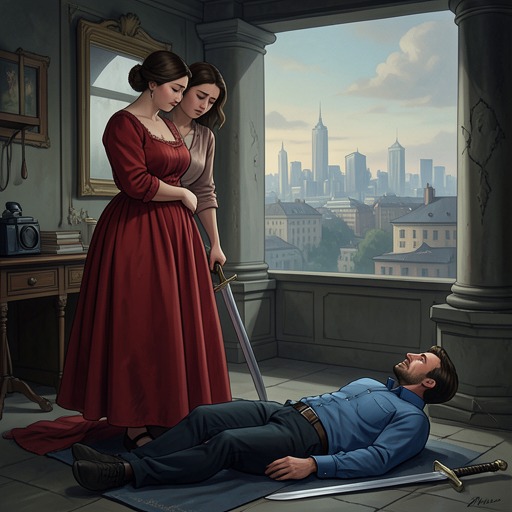
The duel’s violence then turns that surrounding conflict into a personal catastrophe. Tony tries to stop the fight, but Bernardo kills Riff; Tony takes up Riff’s knife and fatally wounds Bernardo. For Anita, the gang rivalry is no longer an abstract contest between groups. The man she loves is dead, and the person Maria loves is the one who killed him. The relationship’s tragedy lies partly in that collision: private attachment persists across the very line of violence that has taken Bernardo from her.
Grief and the Conflict with Maria
When Anita confronts Maria after Bernardo’s death, she responds with fury to the discovery that Maria has been with Tony. She sees Maria’s intimacy with Bernardo’s killer as an unbearable betrayal of her brother and of the dead. Her accusation is not detached judgment: the scene places it against her own loss, as she tries to understand how Maria can love the man responsible for Bernardo’s death.
Maria answers that Bernardo would have killed the man she loved. Anita’s reply—that Bernardo should have killed Tony instead—reveals the immediate force of her grief: she imagines a different outcome in which Bernardo survives and the rival lover dies. Maria then makes clear that this alternative would still have meant Bernardo killing the man she loves. The exchange does not reconcile them. It exposes two incompatible loyalties, each rooted in love and sharpened by the same death.
Anita’s grief becomes more directly audible when she admits that she loved Bernardo. The admission follows her memory of having worn Orchidée noire, waited eagerly, watched the first star, and made a great wish; now she must find a black dress for the funeral. The contrast compresses the change in her circumstances: the night she had anticipated as a time of possibility has become a night of mourning. Her wish is not explained, but its recollection beside the funeral dress makes the loss of the night’s promise part of her bereavement.
Aftermath and Narrative Significance
Anita’s relationship to Bernardo remains present even after his death. When the police question Maria, Anita tells Schrank to treat her gently because she has suffered enough, then identifies herself as Nardo’s girlfriend. Schrank corrects her to the past tense. His correction is bluntly factual, but it gives the scene a painful social edge: Anita asserts the bond in the present, while the officer reduces it to a relationship ended by death. She stays with Maria until her parents return, taking on the immediate responsibility of ensuring they will hear the news.
Later, after the Jets assault her at Doc’s store, Anita says Bernardo was right about them: if one of them were bleeding in the street, she would pass without stopping and spit on him. The statement turns her memory of Bernardo into a judgment on the gang’s conduct, not a call for reconciliation. His death has altered her relation to the Jets and to Maria’s hope of leaving with Tony; the tenderness she has confessed coexists with anger directed at the people and choices surrounding his death.
The relationship’s narrative significance comes from this movement between couplehood and its aftermath. The dance gives Bernardo and Anita a shared place in the crowd; the fatal fight removes him from that place; and Anita’s later actions show how grief continues to structure the lives of the survivors. Her insistence that she loved Bernardo is not a resolution of the feud. It is a personal truth spoken in the middle of it, where love, loyalty, and revenge remain painfully entangled.